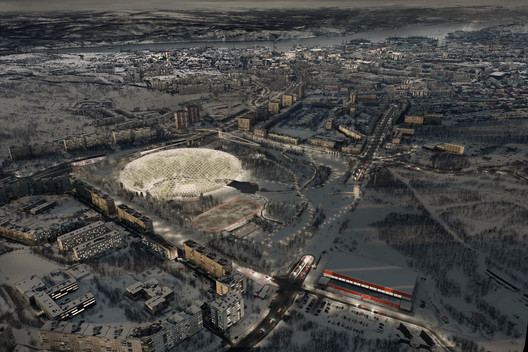
Mexican architecture firm gutarqs has been awarded an honorable mention in the International Architecture Competition for the Development of "Coziness Valley" in Murmansk, the largest city in Russia located above the Arctic Circle. Jointly organized by the Government of Murmansk and the ANO Urban Development Center of the Region, the open call invited participants from around the world to develop an ambitious project to transform the 23-hectare area into a major public space adapted to the polar climate, promoting comprehensive development and urban improvement in the region.
The proposal by gutarqs draws on extensive research, ranging from the study of the city's unique culture—which moves to the rhythm of intermittent sunlight and harsh winter climates—to the technical analysis of systems designed for the efficient use of thermal, electrical, and wind energy. Additionally, the firm conducted an in-depth study on the use of modular structures to develop a construction solution capable of covering a seven-hectare area while maintaining indoor thermal comfort conditions within an essentially open structure.
Read on for more details about gutarqs' proposal for the Coziness Valley public space in Murmansk, Russia, in the words of the designers:

Today, Murmansk represents a bastion of Arctic cities; its strategic importance within the complex activity of this part of the Northern Hemisphere positions it as a paradigm of human settlement. Coziness Valley encompasses natural and community values that seek to communicate comprehensively on different levels and continuously interact with the wide range of activities taking place there.
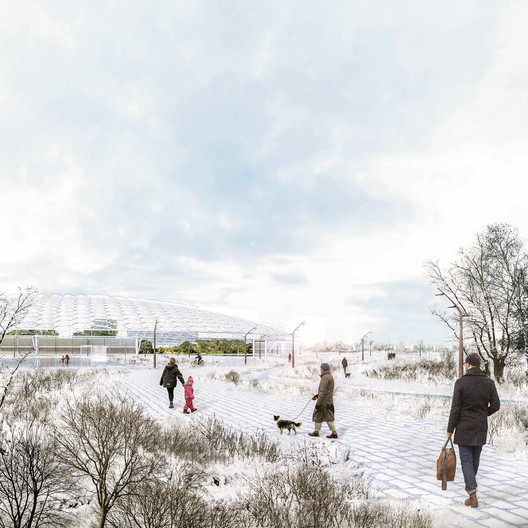
The proposal seeks to generate a field of urban intensity that highlights pre-existing features, thereby preserving identity while regenerating a sense of community as the fundamental purpose of public space.
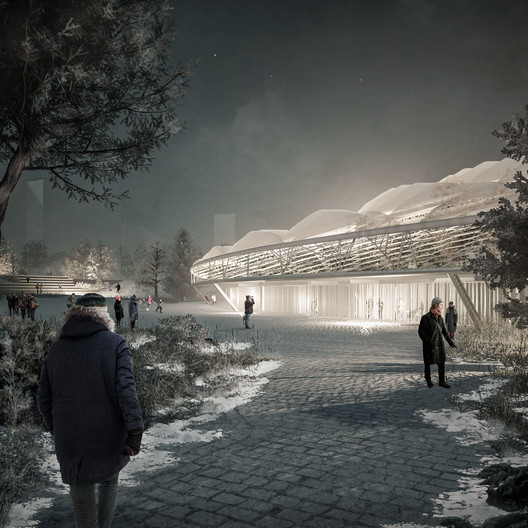
The intervention extends to reclaim the streets; appropriation occurs openly as one walks, discovering the site in an exploration of sensations, movement, and collectivity. Activity is atomized, generating tensions and expansions that unify the program developed from a responsive and permeable interaction with the environment. The relationship between atmospheres is nuanced through dynamic interfaces adapted to the dual condition of the sheltering skin and the natural surface of the land, which unfolds to embrace immense possibilities for activity emphasized by gathering hubs that attract users, fostering a living, moving fabric.
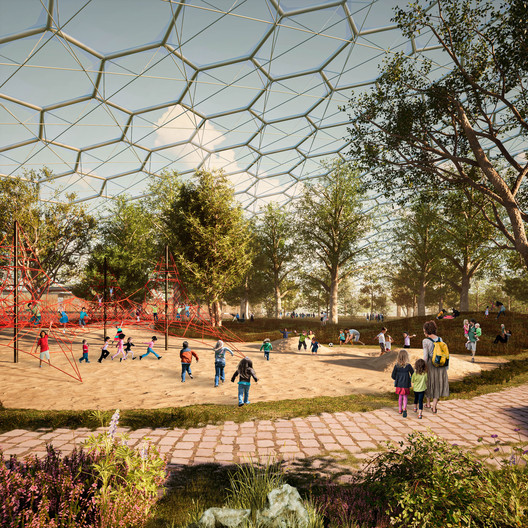
Coziness Valley aims to be a meeting point, an urban hub for sports, art, and leisure, a warm exchange, a temperate blend of local activities, and a vital magnetism that continuously invites appropriation and use. Through this "place of places," the proposal seeks to systematically and logically, yet organically and flexibly, address all of these visions.
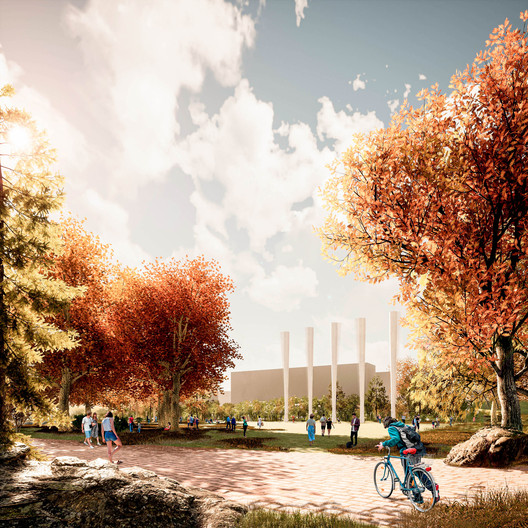
The main goal of the intervention is to redefine public space habitability within the complex reality of the Arctic world. It aims to actively use resources to benefit both users and the site itself, connecting the city on multiple levels, humanizing the scale of the space to make it welcoming—a destination to visit and a starting point from which to continually rediscover the city itself. It is a place for everyone: open, accessible, and an experience that revitalizes the essence of Coziness Valley and its heartbeat within Murmansk.

- Project Team: Martín L. Gutiérrez Guzmán, Martín Gutiérrez Córdoba, Natalia González Martínez, Jorge Andreas Hernández, Sergio Álcocer Lira, Juan Clavel.
- Graphic Design and Visualization: Héctor Martínez, Patricia Durán.
- Clients: Government of the Murmansk Region and ANO "Center for Urban Development of the Murmansk Region".
- Engineering: Javier Ribé.
- Landscape Architecture: Ambiente arquitectos.
- Consultants: Saad acústica (acoustics), Victor Fuentes (bioclimatic architecture), Gustavo Avilés (lighting), Marissa Meljem (sustainability).
This article was written by Belén Maiztegui. The translation is powered by AI.