
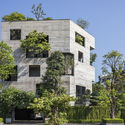
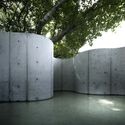
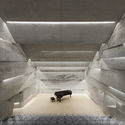
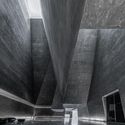

"The image provided by Brutalism, an architecture of sensual extremes, is often an extraordinary and unfamiliar experience for the city explorer. There can be something aggressive and a bold vocabulary (...) in the expressive palette that displays the truth of its materials and a disdain for the frivolous." This is how Simon Phipps [1] describes the fascination that Brutalist works still hold for us today. Yet, what does it mean to think about this architecture in 2021?

Brutalism originated in the post-World War II works of Le Corbusier in the mid-1950s, when he began exploring the plastic possibilities of concrete and left it exposed—"béton brut", which translates to “raw concrete” and gave rise to the term. Since then, various interpretations have emerged regarding how this technique is applied to designs, ranging from British New Brutalism to the expansion of what is considered a Brutalist "style."
- Related article: What is Brutalism?

As Ruth Verde Zein [2] reminds us, the only thread that binds these works together is their "external and superficial appearance." She references William Curtis's observation that “the cliché of this architecture was the exposed reinforced concrete surface, achieved with the help of rough timber formwork,” though the architect considers this "too little to constitute a trend, let alone a style, since not even this requirement is absolute—there are, for example, confirmed Brutalist works built in brick masonry."
Zein concludes that despite conceptual differences, a body of Brutalist works can be defined by formal and superficial characteristics. This may explain why, in the collective imagination, we automatically associate Brutalism with the image of an exposed concrete building—a material that remains a favorite among architects. However, this scenario raises a question: if Brutalism turned concrete into a fetish for many professionals, how do they remain seduced by a material that over the last decade has been one of the world's leading polluters?


Lucy Rodgers has stated that "if the cement industry were a country, it would be the third-largest CO2 emitter in the world—behind only China and the US," and the United Nations Environment Programme found that in 2012, the world used enough concrete to build a wall around the Equator 27 meters high and 27 meters thick.
These alarming figures have not stopped the material from being used today; every day we encounter contemporary examples that adopt raw concrete. After all, its structural performance and plasticity are just a few of the qualities cited by those who choose to use it.
A key argument in defense of current projects highlights the fact that concrete requires little maintenance and elegantly expresses the passage of time on the built object.


The versatility offered by concrete is also noteworthy. Depending on the formwork used, there is an infinite variety of potential textures, allowing for a distinct rhythm on surfaces and different atmospheres that can result in an interesting play of light and shadow.
Furthermore, its appearance is read as "neutral," allowing other elements to be emphasized: furniture, the interplay of light and shadow, artwork, or the users themselves within the space. Its chromatic coherence is also used to reinforce contrasts, whether to differentiate a contemporary intervention from pre-existing structures or to enhance the green of nature.


Still praised by professional juries and relying on a technique mastered by builders worldwide, concrete is far from disappearing from the architectural landscape. The good news lies in ongoing research that brings more ecological alternatives, such as "bioreceptive concrete" developed by Dr. Sandra Manso-Blanco—which encourages the growth of mosses and lichens that can absorb CO2 in large quantities on the material's surface; a concrete that uses less water in its production and offers greater strength, produced by Taktl; and finally, a concrete block that uses no cement and has structural properties very similar to those of the traditional material, developed by Watershed Materials.
Therefore, while Brutalism had its historical peak defined by raw concrete, in the not-too-distant future it may find material alternatives that will forge a new legacy—one that is more environmentally conscious without losing its distinct qualities—thus opening up even more possibilities for its definition.

References
[1] PHIPPS, Simon. Brutal London. September Publishing, 2016.
[2] ZEIN, Ruth Verde. Brutalismo, sobre sua definição. (ou, de como um rótulo superficial é, por isso mesmo, adequado). Arquitextos, São Paulo, vol. 07, no. 084.00, Vitruvius, May 2007.
This article was written by Victor Delaqua. The translation is powered by AI.


