
Shaped by the pandemic, how can we address a challenge as complex as the proper functioning of supply markets and street vending? We all know that, in one way or another, we need to reinvent them.
The "Ideas en Pandemia" and "Proyecto Perú" initiatives, together with the Municipality of Lima, organized the First International Post C-19 Competition. This event focused on generating contributions from civil society to improve conditions in Lima's most critical supply hubs: its markets.
The challenge focused on interventions in Municipal Retail Markets No. 1 and 3 de Febrero, located in the La Victoria district of Lima, Peru. More than 100 teams registered for the competition, from which six teams—including winners and honorable mentions—were selected after a highly competitive deliberation process.
Below, we present the selected proposals, highlighting the specific areas where they excelled, whether for the market design itself, the public space generated, the commercial module, or the management model.
First Place: "Resilient Markets"
Team: Julio Antonio Ramirez Rodas, Carlos Alonso Herrera Mogollon, Yasmin Alessandra Jasahui Ocampo, Franco Sebastian Loo Lecca, Luis Enrique Lozano Nuñez
Country: Peru


The "Resilient Markets" proposal stems from concerns over poor urban development, commercial chaos, and the low-quality urban conditions in the area. It focuses on creating urban sutures and direct relationships between the markets and their context, manifesting as a commercial super-block. Its function and adaptability to a changing future were rethought, making it more organized and dynamically connected to the outdoors. To maintain its hierarchy and organizing role, the project proposes a massing designed as a single unit with open internal circuits, merging with the public space through an extension of Parque del Migrante—imagined as a public terrace over the markets to promote green areas and social activities.
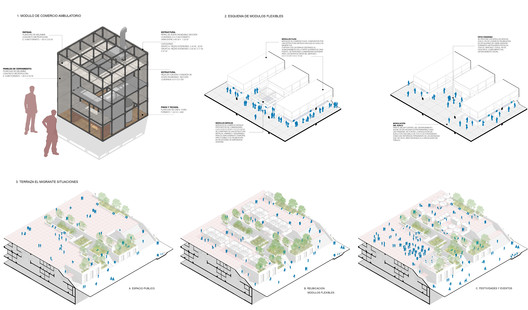
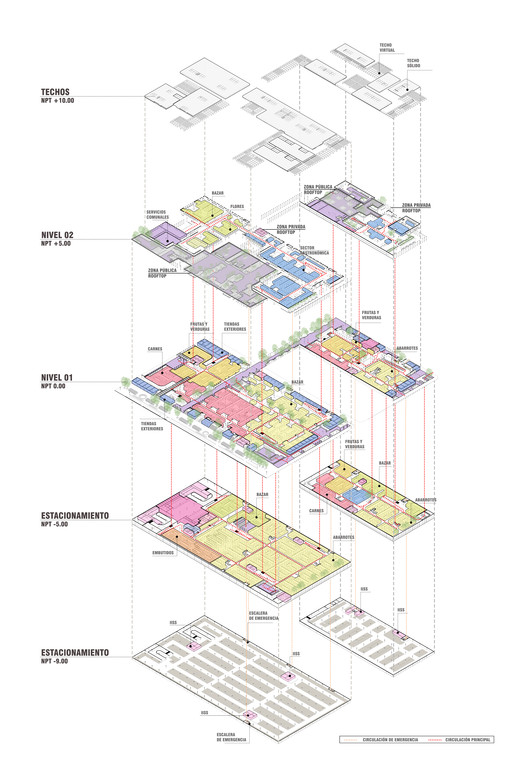
The organizational system prioritizes order and flexibility under different scenarios. It features a flexible layout with fixed stalls as dominant elements, alongside "mobile" modules that can be reorganized to create small interior courtyards. Additionally, operational, supply, and solid waste management processes were redesigned for proper development. In times of change and transformation like these, we believe it is time to rethink the concept of the market, adapting it to the scale of humans, the city, and the environment.
Recognized as:
- Best market proposal
- Best public space proposal
- Best commercial module proposal

Second Place: Manifiesto
Team: Rodolfo Javier Bocanegra Palomino, Ricardo Arturo Huanqui Abeo, Juan Pablo Sarmiento Barletti, Julissa Tabata Paredes Cóndor, Sammy Daniel Tejada Salazar, Ana Paola Córdova Gamboa, Nathalie Ximena Muñoz Vilcapoma
Country: Peru
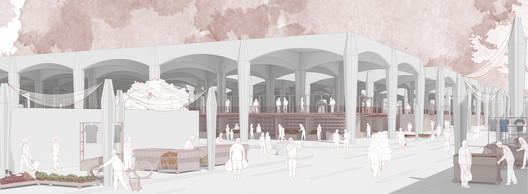

The project is conceived as a programmatic extension that literally takes over the street, transforming it into a longitudinal space of commerce and exchange without defined boundaries. The architectural intervention organizes the existing conditions, providing a recognizable, open, and powerful spatial structure that becomes more than just a building. The project functions simultaneously as continuity, unity, and context.

The spatial strategy integrates the street into the market and vice versa, introducing a series of urban interventions in the immediate surroundings while following the market's own spatial and formal logic. Consequently, the concept of the market is preserved as a public space/street rather than just a building.
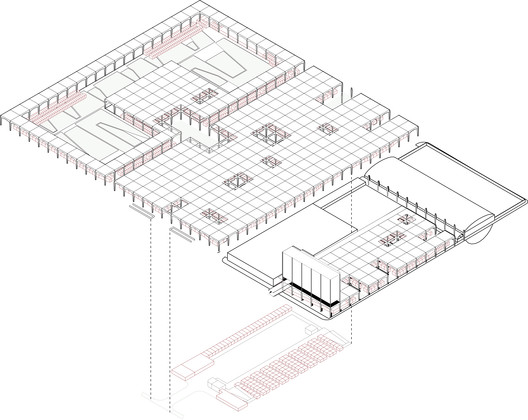
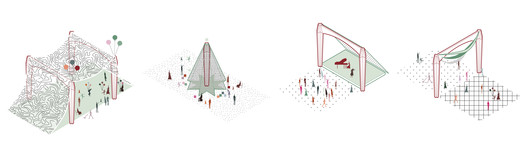
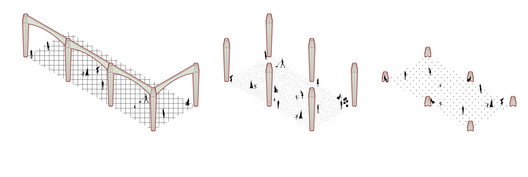
The project is designed to be read as a unified whole, where everything is connected through form. The proposal explores a system designed to be easily recognizable—sober yet robust. As an urban concept, the market stitches this sector of the city together by establishing itself as a branched, polycentric structure. This approach subtly guides visitors, gradually building the feeling of being "in the market."
Recognized as:
- Best management model proposal
Third Place: Mercado Calle
Team: Maria Alejandra Pardini Osorio, Elizabeth Wendy Corzo Jara, Sofía Yumi Nakasone Araka, Carol Vanessa Reque Arana, Elizabeth Giovana Zuloaga García
Country: Peru

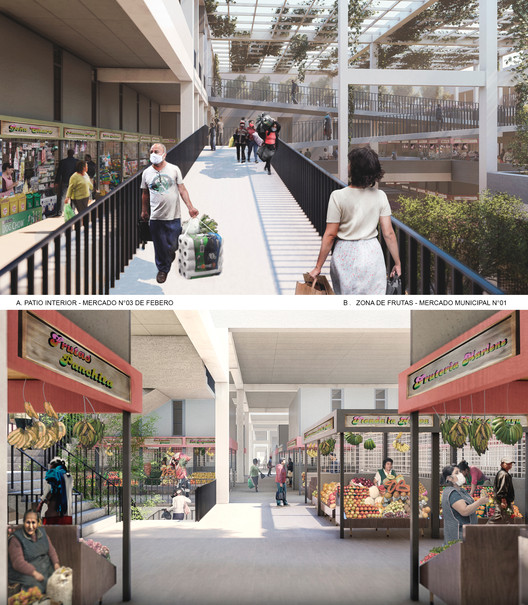
The concept of the proposal stems from bringing street-level relationships into the markets, creating an atmosphere that integrates the various actors within the urban context. The project establishes connections between the retail commercial sector and the Gamarra textile hub through four pedestrian promenades, opening Parque El Migrante to its surroundings and integrating it into the active dynamics of the markets. Furthermore, the heavy presence of street vendors surrounding the markets called for an approach that integrates these actors into both design and management. Accordingly, both markets incorporate spaces designed for organized street vending, ensuring safety and sanitation while reinforcing the street-like character they aim to preserve.

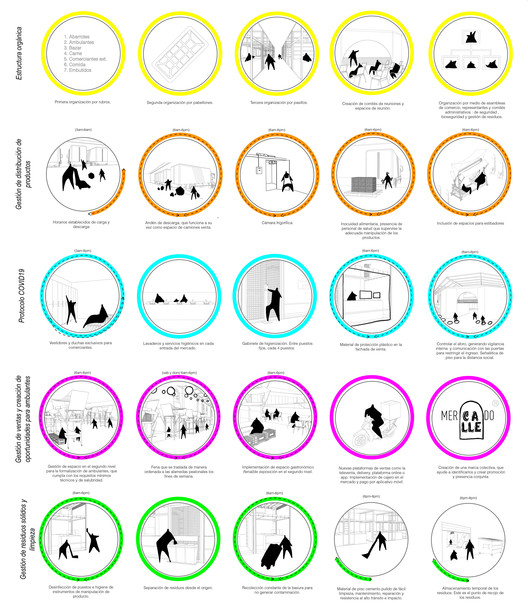
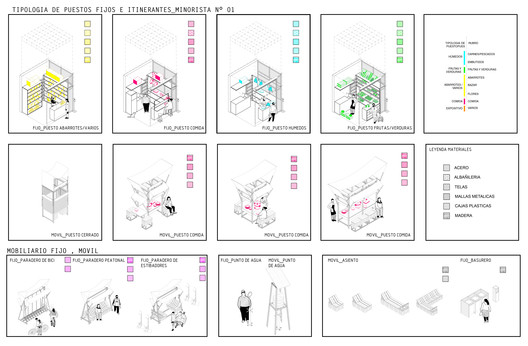
For the 3 de Febrero Market, the proposal suggests a partial rehabilitation that maintains the core structure of the internal stalls while upgrading them to meet health and regulatory compliance in the COVID-19 context. In contrast, a complete redesign is proposed for Minorista 1 Market. The proposal also includes new programming that complements the markets' daily operations and aligns with their uses, such as elevated plazas designed for temporary markets or community gatherings, alongside peripheral walkways acting as elevated shopping streets. For both the fixed and temporary stalls, the team created a catalog of different typologies tailored to the various commercial categories. In this way, spaces are connected and diverse commercial scenarios are woven together with new flexible spaces that reinforce local identity, allowing for the organized and accessible community appropriation of new public areas.


Honorable Mention: Arantina Wasi
Team: Sally Fernanda Torres Mallma, Claudia Suemi Afuso Muñoz, Catherine Kaori Gushiken Uehara, Oumayma Boudouane
Country: Peru and Morocco


Arantina Wasi is an integrating node that represents the diverse heritage of Lima. Analyzing the immediate surroundings, the design abstracts the intense, symbolic colors of the migrant multiculturalism found in the neighborhoods surrounding the markets. It also considers the strong presence of the Gamarra economic hub, filled with the shouting calls of local entrepreneurs. Finally, the market serves as a convergence point for the biodiversity coming from rural fields and provinces—an essence that connects us to Pachamama and completes the node.


These three conceptual pillars come together in the market, creating an integrating node as a living space of exchange and giving a sense of place to the La Victoria market. This is achieved through inclusive spaces for diverse vendors and the implementation of site-scale green infrastructure, helping to balance the area's current state with a focus on the most vulnerable to foster sustainable development. Based on user flow, the markets are differentiated into "El Mercado del Caserito" (The Regular Customer's Market) for daily shoppers, and "El Mercado del Emprendedor" (The Entrepreneur's Market) for those purchasing wholesale supplies for their businesses.


Honorable Mention: Comunidad Radical
Team: Marta Maccaglia, Veronika Rodriguez Yamuca, Giuliana Miglierina, Juan Pablo Astudillo Cordero, Jaime Sebastián Astudillo Cordero, José Omar Guncay Montenegro, Dalton Rubén Paz Cueva
Country: Peru, Italy, and Ecuador

Comunidad Radical is a proposal based on the following principles:
Social self-production of habitat, starting with an open and generic floor plan that allows citizens to appropriate the space according to their needs, desires, resources, and imagination.
Urban integration, featuring a layout similar to pre-modern cities—without zoning or segregation, continuous, spontaneous, mixed, and therefore alive, championing a new urban model that breaks down barriers to unite neighborhoods and residents.
Cooperative and communal focus, understanding and leveraging the city’s inherent dynamics transferred to a market context, along with the capacity of its members to self-organize.

Under these principles, the Comunidad Radical project aims to be a replicable market model that achieves its ultimate meaning by responding to the specific needs of the site. It generates a process that recognizes cultural, social, productive, and economic complexity and diversity, organized through community action guidelines for management and self-construction.


Ultimately, through the interaction of citizens with the market, the market with the city, its preservation, and community appropriation, the project seeks to propose a flexible urban model using mobile architecture. It also reaffirms the acceptance of a city always in motion and under construction—created by and for citizens—adapting to changing needs. However, the proposal notes that "citizenship must be guided because participation is not spontaneous and cannot simply be claimed or demanded," addressing the absence of the state, the memory of a city self-built through land occupations, and avoiding the romantic exoticization of traditional "communal labor" (faena comunitaria).


Honorable Mention: Rizoma
Team: Katerine Angela Rado Cusi, Teresa De Jesús Moreno Fuenzalida, José Manuel Huillca Arredondo, Gianfranko Heinz Armando Zapata Sánchez, María Silvia Villalba Portillo
Country: Peru, Chile, and Paraguay


The area features unique urban conditions:
- Cerro San Cosme is densely populated, facing challenges with violence, alcoholism, drug addiction, poor sanitation, and tuberculosis (even before the pandemic, "Do not spit on the floor" signs were posted, and masks were mandatory).
- "Gamarra," Peru's largest clothing manufacturing hub, draws major pedestrian and vehicular traffic. In 2018, the Municipality of La Victoria evicted street vendors and gated the entrances to this sector, creating a 1.2 km urban barrier.

Situated between the two is our intervention area, which carries its own history: in 2012, the municipality evicted the "La Parada" wholesale market, resulting in violence and unemployment. In its place, "Parque del Migrante" was built—a fenced park that fails to integrate or strengthen community life in the area.


This context, coupled with the pandemic, motivated us to propose an integrated, open, accessible, participatory, and sustainable project:
- Open markets featuring a colorful canopy reminiscent of street vendors' stalls, connected by ramps, with one market intersected by a diagonal street that addresses the need for connection between Gamarra and San Cosme.
- Parque del Migrante will be reclaimed, hosting services such as a health center, library, bank, and offices, among others.
- Gamarra and its surroundings will become more permeable, integrating a public transit lane, vehicle-tolerant streets, loading and unloading zones, bike paths, a network of public spaces, and designated streets for street vending.
This article was written by Fabian Dejtiar. The translation is powered by AI.


