Rescuing the invisible, diving into an erased urban memory, and walking on water. Surprising as it may seem, the world has not ended yet. However, those walking through Belo Horizonte, passing the busy intersection of Afonso Pena Avenue and Brasil Avenue, might be able to pinpoint exactly where it does. The “Acaba-Mundo” [World's End] is a creek that crossed the Curral del Rei settlement, the site to which the capital of Minas Gerais was relocated in 1897.
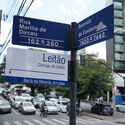
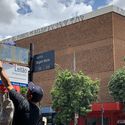
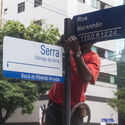
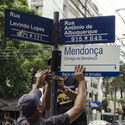

Where only water once flowed, packed buses, cars, and hurried motorcyclists now rush. Perhaps someone pushing a stroller, a pedestrian, or a child learning to read will look away from the bronze Tiradentes statue that gives the square its name and notice a sign. The “Acaba-Mundo” used to flow through Curral del Rei and still flows today beneath the asphalt, the vehicles, and the feet walking through downtown Belo Horizonte. Unlike the statue of the Inconfidência martyr, “Sobre o Rio” [Above the River] is a different kind of monument to this city.

Sobre o Rio
The work *Sobre o Rio* is part of the career of Isabela Prado, who, since 2006, has developed various artistic interventions exploring the presence of water in the city. Together, these works form part of a broader research project called Entre rios e ruas [Between Rivers and Streets], which invites us to reflect critically and sensitively on urban water dynamics. Prado's work highlights the emotional and historical developments of the relationships between the environment and the inhabitants of urban spaces.

Through a project approved under the Municipal Cultural Incentive Law in 2018, 230 street corner signs were installed within the perimeter of Avenida do Contorno (the core of Belo Horizonte's original master plan). These signs indicate the presence, however hidden, of culverted creeks flowing beneath the city that make up the Ribeirão Arrudas Basin: Leitão, Serra, Acaba-Mundo, Mendonça, Zoológico, Barro Preto, and Afluente Serra.

“*Sobre o Rio* has a public character, as it is executed in the streets. It brings visibility to something invisible and reinstates the creeks as elements of the city landscape. Once the presence of these creeks is identified and remembered through the street signs, their existence becomes natural, recognized by the citizens moving through Belo Horizonte. Thus, the work fosters a new relationship between the city and its inhabitants, engaging society as a whole in (re)recognizing this body of water that lives within the city.” (Isabela Prado)
The Campaign
A crowdfunding campaign has been active since November 16 to fund a comprehensive, bilingual (Portuguese and English) printed book. This publication will document the creative processes, reflections, and records of the “Sobre o Rio” project, in addition to featuring essays by experts in fields related to the project.
The campaign aims to secure backers to fund the graphic production and printing of a 1,000-copy run of the book. It will feature high-quality finishes and an in-depth presentation of the processes and reflections sparked by “Sobre o Rio.” Along with the book, rewards include other works by Isabela Prado, such as silkscreen prints, the book “Lição: se esta rua fosse um rio” [Lesson: If This Street Were a River], and even an original steel replica of the “Acaba-Mundo” creek sign.

The editorial and graphic design process, led by graphic artist and editor Clarice G. Lacerda, will combine text with highlights of Isabela Prado’s artistic career, which culminates in “Sobre o Rio,” her latest work. In addition to process documentation, the book will feature unpublished essays by Michele Arroyo, Alessandro Borsagli, Josué Mattos, Roberto Luís Monte-Mór, and Guilherme Wisnik, as well as an interview with the artist conducted by curators Clarissa Diniz and Josué Mattos.
About the Artist
Isabela Prado (Belo Horizonte, 1973) is a visual artist and professor at the School of Fine Arts of the Federal University of Minas Gerais (UFMG). Holding a Bachelor of Fine Arts from UFMG and an MFA from Indiana University, she has participated in several artist residency programs internationally (Argentina, Brazil, US, Jordan, Palestine) and in solo and group exhibitions in Brazil and abroad. In 2011, she received the Funarte Contemporary Art Prize for the *Entre Rios e Ruas* project, which led to the book *Lição: se essa rua fosse um rio* (2016). She was also a finalist for the Marcantonio Vilaça Prize for Visual Arts in 2019.

Learn more about the project on social media:
www.instagram.com/entrerioseruas
www.facebook.com/entrerioseruas
This article was written by Romullo Baratto. The translation is powered by AI.