
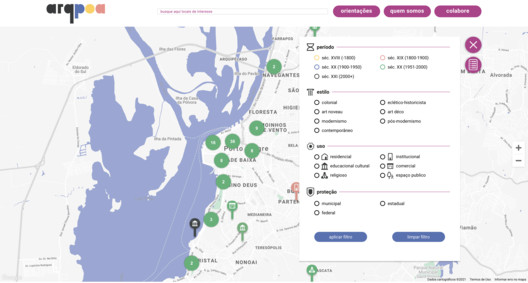
Porto Alegre now has an online guide aimed at preserving the history and memory of its architectural heritage, both historic and contemporary. Conceived by architects and urban planners Rodrigo Poltosi and Vlademir Roman, the Guia Arqpoa brings together texts, photographs, and information on 100 architectural, urban, landscape, historical, and cultural works in the city. The mapping is based on the buildings and public spaces featured in the print publication released in 2017, titled Guia de Arquitetura de Porto Alegre, and allows this initial list to be expanded through the collaboration of new contributors.

The city's urban and architectural evolution showcases the traces of its history. Porto Alegre, however, lacked a comprehensive record. “The realization that there was no guide showcasing, highlighting, and analyzing its architecture across different historical and stylistic periods motivated us to organize all this material. Porto Alegre's architecture is not sufficiently known or valued, even by its own residents. São Paulo, Rio de Janeiro, Montevideo, Buenos Aires, and even Pelotas and Caxias do Sul, to name a few nearby examples, have their own architecture guides,” the architects explain.
Curation and Selection Process
The creation of the Guide took into account heritage sites already recognized by public authorities and the project creators' knowledge of the city. Out of an initial list of 200 spaces, 100 were selected. “The priority was to highlight locations that can be visited, since the Guide is not geared specifically toward architects and urban planners, but mainly toward residents, tourists, and visitors to the city,” Rodrigo explains. And anyone who thinks the project is restricted to buildings is mistaken. “We like to emphasize that, in addition to buildings, there are squares and examples of landscaping and urban planning, such as the IAPI neighborhood, which was inspired by the garden city concept.”

Architecture, History, and Aesthetics
New and old buildings share the same space in Porto Alegre, giving it a highly diverse architectural aesthetic. This is just one of the observations made by the architects and urban planners behind the project. “It is quite impressive how many old buildings have had one or even two floors added on top of the original construction, such as the building that houses the State Treasury Department,” Vlademir points out.

According to the architect and urban planner, the modernist period is rarely recognized, even though it contributed high-quality works, such as the Jaguaribe and Esplanada buildings in the city's central area. “The Iberê Camargo Foundation, for example, is a landmark recognized by a large part of the population, but there is an entire recent modernist period that needs to be valued.” He adds: “The goal of the online guide is to enhance people's relationship with the city, helping them learn how to look at their surroundings and begin to recognize and value their architectural heritage. As Walter Benjamin said, the city is a book of stone. If we do not read it, we fail to recognize it as culture and a witness to history.”
The project was developed through a public call launched by the Council of Architecture and Urbanism of Rio Grande do Sul (CAU/RS), in partnership with the Institute of Architects of Brazil (IAB/RS).
Explore the Guia Arqpoa and discover some of Porto Alegre's architectural gems.
This article was written by Romullo Baratto. The translation is powered by AI.


