
“From the problem of locomotion derive all other problems of urbanization.” It was in 1882 that the Spanish urbanist Arturo Soria y Mata made this assertion, and in response to it, created and implemented the concept of the linear city. Based on a functionalist doctrine, this city model abandons traditional structures such as squares and blocks, subordinating the design to circulation paths in its most rational spatial configuration: the straight line.



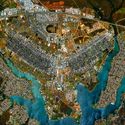

The linear city, in its original conception, would consist of a spine in the form of an urban thoroughfare of unlimited length—which, according to Soria y Mata, could connect Beijing to Brussels—intersected by short perpendicular streets 200 meters long, providing access to housing and workplaces. In the center of this huge central thoroughfare, all basic urban infrastructure for the city's supply would be installed (piping for water, power, etc.), as well as public facilities related to the basic needs of the population, such as healthcare and security. As a critique of polycentric cities, this model relies on dispersion as an organizing element, advocating for an “efficient and equitable” urban planning—or, in Soria y Mata's own words, “affordable land and fast, frequent, and economical communication.” This efficiency would stem from mass transit technology—at the time, the train. His arguments condemning circular and garden cities were therefore based on the financial inaccessibility of central land, congestion in city centers, and the marginalization of the peripheral population.


