
Matosinhos, in northern Portugal, will host the newest project by BIG, the Danish firm led by Bjarke Ingels. Titled Fuse Valley, the project is a mixed-use corporate complex located near the city, dedicated to Farfetch, a global luxury fashion platform, and the Castro Group, a real estate development and construction company.
Promoting the concept of a "sustainable" development that will pave the way for a "future tech valley" to emerge in Matosinhos over the next four years, the companies highlight that more than 80% of the outdoor spaces will be "fully open to the community, in total harmony and respect for the surrounding environment."


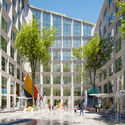


Located away from the city center, connections to the public transit network will be provided via shuttle buses. Within the development's boundaries, sustainable mobility is a key focus, featuring electric vehicle charging stations as well as bike and electric scooter sharing hubs for shared use within the valley's perimeter.

The complex's program is extensive, featuring "a daycare center for employees' children, a wellness-focused gym, and rooms for meditation, yoga, and exercise, promoting the physical and mental health" of Farfetch employees. The company will occupy seven of the 14 blocks that make up Fuse Valley.

In our vision of the future of work, company spaces are more than workspaces; they are hubs for connection, creativity, and innovation, but they are also spaces where we want to create the conditions to promote well-being. At Fuse Valley, we want to bring together the conditions that allow people to feel included in a space that facilitates hybrid work models where in-person and remote meet in perfect symbiosis, and where company culture is fostered. — José Neves, CEO and Chairman of Farfetch
The other seven buildings will be occupied by the Castro Group, which will include in its real estate program 62,800 square meters of office space available for other companies, a 75-room hotel with 42 apartments, 5,000 square meters of retail and support service spaces, such as dining areas, a gym, and a spa, as well as an open-air amphitheater for art exhibitions, lectures, and workshops. Paulo Castro, CEO of Castro Group, noted that the plan is to "develop a smart city, or in this case, a smart valley" with 24 buildings, 14 of which are scheduled for completion by 2025.


With a captivating cascading massing – a feature seen in other BIG projects – and lush landscaped roofs, the corporate complex aims to be "the most sustainable development in Portugal and one of the most sustainable in Europe." Aside from a brief mention of "sustainability principles applied to construction," there are few details on how this goal will be achieved. However, one thing is certain: Bjarke Ingels Group's design for Matosinhos stands out for its massive scale and the beautiful natural setting in which it will be built.

Via Castro Group.
This article was written by Romullo Baratto. The translation is powered by AI.


