
Atelier Marko Brajovic recently shared the design for a Floating Community Library on Lake Mamori, in the Amazon Rainforest. Developed in close collaboration with the local community, the project aims to become a benchmark for sustainable construction and environmental education.
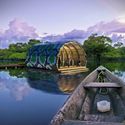
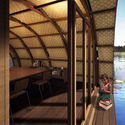

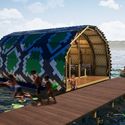

Lake Mamori has a population of about two thousand inhabitants, many of them children, living along the lake's extensive shoreline. After nearly two decades of research and experimentation in design and architecture, combined with a strong relationship with the local community (through the Architectural Association Visiting School Amazon workshop), the project team discovered that the main local issues are directly related to industrialized construction technologies and materials.

The use of these imported construction materials and techniques has introduced new architectural typologies that fail to respond to climatic conditions, undermining the quality of life of the local culture. "Our project presents an experimental architecture prototype utilizing local and recycled materials," the architects add.

The project also aims to serve as a benchmark for sustainable construction and environmental education. The simple yet effective infrastructure houses a library for children and adults with a curated selection of books related to cultural and natural preservation, ecology, waste management, and recycling. The library will be managed locally by a female community leader and updated with books from the NGO Vaga Lume, which will kick off with an initial donation of 200 books in the first year and an annual supply of 100 new books each year thereafter.

The development of the ongoing project is made possible thanks to the Goethe-Institut and Prince Claus Fund program "ARTISTIC RESPONSES TO ENVIRONMENTAL CHANGE," in collaboration with biologist and biomimicry specialist Alessandra Araujo from Bio-inspirations, Nacho Marti, designer and co-director of the Architectural Association Visiting School Amazon, the NGO Vaga Lume, and the Lake Mamori community.
This article was written by Romullo Baratto. The translation is powered by AI.


