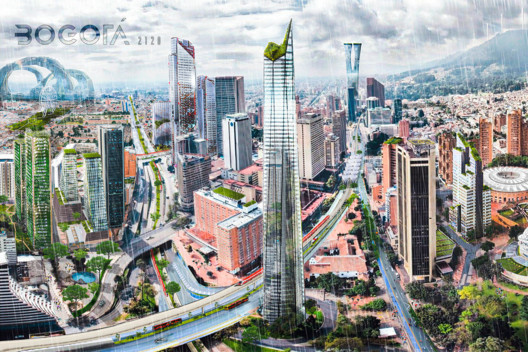
If we could travel back in time one hundred years and organize an ideas competition to visualize what Bogota would look like in 2020, the proposals would be far from the reality of the urban landscape experienced today in the Colombian capital. Back then, little was known about the events that would later shape history, such as the Bogotazo, which led to the rebuilding or remodeling of most of the buildings that served as architectural landmarks of previous centuries.
The uncertainty of a distant future is perpetual. Yet, this does not stop the imagination from creating utopian or dystopian scenarios of that urban dimension for 2120. This was the main goal of the rendering competition organized by the Student Collective of the Colombian Society of Architects (CESCA) of the Bogota and Cundinamarca chapter.
The competition allowed total design freedom for each proposal, which had to be accompanied by a design statement to complement the narrative visualized in the rendering.
Statement from the competition organizers: Amidst uncertainty and the emergence of new ways of inhabiting space due to the pandemic, the Bogota 2120 Ideas Competition was conceived. This exercise was developed as part of the virtual workshops and meetings organized by CESCA to enhance community learning, encouraging architecture students to creatively explore the future of Bogota.
Conceived as a proposal expressed through a single digital image, the competition invited participants to explore utopian and/or dystopian visions of the city's transformation over time. Below, find the details of the winning ideas:
First Place
Designer: Willian Steven Rivero Coronado, Student at Universidad de la Salle
Technique: Revit, SketchUp, V-Ray, Lumion, and Photoshop

“The third-highest capital city in South America, 2,600 meters closer to the stars—a cold dystopia born from the foolishness of a city built on the cultural overlaying of its native inhabitants, whose overshadowed practices and knowledge will lead to the search for a dissolved identity resulting from international mixing. In a distant future, the mechanical must coexist with the organic, alongside the automation of various techniques and labors, the dissolution of the tangible, and an intense struggle of knowledge that favors the capital to drown out the ego of the masses.
Regarding city-building, chaos and order assume a duality where projects ignore certain social realities. However, they achieve a greater feat when shifting from anthropocentrism to acentrism, accepting a reality where the Earth will endure long after our species is gone, just as it did before. Consequently, we will strive to coexist with other natural entities through organic architecture. We will convert our common spaces, such as the bullring, into multipurpose areas, elevating physical, sculptural, and creative challenges into architectural facts as expressions of the historical moment we inhabit: "2120." Furthermore, this vision integrates functional solutions to existing needs, such as transportation, where science and design join forces to address current shortcomings through magnetic levitation or electric metros and trains. Similarly, the energy revolution will see wind power generated through oscillation to achieve aeroelastic resonance (vortex bladeless), combined with public policies that protect habitats and help reinvent our heritage. This will foster learning about our territory through the universal void, using reformed facilities for research, without overlooking the main ecological structure. This includes recreational and productive spaces such as multifunctional parks, vertical farming buildings, and green roofs, and finally, tackling structural challenges like parabolic buildings designed for uniformly distributed loads.
In short, a dystopia where, to understand order, one must accept its chaos—much like happiness without suffering. That is Bogota 2120: a reality where sound decisions go hand in hand with fallacies.”
Second Place
Designer: Ferley Molina Aley, Student at Universidad La Gran Colombia
Technique: SketchUp, 3ds Max, and Photoshop

Glaucopolis
“On the night of June 30, 2040, the district declared a purple alert due to high pollution levels in the nation's capital. According to official statistics, the resident population surpassed 20 million, and the entire urban ecology was on the verge of collapse. Although the measures adopted by the district administration helped mitigate the issue, they were not enough. Experts proposed redistributing the urban population to relieve congestion in the center of the country.
Eighty years later, however, the city remains in chaos. We have built the latest concrete ecosystemic megastructure, featuring a vast artificial surface, air purification cylinders, and surrounding triangular spaces that simulate a housing network. Its structure is fully exposed, and in an act of innovation, we decorated its exterior. According to expert Glaucotans, this is the future of urban planning; consequently, the sprawling city is no longer an option. The entire metropolis is divided into cylinders containing homes, offices, and public facilities. Since then, residents travel from cylinder to cylinder, while Glaucotans study for over five decades to give each cylinder its own personality.
Nevertheless, as I enjoy the sunset over the capital from the Ata Monument, I cannot help but wonder if we are doing the right thing. As a Glaucotan, I can tell you it was a matter of life or death—a question of time, or rather, space—since we were no longer human, but fluid, ever-changing entities full of cruelty and thirst for power, with a single goal in our short lives: to buy the best cylinder in the city and slot it into the tower as a symbol of our personal achievements.
For all these reasons, I have come to the conclusion that cities, and those who shape them today, suffer from glaucoma.”
Honorable Mention
Designer: Sergio David Cortés Aya, Student at Universidad Nacional de Colombia
Technique: SketchUp, Rhino, Photoshop, Illustrator, and Lightroom

“It is a visual conversation about a city like Bogota, shaped by hybrid environmental, social, and cultural determinants in constant motion. Characterized by an eclectic urban structure made up of blended styles and movements, it generates a sort of palimpsest that combines natural elements, such as the landscape of the eastern hills, with man-made ones, like the city's formal and informal growth.
The interacting layers of Bogota, built across different eras, engage in a constant dialogue of mismatched languages. Now undergoing rapid growth, this expansion offers diverse solutions leading toward the heterogeneity and hybridization of a speculative future of palimpsestic growth, leading to an even more eclectic Bogota.
Bogota 2120 will have new layers. New transportation systems will break up the natural and urban landscape, with intertwined structures connecting the city, the region, and the country. There will be new parks, green patches, and landscapes of natural and artificial interaction, alongside unfinished, regenerative, generative, walking, extroverted, and definitively hybrid architectures.
This speculative future will be an era of swarm intelligence, collective behaviors, and decentralized, self-organized systems, both natural and artificial.”
This article was written by Santiago Baraya. The translation is powered by AI.