
The urban drainage infrastructure in most cities, particularly in Brazil, is already obsolete, making its expansion and adaptation crucial. However, this requires a new model of stormwater management that considers long-forgotten ecological aspects. In recent years, the concept of urban ecology has gained traction as a path toward developing regenerative, more resilient cities. These have been called eco-cities or biocities—terms that vary from author to author but share a common focus on nature-based solutions and ecological relationships.



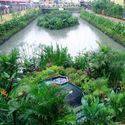

One such model is the so-called "sponge city," which can be understood as an urban area designed to prioritize stormwater infiltration over runoff. The term "sponge" represents the pursuit of greater porosity and permeability in both open and built spaces, allowing water to be absorbed and returned to the groundwater, while also offering indirect benefits such as improving the urban microclimate, increasing biodiversity, capturing and storing CO2, and providing other ecosystem services. In 2014, China launched the "Sponge City Program," which was implemented across 30 cities to address stormwater management issues (Nguyen et al., 2019).


