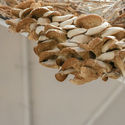
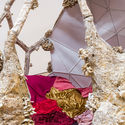
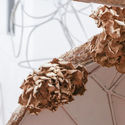

Breeding Space is a living architecture that grows, is cultivated, and even generates edible byproducts. Created using generative algorithms, the space uses oyster mushroom mycelium (Pleurotus ostreatus) and straw as raw materials. The structure was built in a garage-turned-laboratory, through a collaboration between a digital fabrication company and an artisanal workshop. Measuring 3.7 meters in diameter and 2.5 meters high, the installation reveals from the inside all the auxiliary elements required for its construction: an endoskeleton of welded iron rods and a permanent formwork of wood panels. The space is completed by a soft floor made of stuffed traditional Moroccan fabrics and the audiovisual projection Amplifying by Espírituescalera, which narrates other possible worlds.


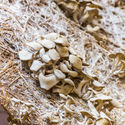
The project originally included 16 kombucha bubbles made from a translucent biomaterial (bacterial cellulose) to seal the openings, but only three were successfully produced. However, contamination from environmental spores—which contributed to the issue—ended up creating striking landscapes, captured in a series of 20 photographs. These Breeding Territories, which may appear microscopic or extraterrestrial, are actually pools of kombucha and mycelium on jute, colonized by various types of mold.


The production, which took place in the summer of 2019, was documented daily through Instagram Stories on the Maria Mallo account. This offered an alternative to conventional architectural narratives by highlighting both the successes and failures inherent to experimental research. Breeding Space and Breeding Territories were exhibited at the Rabat Biennale between September and December 2019. In January 2020, Breeding Space was donated to the Mohammed VI Museum in Rabat, where it is currently biodegrading in the museum gardens. Additionally, a scale model of the project was created and, since July 2020, has been part of the experimental architecture collection at the Frac Centre-Val de Loire in Orléans, France. The model was fabricated using 3D-printed thermochromic PLA, hand-molded kombucha bubbles, LEDs, Moroccan fabric, and a laser-cut wood base.


Credits
- Breeding Space is a project by María Mallo for the Biennale de Rabat 2019 (Sep 24 – Dec 18)
- Digital Design Assistant - Nacho F.C. Monereo
- Production Assistants - Nacho F-C Monereo and María G. Sanchez
- Mycelium Advisor - José Ramón Jiménez Ramírez
- Kombucha Advisors - Arturo Artica and Marta Ochoa
- Production Team - Manuel Muñoz (master welder), Wladimir Pulupa, Miguel Ángel Ygoa, Víctor Sanz, Rafael Munhoz, Anastasia Lekkou, Esthela Palau, Ainhoa Velayos, María Gras, Juan Muzquiz, Diana Piñeiro, Alba Morcillo, Eva Gordo, Ines Miño, Ivan Zurdo, and Damian Zurdo.
- Interior Audiovisual Piece “Amplifying”- Espírituescalera
- Photographs – Victor Lavilla, Jaime Mangas, Wladimir Pulupa, Nacho A. Monteserín, and María Mallo
- Special thanks to the Monereo sisters.
This article was written by Belén Maiztegui. The translation is powered by AI.