
Boxing Boxes is a project resulting from two years of architectural research by Carlos Ortega Arámburo and Daniel de León Languré that combines boxing, as a tool for self-discipline and violence control, with a structure that activates civic space in marginalized areas. For this year's Lisbon Architecture Triennale, the Mexican architect, along with a local interdisciplinary team, installed the equipment in the Portugal Novo neighborhood, in Olaias, Lisbon.

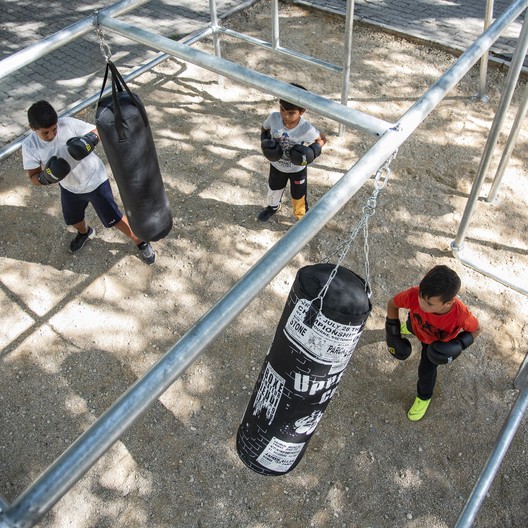
The project features an "out-of-the-box" architecture that seeks to provide a gathering space for the community and bring new energy to it. While the program embraces boxing, it can be much more: a gym, a playground, or a meeting point. Ultimately, it serves as a community space in an area lacking high-quality public spaces, as previously noted by the newspaper Público in an article about the Portugal Novo neighborhood:
"In a community where a large part of the population consists of children or the elderly, the difficulties imposed on them condition their daily lives. On a hot summer afternoon, children go out onto the street. School is over, and playtime takes place in the middle of the road or on a corner untouched by the sun. In the entire area surrounding the neighborhood's five housing blocks, there is no playground or sports field."

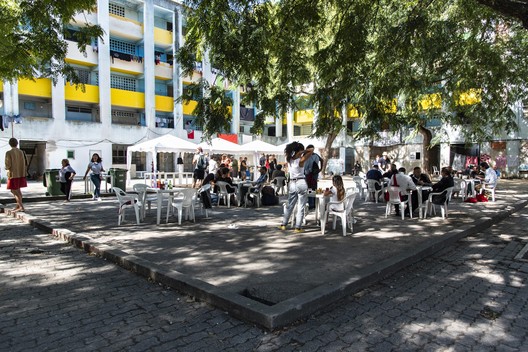
Arminda, a resident of the neighborhood, points out that the housing complex was originally started by the Portugal Novo Affordable Housing Cooperative, which went bankrupt during construction. Since then, the community itself has had to take over the architectural and construction responsibilities. With limited resources, they invested in their own homes and were unable to prioritize public spaces.
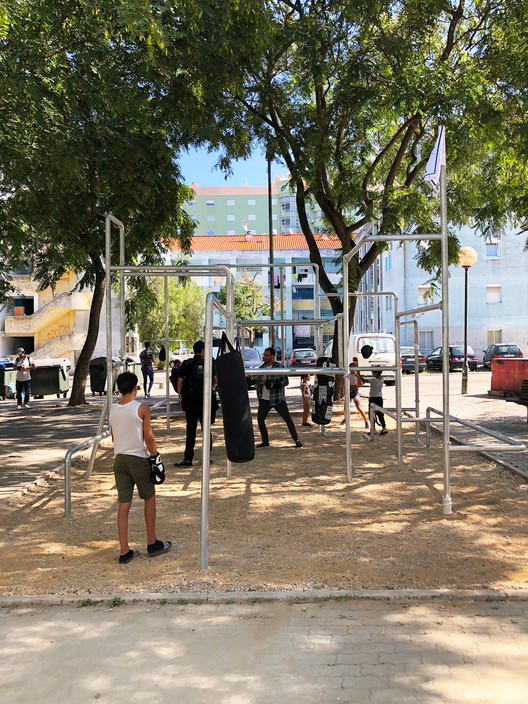
As a result, for over 30 years, the neighborhood has had "limited spaces for children to be children," as Languré pointed out during the opening of Boxing Boxes. For this reason, the project presented at the Triennale is highly significant for the community, creating a gathering space within the neighborhood that everyone can enjoy, regardless of age or gender. In fact, residents are already developing a program to explore positive ways to use the structure through exercise, play, and other activations in the surrounding area, such as parties.

Therefore, the installation of the equipment addresses the lack of public facilities and the need for social integration in the area. Even during its construction, the structure began to fulfill its purpose, as it was built in collaboration with the community. This led to immediate acceptance by the residents, who already notice a difference in their daily lives through this small intervention in the public space.


As the project's authors remind us: "boxing is used as a means for body exploration and the reassessment of leisure, which is often dismissed by athletes, sociologists, and architects. In short, Boxing Boxes leverages the rational use of scarce material resources to create the social dynamics of civic and individual development." Once again, this proves that spectacular architectural gestures are not necessary to make a difference in the social sphere.
PROJECT CREDITS
Participants: Daniel De León Languré (MX), Claraluz Keiser (BR+CH), Maddalena Pornaro (IT), Sofia Costa Pinto (BR), Camila Ulloa Vásquez (CL), Araceli Itzel Espinosa Suárez (MX), Mariana Sánchez Pontón Ocampo (MX), Miguel Ángel Reyes Facio (MX), Susana Verónica Alfaro del Ángel (MX), Portugal Novo Residents Association (PT)
Organization: Diseño Espacial
Design: Daniel De León Languré and Carlos Ortega Arámburo
Production: Daniel De León Languré, Camila Ulloa Vásquez
Installation, Production, and Setup: EDA – Ensaios e Diálogos Associação: Claraluz Keiser, Maddalena Pornaro, Sofia Costa Pinto
Collaborators: Araceli Espinosa (MX), Mariana Pontón (MX), Miguel Ángel Reyes Faccio (MX), Susana Verónica Alfaro del Ángel (MX).
Support: Instituto Tecnológico y de Estudios Superiores de Monterrey
This article was written by Victor Delaqua. The translation is powered by AI.


