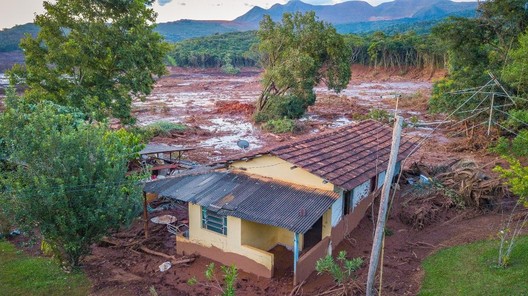
Brazilian architecture and urbanism organizations have published a technical note regarding the failure of the Vale mining company dam in the city of Brumadinho, Minas Gerais, on January 25 of this year. Released last Friday, the document outlines ten points that comprise a preventive action strategy aimed at avoiding further tragedies and "protecting and saving lives."
Read the full letter below:
The Architects and Urban Planners of Brazil, through their representative organizations—the Institute of Architects of Brazil (IAB), the National Federation of Architects and Urban Planners (FNA), the Brazilian Association of Architecture Firms (AsBEA), the Brazilian Association for Architecture and Urbanism Education (ABEA), the Brazilian Association of Landscape Architects (ABAP), and the National Federation of Architecture and Urbanism Students (FENEA), convened in the Brazilian College of Architects (CBA)—seek to contribute to the practical implementation of disaster prevention measures in the fields of Urban, Landscape, Environmental, and Territorial Planning, at both local and regional scales:
without prejudice to emergency relief efforts for the victims;
without prejudice to urgent inspection and control measures;
without prejudice to relevant geotechnical and dam engineering efforts;
without prejudice to rigorous and urgent criminal proceedings, liability, and appropriate compensation;
considering that surveys are available to precisely analyze, plan, and design the territories and areas directly affected by mining activities and at risk; recognizing that mining activities significantly impact the territory and must, therefore, be subject to close attention from local planning, which is a constitutional municipal responsibility; and, finally, recognizing that technical, academic, and practical knowledge is available within the country, without prejudice to international support, they resolve to propose immediate and continuous actions aimed at protecting human lives and economic, social, and cultural activities.
1. precise risk mapping and analysis of all situations must be conducted;
2. human settlements and economic activities must be preventively relocated outside areas of influence and risk, anticipating impacts or potential disasters before they occur;
3. relocation efforts must be separated from post-disaster legal proceedings, which result in the loss of many precious lives;
4. an immediately effective fund must be established to finance these actions and anticipate disasters;
5. as an immediate solution, this revolving and reimbursable fund, to ensure speed and efficiency, must have access to public budget resources, funds from fines and legal and/or voluntary compensations, and available financing sources as determined by law. This includes resources from BNDES, FGTS, and international development banks, such as the IDB and the World Bank, whose loans can be repaid using recovery funds retrieved from potential liable parties, with the financing entity holding these credits;
6. such planned relocations must result from broad public participation of the residents in directly affected areas;
7. there is an urgent need to organize urban and regional planning actions derived from technical mining planning that directly impacts human life, providing new housing and communities. Implementing maintenance and preventive monitoring programs as a product of continuous planning in these areas is essential to the planning of mining activities. Regarding this issue—painful in its nature as a response to tragedies that have already occurred—professional architecture and urbanism organizations can contribute through Technical Assistance for the necessary planning and reconstruction projects, as well as by promoting Public Competitions for Architecture, Urban Design, and Landscape Architecture, thereby offering the best of architectural and urban planning knowledge and expertise to those affected by mining and to the Brazilian Nation.
8. it is necessary to propose technological solutions for the environmental liability generated by the produced waste as a form of remediation, combining ideas or proposals for its reuse. The profession is also dedicated to addressing issues involving the promotion of environmental, territorial, and urban resilience, and the reconfiguration of landscapes, such as those involved in the reconstruction of Bento Rodrigues and Brumadinho.
9. without prejudice to actions for the recovery of material losses from recent tragedies, there is an urgent need—as a preventive alternative and a future response to avoid such tragic events—for an environmental, landscape, territorial, and urban analysis to be translated into a Technical Guidance Plan. Developed by professionals with territorial expertise for the entire national territory, this plan is considered fundamental and complementary to the update of the National Dam Safety Policy.
10. it is necessary to strengthen the public entities responsible for the control and licensing of these activities. Decisions made by public authorities must be free from external interference.
The signatory organizations of Architects and Urban Planners stand ready to assist government bodies, the judiciary, and both affected and at-risk communities.
We will not forgive ourselves if we wait for predicted disasters to occur only to mobilize with palliative measures in the wake of death and destruction.
We have the human, technological, and economic resources for Preventive Action that protects and saves lives.
The letter is signed by Nivaldo Andrade Junior (President of the IAB - Institute of Architects of Brazil), Cícero Alvarez (President of the FNA - National Federation of Architects and Urban Planners), Edison Lopes (President of AsBEA - Brazilian Association of Architecture Firms), João Carlos Correia (President of ABEA - Brazilian Association for Architecture and Urbanism Education), Luciana Schenk (President of ABAP - Brazilian Association of Landscape Architects), and the Executive Board of FENEA - National Federation of Architecture and Urbanism Students.
This article was written by Romullo Baratto. The translation is powered by AI.
