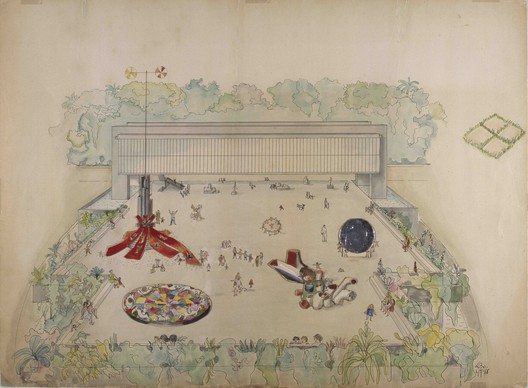
An Italian architect who adopted Brazil, broke down hierarchies between the arts, and shaped a new language of modernism—merging her own radical vision with references from Brazilian culture—will be the subject of an exhibition this April at MASP. In 2020, the show will travel to Mexico and the US.
_Museu_de_Arte_de_São_Paulo_-_Perspectiva_indicando_ocupação_do_Belvedere_com_esculturas.jpg?1554155521)
Lina Bo Bardi (1914-1992) liked to be called architetto, a noun that in Italian, her mother tongue, has only one gender. The word's rigidity could not contrast more with Lina's trajectory as a multifaceted architect who worked in fields as diverse as magazine publishing, education, museums, and what she called “environmental architecture”—an architecture that sought to engage with its context and Brazil's tropical environment. The breadth of her work and thought is the core of Lina Bo Bardi: Habitat, an exhibition opening on April 4 at MASP, accompanied by the most comprehensive catalogue ever produced on the architect's work and legacy. Like the exhibition, the book will be published in three languages (Portuguese, Spanish, and English) and is co-organized with Museo Jumex in Mexico City and the Museum of Contemporary Art (MCA) Chicago. These institutions will host the exhibition in January and June 2020, respectively.
The opening of Lina Bo Bardi: Habitat will coincide with that of the exhibition Tarsila popular, focusing on the artist who was a central figure in the first phase of Brazilian Modernism, starting in the 1920s. Both exhibitions are part of the “Women's Histories, Feminist Histories” cycle, the thematic framework guiding the institution's programming throughout 2019.
The panoramic exhibition will have different configurations in each country. In all of them, as the title indicates, it will feature issues of the architecture magazine Habitat, produced by Lina while she directed MASP alongside her husband, the Italian art dealer and critic Pietro Maria Bardi, MASP's founding director. However, the exhibition and the book go beyond the magazine—just one of Lina's many areas of activity, though fundamental in paving the way for her creations in architecture and the arts. The “habitat” of the title also refers to the architect's deep dive into the Brazilian context, which she sought to understand before applying the modernist ideas she brought from Italy. The couple arrived in Brazil in 1946, leaving behind a war-torn Europe, and permanently adopted the country in 1951 when they became naturalized citizens.
“It is not only an exhibition about Lina Bo Bardi's work as an architect, but, above all, an opportunity to show her as a thinker who worked in architecture and design as well as in the editorial field, pedagogy, criticism, and curating”
says Tomás Toledo, chief curator of MASP and one of the exhibition’s three curators, alongside Julieta González of Museo Jumex and José Esparza Chong Cuy of MCA Chicago.
The exhibition's main themes revolve around pivotal projects in the architect's career, as well as decisive moments in her personal journey. Both the show and the catalogue are divided into three chapters.

The first of these, “Lina Bo Bardi's Habitat”, features the first fifteen issues of the magazine. Lina and Pietro worked on it between 1951 and 1952, when they left to pursue other projects, particularly in Bahia—a state that would have a decisive impact on the architect's work. “It was in Habitat that Lina, who brought magazine experience from Italy, developed and expanded her interests. The magazine covered popular art, furniture, education as social and political transformation, and her non-Eurocentric, non-US vision of art. Without a doubt, Habitat magazine is a major record of the multiplicity and breadth of Lina's work in both practice and theory,” says the curator. In the catalogue, this chapter is complemented by Lina's texts published in other outlets; a prolific writer, the architect also produced a large volume of written work.
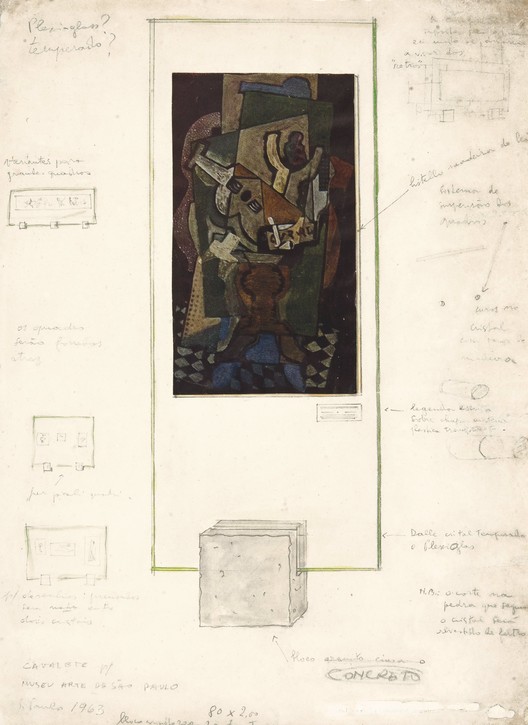
“Rethinking the Museum”, the second part, reviews Lina's involvement with MASP, starting from its original location on Rua 7 de Abril, owned by Diários Associados (the media group of businessman and patron Assis Chateaubriand, MASP's founder), highlighting the iconic building on Avenida Paulista and its radical picture gallery with glass easels. It also revisits her educational proposal and her vision of a social function for the museum, which included organizing exhibitions that desanctified artworks and exhibition designs, and establishing the Institute of Contemporary Art (IAC).
The chapter also traces the architect's experience in Bahia, where she created the Museum of Modern Art (MAM-BA) in the ruins of the fire-damaged Castro Alves Theater, and the Museum of Popular Art at Solar do Unhão—a building whose staircase, constructed using traditional oxcart wood-joining techniques, became legendary in the history of Brazilian architecture. It was in Bahia that Lina fully embraced popular culture, an experience that led to exhibitions such as Bahia no Ibirapuera (held in 1959 at the site that would later host MAM-SP), Nordeste (which inaugurated Solar do Unhão in 1963), and A mão do povo brasileiro (opened in 1969 at MASP on Avenida Paulista).
The final part of the exhibition and book, “From the Glass House to the Hut”, examines Lina's career as a designer. Her path began with a strong influence from European modernism, evident in projects like the Glass House (Casa de Vidro)—her first built work and her residence until her death. Over time, she incorporated references from Brazilian popular culture and vernacular construction techniques, elements that can be seen in projects such as the Valéria Cirell House, the Espírito Santo do Serrado Church, and SESC Pompéia, one of her masterpiece projects.
At MASP, where it will be held in the first basement level, Lina Bo Bardi: Habitat will run from April 4 to July 28, alongside the exhibition Tarsila Popular on the first floor, and Djanira: a memória de seu povo, which opened on March 1 and runs until May 19.
_Museu_de_Arte_de_São_Paulo_-_Perspectiva.jpg?1554155612)
50 Years of ‘A mão do povo brasileiro’
Lina Bo Bardi: Habitat also marks the 50th anniversary of MASP opening to the public. Inaugurated on November 7, 1968, in the presence of Queen Elizabeth II, the building only opened its first temporary exhibition on April 7, 1969: A mão do povo brasileiro, organized by Lina Bo Bardi in collaboration with Glauber Rocha, Martim Gonçalves, and Pietro Maria Bardi. Representing, in a way, the culmination of the architect's previous experiences, as Tomás Toledo notes, the exhibition brought together carrancas (ship figureheads), religious imagery, cowboy attire, and everyday objects. It served as a manifesto for the architect, showcasing her rejection of artistic hierarchies and her vision of the museum as a diverse, multifaceted space. Just like herself. In Mexico and the United States, Habitat will feature glass easels displaying works from MASP's collection, as well as a partial reconstruction of A mão do povo brasileiro, an exhibition previously restaged by MASP in 2016.
Catalogue
Published in Portuguese, English, and Spanish, the book Lina Bo Bardi: Habitat will compile essays by the exhibition's three curators: Tomás Toledo, chief curator of MASP; Julieta González, artistic director of Museo Jumex in Mexico City; and José Esparza Chong Cuy, an architect and former curator at the Museum of Contemporary Art Chicago (MCA) who is currently the executive director and chief curator of Storefront for Art and Architecture in New York.
Richly illustrated, the catalogue includes archival materials, translations of selected writings by Lina Bo Bardi, and essays by Adriano Pedrosa, Antonio Risério, Beatriz Colomina and Mark Wigley, Esther da Costa Meyer, Guilherme Wisnik, Jane Hall, and Luis Castañeda.
The 352-page catalogue can be purchased at MASP Loja, the museum's gift shop, which is free to enter without an exhibition ticket. Prices: R$ 139 (paperback) and R$ 159 (hardcover).
LINA BO BARDI: HABITAT
Opening: April 4, at 8 pm
From March 5 to July 28, 2019
Location: first basement level
Address: Avenida Paulista, 1578, São Paulo, SP
Hours: Wednesday to Sunday: 10 am to 6 pm (ticket office closes at 5:30 pm); Tuesday: 10 am to 8 pm (ticket office closes at 7:30 pm)
Tickets: R$ 40 (general admission); R$ 20 (half-price)
This article was written by Victor Delaqua. The translation is powered by AI.
