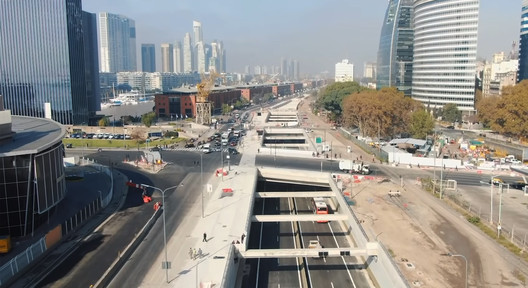
On Monday, the Paseo del Bajo was officially inaugurated: one of the most highly anticipated—and expensive—infrastructure projects in Buenos Aires in recent years.
Alongside international efforts to address urban mobility, the project presented by the government of the Autonomous City of Buenos Aires in April 2016 aimed to connect the Buenos Aires-La Plata and Illia highways through a corridor along Eduardo Madero-Huergo and Alicia Moreau de Justo avenues. This involved construction work spanning 7 kilometers.
Related Article: Luxembourg to Become the First Country in the World with Free Public Transit
The urban design of the proposal not only featured a sunken-trench and viaduct highway exclusive to trucks and long-distance transport, reshaping mobility throughout the area, but also pedestrian spaces and new public plazas designed to reorganize the chaotic traffic in the city's downtown waterfront. Accordingly, the strategic pedestrian crossing is centered on the historic Plaza de Mayo site, where a grand staircase now connects the Casa Rosada to Puerto Madero at the foot of Santiago Calatrava's Puente de la Mujer.
Related Article: 100 Notable Public Spaces: From Plazas to Urban Parks
Social media buzzed not only to celebrate the opening, but also to point out unfinished details—excused as standard post-completion touch-ups—while also highlighting irregularities in the awarding of contracts.
Related Article: Public Transit May Be Poor, But It Will Never Improve by Favoring Private Vehicles.
We take this opportunity to reflect on the role of mobility in contemporary cities, and we invite our readers to share their thoughts in the comment section below.
This article was written by Fabian Dejtiar. The translation is powered by AI.

