
Pavilions have been a key typology in architectural history. Their flexibility and ephemeral nature have allowed architects to unleash their imagination, breaking away from established canons. Each generation has taken the baton, pushing boundaries even further. From demountable structures to spaces that foster a democratic spirit, we look back at the history of Argentine pavilions and reflect on their importance.
The Argentine Pavilion in Paris
In 1889, commemorating the centennial of the storming of the Bastille, the Paris World's Fair (Exposition Universelle) was held in France. The event aimed to showcase global technological, artistic, and cultural advancements, with participating nations displaying their achievements in innovative pavilions.

Previously, Latin American nations had been forced to share pavilions. On this occasion, however, Argentina had the opportunity to present an independent pavilion. The Argentine government commissioned French architect Albert Ballu to design a structure that would showcase the progress of the young nation.
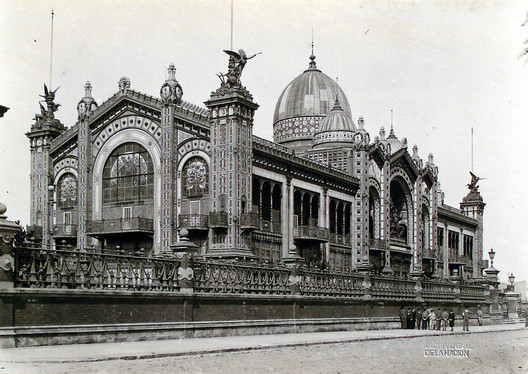
The pavilion received an award, as did the urban plan for the city of La Plata, which won two gold medals in the "City of the Future" and "Best Built Achievement" categories.
.jpg?1556285388)
Thanks to the advancements of the Industrial Revolution, the structure was built of iron and designed to be disassembled. Consequently, once the exposition ended, the pavilion was easily relocated to Argentina.
Due to an economic crisis, the government considered dismantling the structure and auctioning it off in parts. However, Francisco Seeber, the mayor of Buenos Aires at the time, prevented this catastrophe.
.jpg?1556285053)
In 1893, the pavilion was erected in front of Plaza San Martín. Over the years, its highly flexible structure allowed it to serve various purposes, including hosting the Buenos Aires National Exhibition and housing the National Museum of Fine Arts (Museo Nacional de Bellas Artes).
Unfortunately, in 1933, the pavilion was demolished by order of Mayor Guerrico to expand Plaza San Martín.
The Centennial Pavilion
Located on Cerviño Street and Bullrich Avenue is what was once the striking pavilion built to represent the Postal Service at the Railway and Land Transport Exhibition, held as part of the 1910 Centennial of the May Revolution.

Designed by architect Virginio Colombo and built by architect Pedro Vinent, the pavilion was awarded a gold medal for its outstanding design.

Today, its past glory lies buried under dust, rubble, and cracks. Is this the price of neglect, or a reflection of the present?
Over the years, citizens recognizing the pavilion's importance have fought for its preservation. Fortunately, the structure is now part of the national historic heritage, and a few months ago, a competition was launched to restore it. Hopefully, it will soon recover all its former grandeur.

Palermo Exhibition Pavilion
In 1966, Amancio Williams made waves by introducing his iconic "umbrella" shells (bóvedas de cáscara), a typology that would become a milestone in Argentine architectural history. This design was featured in the exhibition pavilion for the Bunge y Born corporation, built in the fairgrounds now known as La Rural.


Beneath these shells, a column-free, beam-free space housed the exhibition areas. Williams pushed boundaries, creating an unprecedented work of architecture.


Williams' "umbrellas" did not disappear after the exhibition ended; instead, they stood the test of time and continue to inspire architects today.

The IX BIAU Temporary Pavilion
Diego Avendaño, Juan Manuel Balsa, David Sebastián Coffio, and Francisco Figueroa Astrain were the authors of the winning proposal for the temporary pavilion of the IX Ibero-American Biennial of Architecture and Urbanism (BIAU) 2014 in Rosario.

Much like the historic Argentine Pavilion, the design featured a demountable structure—in this case, made of scaffolding—to allow for flexibility of use, addressing a challenge that architects have faced for over a century.

Horizontal Vertigo
At the 16th Venice Biennale, the team led by Pablo Anzilutti, Federico Cairoli, Francisco Garrido, and Javier Mendiondo broke the mold, representing the country with their proposal titled Horizontal Vertigo.
.jpg?1556284591)
By channeling the vastness of the Pampas, the Argentine pavilion presented a horizon that invited reflection on the democratization of public spaces, equality, dignity, and humanity. Is this where we are headed? Let us hope so.
.jpg?1556284646)
This article was written by Mariana Etulain. The translation is powered by AI.


.jpg?1556284591 "Argentine Pavilions Through Time")
.jpg?1556284646 "Argentine Pavilions Through Time")
.jpg?1556284615 "Argentine Pavilions Through Time")


.jpg?1556285388 "Argentine Pavilions Through Time")


.jpg?1556285053 "Argentine Pavilions Through Time")



