Argigram is a project that explores the possibilities of developing a local version of the future, presented as an exhibition from July 23 to September 8 at the Mar del Plata Museum of Contemporary Art (MAR). Curated by Martin Huberman, the exhibition focused on the production of nine cities for the 2050-2100 period, where various architects from Argentina had the opportunity to study and test territorial relationships, aesthetic tensions, and cultural developments to reclaim the creative and cultural sovereignty of Argentina's future.
The future is then a fertile territory to be dominated, and within it, countless battles and struggles for its sovereignty can be fought. Those who do not have the means or resources to consolidate a future of their own have no choice but to be carried along by the futures of others.
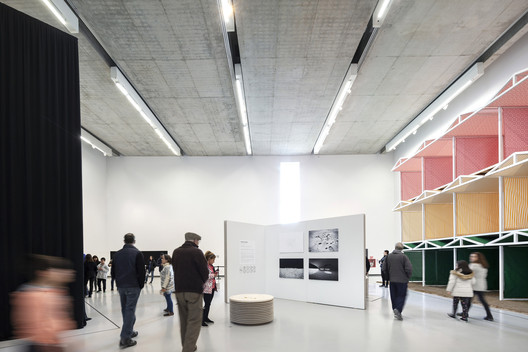
The exhibition finds its linguistic connection and historical precedent in the spirit of Archigram, a 1960s British student collective that built its notoriety by advocating for the future. As such, the exhibition manifests as an effort to reclaim the creative and cultural sovereignty of Argentina's future.

- Related Article:
"Argigram Opening: Argentine Cities of the Future (2050-2100)"
1- Moon City / Diego Arraigada “The Moon City”
The Moon is pure landscape, perhaps the only landscape humanity has shared since its origin: we see the same moon that the first humans saw. A project for the Moon must be, first and foremost, a landscape project that dialogues with its perpetual state. For any intervention on the Moon, we propose to begin by mirroring the concave geometry of the craters to materialize lightweight, convex domes—highly structurally efficient in low lunar gravity—that define and protect interior spaces.

Viewed from above, their shadow will be similar to that of the original crater, but inverted. It is an open system that pairs craters with domes, studying their sizes and configurations to generate opportunities for clustering and habitable spaces. Extensive lunar topographic data will help determine the best location options for domes of various sizes and clustering conditions.

From Earth, the interventions will be almost imperceptible, and the Moon will remain just as it has always been. There are only subtle anomalies: some craters have mirrored shadows.

2- Border City / Alarcia-Ferrer “Border Oasis”
“The border is the territorial zone of social transition between two cultures.” Throughout history, borders between countries have fluctuated in their configuration because their origin was the result of an arbitrary imposition or an extraordinary event, rather than a natural segregation between diverse cultures. In many cases, this artificial division led to the border being characterized as a territory of tension.

In this context, border cities offer an opportunity to address this conflict in a specific way. Reconfiguring borders through a deep understanding of territory and culture is perhaps the challenge for cities in the years to come. The border will cease to exist as a boundary, transforming instead into a complex layering that enriches and enhances its location—the boundary, or the boundary condition, as a catalyst and space of opportunity. Furthermore, the border should not be conceived as a singular situation, but rather as a continuum of variables. There is no “single” border, but rather a succession of diverse elements nearing the boundaries, interwoven and connected with one another.

3- Exile City / Manuel Pablo Cucurell “Exul”
The word exile comes from the Latin exsilium, derived from exul, which means a wandering person. Since the beginning, its cities were “The City of Exile”—an unplanned, non-consensual byproduct of that complex, chaotic, volatile, and strange cultural kaleidoscope of which we are both products and producers. Its cities, those grids designed to colonize infinity, were always a beautiful collage of memories turned into stone. Nostalgia and longing are part of the genetic code of every Argentine, and thanks to them, the melting pot remains a defined whole, albeit with fuzzy edges.

Now that human activities are completely detached from space, and we can move from one point of the planet to another in a matter of seconds, anchored only to time, we Argentines remain that cluster of longings and nostalgias. I inhabit a city that is also conceived from constellations of memories.

In this new city, the concepts of center and edge are obsolete, as are those of scale and continuity. Both spaces and objects fluctuate, expanding or compressing, linking or fragmenting, as the memories from which they are born and nourished are imprecise and cannot yet be measured—much like how dreams work. This new city materializes as an infinite space where I can wander freely in my own desire to RETURN.

4- Seaside Resort City / Monoblock “Alta Carpa”
Resort cities are the playground of work cities. They have sand at the edge of the sea, serving as a metaphor for softening the hard ground. The extent of the resort city's perimeter is crucial to giving each citizen a piece of fantasy-landscape, where the idea of the individual gazing at the natural horizon is recreated. However, the amount of perimeter that guarantees the space needed to stage this scene is insufficient for all the aspirants who seek to become natural subjects again during the summer migration.
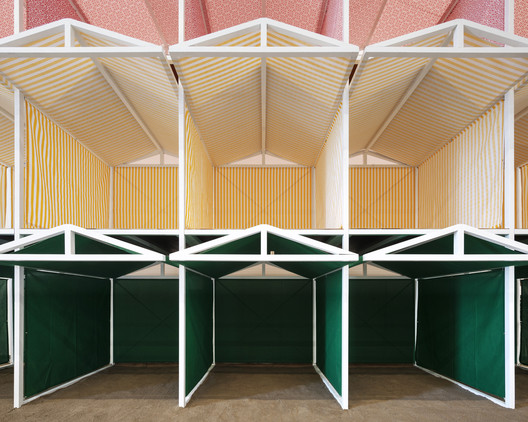
Buildings just meters from the coast. Beach clubs meters from the sea. Private sandy enclosures with plots marked off by ropes. Tents with neighbors in numbered plots and circulation corridors. Plastic lounge chairs, two per tent. How much more can the resort city resemble our inevitable way of being together?


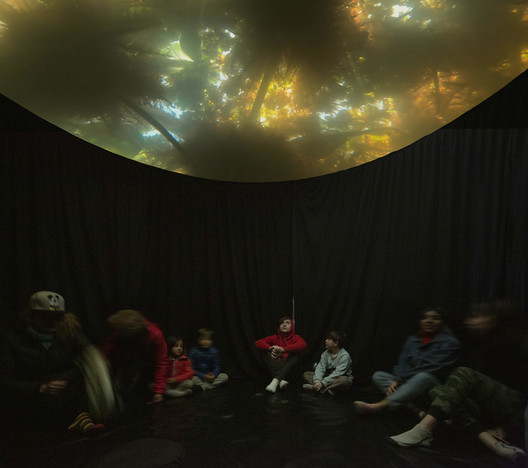
5- Exploitation City / Sustantivo Colectivo “Camalotopía”
While we—educated, believing ourselves capable, holding some share of power—sought at every opportunity to change, order, and guide the city and its inhabitants to the best of our understanding, the city itself multiplied, thriving like a massive, redundant machine, consuming and spilling over itself again and again.
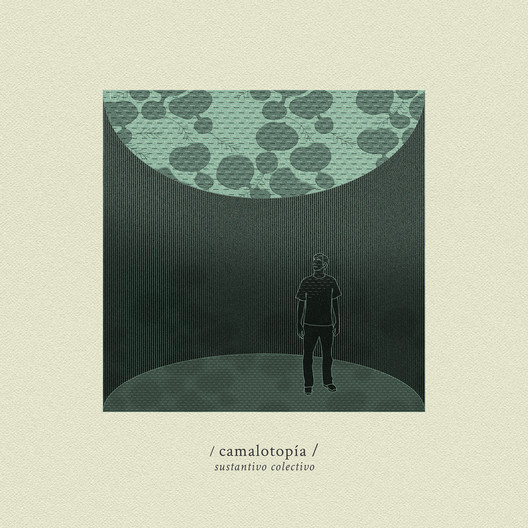
Perhaps by virtue of simply being, the islander was able to preserve the certainty we forgot: in the landscape, nothing is left to chance. There is a deep, transversal time that sustains all things, and in the dance of multiple, dispersed forces, there is a law of harmony that tolerates no rupture. Nature speaks in its ancient, absolute language. The exploitative city abounds in corridors and crossroads. Occasionally, a glimpse of horizon and sky, deep yet intimate, exposes the illusion of individuality: in the inexhaustible concert of nature, the self is merely an idea, because to be in the landscape is to be the landscape, and to look at the landscape is, ultimately, to look at oneself.
6- Natural City / Ana Sol Smud “Return to the Low City”
The mythical sunken city of Ys retains a remarkable influence over our arts and culture. Every version of the story agrees that a prosperous and sophisticated city known as Kêr Ys (the low city) was built in time immemorial on the shores of the Atlantic, on land reclaimed from the sea and protected from the constant tides by an eminent dike.

Almost all who recount the myth of Ys maintain that the low city, right by the sea, will return one day. However, in the cities of the future, it is highly likely that no one will strive too hard to subdue the unleashed forces of nature. Sooner rather than later, we will stop building dikes or breakwaters, and digging canals or drains to control external nature. In the same way, we will no longer create families or institutions, nor erect panopticons or courts to contain internal nature.

A natural city must be an open city. Without access points, walls, ideas, or laws to limit it in any way. At every moment, buildings and passersby will have to allow themselves to be swept through by winds, waters, desires, and fears, never offering resistance. Like the remains of marine creatures and the damp sand of the beaches where they lie, the builders of such a city and the natural world in which they are immersed will no longer find each other unbearable.

7- City City / BAAG “City - City”
In the city-city, architecture has been taken to extremes; there is a public world and a private one. Private space is intimate, utilitarian, basic, minimal, and sufficient. Public space is social, artificial, vast, and complex. Having been exploited and depleted, the territory was liberated, and the city-city became independent of the ground. Public space emancipated itself from the private, reorganizing and precisely defining its limits.

The city-city is concerned with its horizon, planning itself only on its horizontal plane. It remains mindful of its connections, avoiding any margin of polarization that would put its system at risk. Private life takes place in vertical buildings. These buildings are connected by transparent tubes, and it is within them that life with others occurs—a new, defined public space, aseptic and artificial. There is no doubt where one begins and the other ends.

The city-city is concerned with its own sustainability and imagines technologies to meet new demands. Its citizens are hyper-connected, all geolocated, each with an identification of the level to which they belong. Within it, there is diversity of class, gender, religion, and culture, but always enclosed within the unity of the glazed tubes. The city-city desperately seeks to consolidate an identity, even though its practices, lifestyles, and consumption are globalized. The city-city has its successes, flaws, virtues, and clear contradictions. This is how it feels alive.

8- Informal City / Ana Rascovsky (Supersudaca) “The Decoded City”
The city we know today was born from a dual circumstance: the transformation of the city's physical form due to climate change, and the failure of the new urban code, due to its bureaucratic and confusing nature. In 2019, Argentina had 4,300 informal settlements (villas), and there were two ways of inhabiting the capital city: the formal, historical city, regulated since its founding; and the other—self-managed, fragmented, organic, and opportunistic—which, fueled by environmental chaos and the ingenuity of its inhabitants, overcame and absorbed the old city.

Currently, the urban configuration must protect the population from solar radiation. High temperatures, heat waves, heavy rains, and rising sea levels modified the urban fabric, making the use of the ground floor difficult for housing and traditional transport. The private and community appropriation of airspace served as an urban solution to restore shade and freshness to the streets.
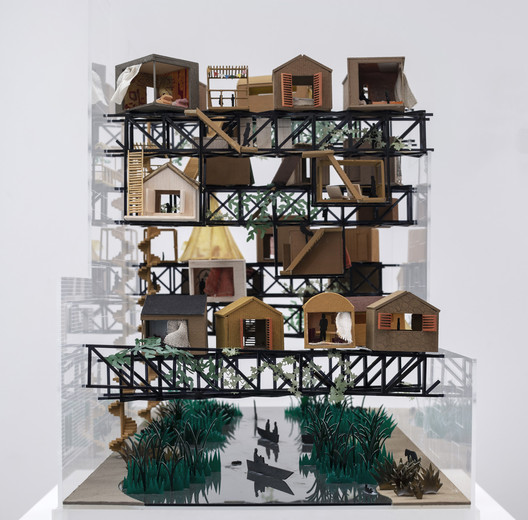
The democratic community created by social media technology enabled peer-to-peer (P2P) agreements to validate each micro-agreement, shaping the current common space network—the REC. Through this common network (privatized by its component parts), all COSs are linked (COS is the name for the former co-workings and co-livings, which are currently the only way to live). Notarized contracts do not exist; all rentals are seasonal. Current urban well-being depends on a community connected by digital technology and human physical power.

9- Satellite City / IR arquitectura “Satellite”
Common sense—that which allows us to function as a large human macro-organism—was disconnected for a long time. Just as we compensate with other senses when one is lost, being limited in our ability to build collectively, we compensated by sharpening our fear, which led to a pathological drive to accumulate. It became clear that comfort was the hardest drug.
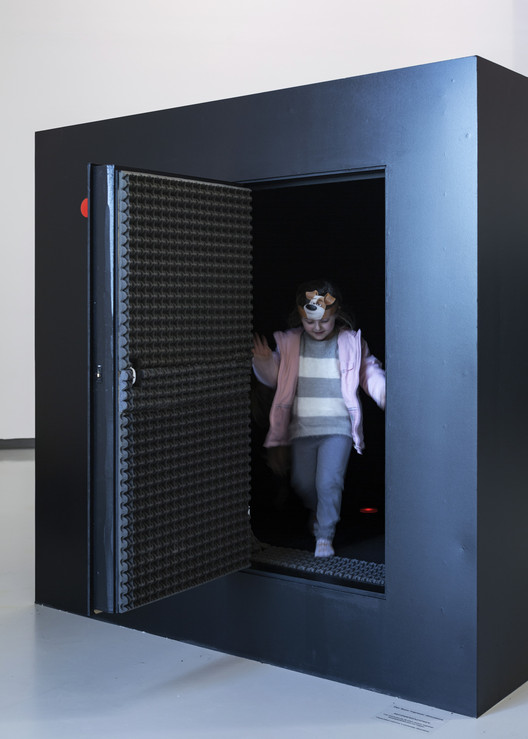
The emergence of efficient communities threw governments into crisis. The necessary invention of resource-regulating systems brought a new level of efficiency to the human experience: excess was regulated by scarcity. Today, our cities are no longer machines for production. Ambition is not what organizes our ecosystem.

Satellite cities, formed by gated communities and their precarious mirrors, were true laboratories. Demolishing the perimeter walls generated new modes of organization. The next step was regrouping in non-urbanized territories, forming villages capable of efficiently managing local resources. Over time, residents of the central city joined this movement, leaving large portions of the urban fabric vacant. Ultimately, this led to the definitive reorganization of the central cities. Reestablishing common sense was a slow process. Through deliberate introspection, we found the key to collective intelligence. For the first time, we were able to ask ourselves how we wanted to live.
This article was written by Belén Maiztegui. The translation is powered by AI.