



In 2014, a group of friends from Ciudad Juárez, Chihuahua, eager to contribute to their city's resilience and recovery process, came together to discuss and share ideas for reclaiming streets, plazas, and parks through sociocultural projects and urban interventions in public spaces. This is how Nómada Laboratorio Urbano was born. Ciudad Juárez is an industrial city located on the northern border with the United States, directly across from El Paso, Texas. Over the years, Juárez has been economically dominated by the “maquiladora” manufacturing industry and was once considered one of the most violent cities in the world due to a wave of crime between 2008 and 2012.

After experiencing the social isolation triggered by this violence, Nómada Laboratorio Urbano began by focusing on ephemeral and pop-up interventions designed to capture the attention of citizens who were starting to return to the streets, encouraging them to reclaim their role as active participants in public spaces. Over time, Nómada's experimentation evolved toward implementing participatory art and design strategies, tactical urbanism, and placemaking, with the vision of growing the urban laboratory through community collaboration and participation.

For decades, the maquiladora industry has dominated industrial activity in Ciudad Juárez, serving as the main driver of economic development in this border community. While the maquiladora industry has provided significant employment and economic benefits to the local population, it has also sparked a broad debate over the management and treatment of materials and waste that are discarded once they have served their purpose.

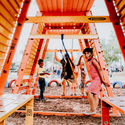
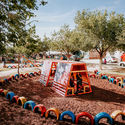
To address this issue, Nómada Laboratorio Urbano was contacted by a ladder manufacturing company to design a strategy for reusing fiberglass beams that accumulate over time and are classified as non-hazardous industrial waste. Once received and restored, the material was tested through participatory design workshops with neighborhood committees seeking to add playful elements to their parks and public spaces. Through these processes of innovation and social engagement, the team decided to build a prototype for shading and play furniture that could be replicated in various communal areas.

The result was “LúdicA”: a playhouse that provides shelter from the sun—highly necessary in desert cities—and a space for children's recreation and social interaction. As a replicable project, “LúdicA” has the great advantage of not requiring specialized labor for its assembly, and it can be easily reconfigured to suit the desires and needs of specific communities. Thanks to this urban experiment, the project successfully influenced the reshaping of public policies and strengthened the maquiladora industry's social commitment to the community.
Learn more about the studio here.
This article was written by Mónica Arellano. The translation is powered by AI.


