Few names fit the label of “cult writer” as perfectly as Raymond Queneau, who boasts a fanatical following of near-militant devotees of the cause: literature as a very serious game. From the outset, and even upon the most cursory reading, Exercises in Style, written by the French author in 1949, is radically different from conventional literature. The book positions itself—or pretends to—in a kind of no-man's-land between literary theory and practice, giving the impression of having been crafted based on the chapters of a style manual. Queneau rejects any preconceived schema that might have grouped the “exercises” by theme, gradual complexity, or simple alphabetical order. He does not even work from a single baseline text. At times, he opts for a purely mechanical game of textual transformation to produce a sense of sheer nonsense.
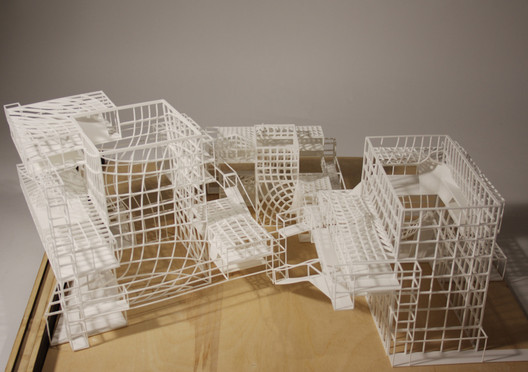
It is no wonder that this seven-decade-old book still feels revolutionary and remains an essential manual in literary programs. What Queneau showed us then—that playful, mocking creative freedom—remains difficult to match today. For this reason, such an exercise in variation, of refusing to set limits on the imagination, is and must be compatible with the craft of architectural model-making. What Queneau demonstrated, starting with an unremarkable text and transforming it 99 times, is precisely what any architect should attempt to translate into their model-making. It is the art of variation and accumulation—“difference and repetition,” as Gilles Deleuze would say. It means working 99 times on the same idea, watching it transform until, at some point, we are able to recognize its ultimate synthesis.