
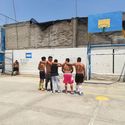

The “LA DOCE” court is a collaborative project, part of a network and a proposal for change born from the need to develop quality public spaces in marginalized areas of various cities worldwide. Soccer is one of the most beloved, widely played, and perhaps most followed sports globally. It is a way to connect with ourselves and others.
Participating, observing, and coming together are activities that allow us to look beyond the obvious and everything surrounding the sport; soccer thus emerges as a social construct, a pastime that fosters connection through play, an event that does not distinguish between social classes and grants those who take part in the moment the opportunity to unite as a team, to be part of something larger than themselves.

The ideas outlined above serve as the foundation for the collaborative project Cancha “LA DOCE,” which aligns with the mission and vision of love.fútbol. For 20 years, this non-profit organization has facilitated the restoration and recovery of disused sports courts in marginalized urban areas worldwide through the management and sponsorship of various entities, restoring quality public space to the communities involved.

This concept led to the collaboration between love.fútbol and All Arquitectura—the former as the promoter, the latter as the architect—with the support of Novaceramic. On this occasion, project development began with sponsorship from English Premier League soccer club Manchester City. Engaging local partners is central to love.fútbol's work; consequently, NATLIK, a local non-profit, was brought in as the community intermediary.

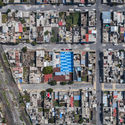
Located in the municipality of Valle de Chalco, State of Mexico, the project returns a vital space to one of the most marginalized and violent areas east of the Mexico City Metropolitan Area (ZMVM). Valle de Chalco serves as a destination for many indigenous groups from all regions of the country—a commuter town that highlights one of the most complex challenges of contemporary cities. This melting pot of origins poses a unique challenge for building a collective identity and shaping the community's relationship with its space.

As a result, “LA DOCE” embodies collaboration, coordinated effort, and a partnership of designers, architects, artists, civil organizations, and neighbors. Through a convergence of ideas and social action, the project aims to foster integration within a fractured community.

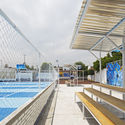
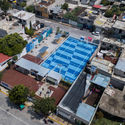
The project is conceived as two independent spaces that, rather than being experienced in isolation, are linked by the activities they host. A 15m x 25m court serves as the compositional axis and core of the project, reoriented along a North-South axis to maximize its use throughout the day. Situated between Sur 11 and Sur 12 streets, the site connects both roads, allowing pedestrians to use the space as a pathway that aligns with daily foot traffic through the site and surrounding areas.

An open pavilion anchors one of the court's edges. Under a large roof structure, it houses an administrative area, storage, restrooms, and a boxing gym, alongside a multipurpose space for workshops, classes, and exhibitions that can run at any time of day regardless of the weather. This pavilion also connects neighboring lots—an abandoned library and a vacant plot—with the long-term goal of integrating both into the project. A concrete platform, a remnant of the original court, has been repurposed as a large public plaza where artistic performances can showcase the diverse ethnic backgrounds that shape Valle de Chalco.
The design features a large permeable area that allows rainwater infiltration to recharge the historic Xico Lagoon. The project responds to the shifting needs of a region historically significant to the City and the Valley of Mexico, which, through its people and character, remains an ever-present, indomitable, yet always welcoming periphery.
Credits
Design and execution team: Josemaria Quintanilla, Salvador Guardado, Alejandro Guardado, and Eduardo Ugalde
Lighting design: Brenda Castillo García
This article was written by Mónica Arellano. The translation is powered by AI.


