.jpg?1538415823)
.jpg?1538415966 "© Carlos Díaz")


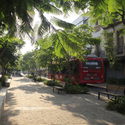
Plazoleta Amo Torres is a project by Echauri Morales in collaboration with Corporación Planen. Located in downtown Guadalajara, Jalisco, Mexico, the intervention comprises a series of urban design gestures aimed at revitalizing the area along Hidalgo Avenue at its intersection with Santa Mónica Street, directly in front of the Corona Market.

Hidalgo Avenue is one of the primary arteries crossing Guadalajara from west to east. As it approaches the historic center, however, it becomes highly pedestrian-oriented, connecting key landmark buildings and public spaces such as the Corona Market, the Government Palace, the Cruz de Plazas, and the Cathedral. Located on this avenue within the city's historic core, this municipal market is highly significant to the region and holds deep traditional value for the local population. Previously, a vehicular tunnel entrance sat directly in front of the building, forcing visitors to navigate narrow sidewalks around the tunnel portal. Through this intervention, the space was reclaimed for the city, creating a public plaza in front of the market.

Commissioned by the Ministry of Infrastructure and Public Works (SIOP), the project sought, from the design perspective of the architectural firm Echauri Morales, to implement a series of interventions to make the space more welcoming for pedestrians, utilizing urban furniture and measures that prioritize foot traffic over vehicles.

Implemented actions:
Cities are currently witnessing a wave of projects that draw on Jan Gehl’s human-scale urbanism or Jaime Lerner's urban acupuncture. These approaches are increasingly gaining traction, providing sufficiently open and flexible spaces for people to reclaim and interact. Though sometimes subtle, these gestures create gathering points that act as natural surveillance, significantly reducing safety concerns in specific areas.
Plazoleta Amo Torres aims to weave existing historical value with contemporary lifestyles tailored to its context, breaking down spatial barriers to create shared spaces that embrace social dynamics. Only through this approach can we create public spaces with deep enough roots to successfully evolve alongside the communities that rewrite them every day.


This article was written by Mónica Arellano. The translation is powered by AI.

.jpg?1538415771 "Urban project transforms Amo Torres Plaza in Guadalajara")


.jpg?1538415786 "Urban project transforms Amo Torres Plaza in Guadalajara")

.jpg?1538415823 "Urban project transforms Amo Torres Plaza in Guadalajara")


