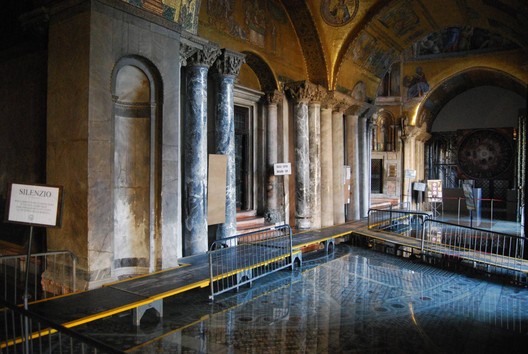
As Europe's second most visited built heritage site, behind only the Colosseum in Rome, St. Mark's Basilica in Venice receives over 5 million visitors annually. Yet, under the strain of this massive influx, the 11th-century Byzantine mosaic floors seem to be succumbing to the effects of the floating city's tides.
The undulations in the basilica's floor are visible to the naked eye—feet have not touched them for a decade, as visitors are only allowed to walk on synthetic carpet runners—and they have even cracked at the most critical points, especially in the center of the building. Currently, only 20% of the geometric marble and stone patterns are original; the rest has been restored over the last ten centuries by the artisans of the St. Mark's Workshop.
Reported by the Italian press as a building on the verge of collapse, St. Mark's condition is indeed critical, but not that extreme, says Mario Piana, who is responsible for the church's conservation. The architect leads a project that aims to protect the cathedral from the force of the sea. Currently, when the tide rises, saltwater from the Venetian Lagoon is carried through underground storm drains and floods St. Mark's Square, the lowest point in the city.
The project led by Piana is simple, at least in theory, and involves waterproofing the drains and installing five valves to prevent tidal water from reaching the square's surface. According to the architect, implementing the proposal will reduce flooding in the cathedral's narthex (entrance). The other sections of the church—the nave, aisles, and presbytery, which sit at a higher level—have only flooded on November 6, 1946.
Simple on paper, but complex in practice, like any project involving a building of this significance and age. However, Piana is frank about the basilica's condition and what can actually be done: “It suffers from a wide variety of forms of decay affecting the marble, stone, and mosaics. We continue working to counter this deterioration. It cannot be cured, only mitigated.”
Source: El País.
This article was written by Romullo Baratto. The translation is powered by AI.
