Datong Twin Towers / Plasma Studio

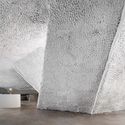
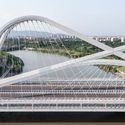
Plasma Studio’s newest project in China, a bold angular set of towers, speaks to the firm’s geometric obsession. The project was recently awarded first prize in an invited competition in Datong, Shanxi province. The mix-use complex, measuring of 70,000 m2, will include a hotel in one tower and offices in the other. Running along a highly trafficked street, the towers create a strong presence along the streetscape and are pulled away just enough from the site’s edge to provide places for pedestrians and greenery.
More about the awarded project after the break.
Shijiazhuang Convention Center / Woods Bagot

Recently awarded first prize, Woods Bagot’s vision for the Shijiazhuang International Exhibition and Convention Center will be manifested in a sleek faceted glass tower that rises from smaller geometric exhibition halls. The master plan is designed to uplift the city’s coastal area, which is currently underdeveloped, by attracting tourists and locals to the entire complex for different programmatic activities.
More images and more about the master plan after the break.
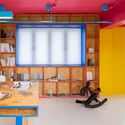
Apartment 3E / Vector Architects

Architects: Vector Architects
Location: Beijing, China
Partner in Charge: Chien-Ho Hsu
Project Area: 265 sqm
Project Year: 2008
Photographs: Chien-Ho Hsu
New Ideas for Ordos 100 / Ordos 20+10 / Plasma Studio

Previously, we have covered the Ordos 100 project quite extensively, giving you an inside look at the Inner Mongolia development. Back when Cai Jiang proposed the initiative to build one hundred 1000sqm villas designed by 100 up-and-coming architects in a mere 100 days, most questioned if the project was a hoax while others felt the development’s free-for-all attitude would not yield a unifying strong result. Yet, even with these concerns, the 100 firms responded to Herzog & de Meuron and Ai Wei Wei’s invitation to design the villas and transform a barren land. However, this development took quite an unexpected twist.
Read more about the project after the break.
In Progress: Nanjing Museum of Art & Architecture / Steven Holl

Special thanks to our reader, Vivian Bratone, for sharing some insight to Steven Holl’s newest museum project with us. Situated in Pearl Spring near Nanjing, China, the museum is only a part of the Chinese International Practical Exhibition of Architecture (CIPEA) complex. The CIPEA project is a complete collaboration of architects from across the world, from Italy to Japan, and Mexico to Croatia. Upon completion, the complex will include more than a dozen buildings that will house exhibits for arts and culture.
More about Holl’s project, including a set of Bratone’s images, after the break.
Qingdao Exhibition Center / NBBJ

The first phase of the Qingdao Water City development at Aoshan Bay, designed by the Los Angeles office of NBBJ, will include a new exposition center of 1,940,000 sf. As the ocean sits to one side of the site, and a wetland on the other, a strong emphasis has been placed on how the exposition is shaped by its interaction and proximity to the water.
More images and more about the exhibition hall after the break.
German Pavilion / Shanghai 2010 Expo
Here’s another great time lapse video from Seppe, this time walking us through the German Pavilion in Shanghai designed by Schmidhuber + Kaindl GmbH (more Shanghai coverage here). Entitled Balancity, the pavilion is designed by Lennart Wiechell and at 6,000 m2, it is the country’s largest structure at any exposition. The building’s geometric mass was conceived as a three dimensional sculpture and the form wraps certain spaces which showcase different aspects of Germany. As you can see in the video, the pavilion includes a central energy source, a factory-like section, an opera and cultural section, and even a park. The areas show Germany’s technological progressions and products meant to help solve urbanization problems, and visitors slowly glide past certain installations on moving walkways. Unlike other countries’ pavilions that seem to work off of one cohesive theme, the German pavilion seems much more “busy” – it is a conglomeration of many different ideas and products with lots to see at each turning corner. What do you think of Balancity?
Check out other videos Seppe has shared with us like his British Pavilion time lapse or his Denmark Pavilion video. Full list of credits after the break.
Update: Shanghai Apple Store / Bohlin Cywinski Jackson by Roy Zipstein

As we reported earlier last week, Bohlin Cywinski Jackson’s newest Apple store (and China’s first!) opened on July 10. For the past five years, photographer Roy Zipstein has been documenting the stores, traveling to America, Europe, Asia and even Australia to highlight the artistry of the sleek structures. Similar to how it takes a certain kind of architect to manifest Apple’s aesthetic and technological philosophy in built-form, it takes a certain kind of photographer to capture that essence on film. Zipstein commented via Bernstein&Andriulli, “The Apple Stores are so beautifully designed, inside and out. It’s been very interesting to witness the design process evolve over the last few years, through the use of different materials such as glass, stainless steel and stone, and the evolving interpretation of the interior space. Having the architects present at some of these shoots and being able to exchange thoughts with them has been an added bonus for me.”
We’re excited to share Zipstein’s latest photographs from Shanghai! And, be sure to see our previous set of images thanks to Flicker user Lesh51.
Shanghai United Nude / Rem D. Koolhaas

Back in 2003, young Dutch architect Rem D. Koolhaas (nephew of “the” Rem Koolhaas) teamed with seventh generation shoemaker Galahad Clark to launch United Nude, a stylish shoe brand rooted in conceptual design, elegance and innovation. Since then, the brand has been quite successful, selling in over 35 countries, and recently, Koolhaas opened a flagship store in Shanghai. Similar to New York’s Fifth Avenue, or Paris’ Champs-Élysées, the store is situated in Shanghai’s prestigious retail strip and the flashy design draws all the attention to the shoes.
More about the store design after the break.
Brittle / Nicolas Fayad

Recent Harvard graduate, Nicolas Fayad, was awarded the Boston Society of Architects’ James Templeton Kelley Prize, an honor recognizing the most successful graduating project. Fayad’s “Brittle”, a School of Arts, is an exploration of responsive and adaptive form. Fayad’s programmatic elements have been organized and molded in response to the changing typography of Chongqing, China – making the design quite flexible as it can easily adapt to any change of land within the city.
More about the awarded design after the break.
Shanghai Apple Store / Bohlin Cywinski Jackson

Similar to their identifiable products, the Apple stores require a sleek, almost instantly recognizable, aesthetic. As keepers of the latest technology, the buildings’ minimalist interiors boast a calm and sophisticated demeanor, complimenting, yet not overshadowing, their prized possessions. It may come as a surprise that the leading architects behind the stores are Bohlin Cywinski Jackson (BCJ), a firm that had never designed a retail store before Apple and whose principal, Peter Bohlin, winner of the AIA Gold Medal, ironically doesn’t use email.
Bohlin has awed us in the past, especially with Apple’s second Manhattan retail store located on Fifth Avenue. Turning a tough retail space into a successful masterpiece, the store’s iconic cube, a 32-foot glass structure, marks the store’s entrance and beckons customers down to the retail level which is illuminated with natural light. And now, BCJ has just unveiled their latest Apple store, and the first of its kind in China which seeks to emulate similar design decisions as the Fifth Avenue project.
James Corner Field Operations to design Qianhai

We’ve heard a lot about James Corner Field Operations particularly due to the High Line in New York. But, now the firm is taking their talent across the world to China where they have just won the prestigious Urban Design Competition to design a new major city, Qianhai. The firm placed ahead OMA/Rem Koolhaas, BLAU Architecture and Urbanism, Bjarke Ingles Group, and SWA among dozens of others for the win.
The Waterhouse / Neri & Hu Design and Research Office

Located on the banks of the Huangpu River in the historic dockyard district and in the vicinity of the 2010 World Expo site, The Waterhouse at South Bund is rooted in an inversion of internal & external spaces. Shanghai-based Neri + Hu Design and Research Office (NHDRO) have transformed a non-descript 1930s riverside building into a modern expression of Chinese aesthetics. This architectural intervention enhances the building’s industrial presence, while outfitting the interior with the ammenities of a luxury hotel.
More about the hotel after the break.
Automobile Museum in Nanjing / 3Gatti Architecture Studio

“The house is a machine for living in.”
- Le Corbusier
With this statement, Le Corbusier acknowledges the relation between technology/mass production and the new ways of living that the modern movement tried to materialize. For him the house was a static car, a designed functional object that could be mass produced. When the Villa Savoye was completed in 1929, 5.3 million cars were produced in Detroit.

From this point forward, architecture and car started a long lasting relation, with examples such as Albert Kahn’s buildings for Ford, Giacomo Matte-Trucco’s FIat Factory in Turin, Archigram’s Drive-In House concept, the Mecedes Benz Museum by UN Studio and the recent Lincoln Rd 1111 parking by Herzog & de Meuron.
Along this line we find the new Nanjing Automobile Museum by 3Gatti Architecture Studio, which was awarded with the first prize on an international invited competition. The project not only shows the car in an unusual way, but it also lets you to experience the museum by car:
In Progress: Shenzhen Stock Exchange by OMA tops out

We first heard about the new Shenzhen Stock Exchange (SSE) building by OMA during the peak of the new chinese construction revolution. Then we saw Rem Koolhaas breaking ground together with the Chinese government, and capitalism in China started to have a tangible representation.
The new building for the NASDAQ equivalent (730 high tech companies & startups, moving over US$500 billion) has now topped out at 246m.
“For millennia, the solid building stands on a solid base; it is an image that has survived modernity. Typically, the base anchors a structure and connects it emphatically to the ground. The essence of the stock market is speculation: it is based on capital, not gravity. In the case of Shenzhen’s almost virtual stock market, the role of symbolism exceeds that of the program – it is a building that has to represent the stock market, more than physically accommodate it. It is not a trading arena with offices, but an office with virtual organs that suggest and illustrate the process of the market.”
- OMA
The project is based on pure volumes, a combination of a tower and a podium suspended 36m high. The podium is one of the biggest cantilevers in the world, an operation that liberates the ground to create a big public plaza which is visually connected (representing the new economic openness) to the lower part of the tower and the podium itself, the places were the stock exchange operations take place. Above the podium, there is a series of office space for internal operations of the SSE, totaling 200,000sqm for the entire building.
The tower’s structure is a robust exoskeletal grid overlayed with a patterned glass skin – the first time such glass has been used for an exterior at this scale. The patterned glass reveals the detail and complexity of construction while creating a mysterious crystalline effect as the tower responds to light: sparkling during bright sunshine, mute on an overcast day, enigmatic at dusk, glimmering during rain and glowing at night.
- OMA
The building is expected to be completed by August, 2011.
Renderings afte the break:
Horizontal Skyscraper / Steven Holl

Our friend and architecture photographer, Iwan Baan , just published on his website some of his recently shot images of Steven Holl’s Horizontal Skyscraper in Shenzhen, China . The project is a long mixed-use complex which includes office spaces, apartments, a hotel and even a public landscape. Baan’s photos illustrate Holl’s idea that the “building appears as if it were once floating on a higher sea that has now subsided; leaving the structure propped up high on eight legs.”
Complete photoset at Iwan’s website, more images and more about the project after the break.
Spa by MTM Shanghai / PAL Design

- © Courtesy of PAL Design
Architect: PAL Design Consultants Ltd, Patrick Leung
Location: Shanghai, China
Photographs: Courtesy of PAL Design
Xi Shui Dong Sales House / Kokaistudios

Architects: Kokaistudios
Location: Shanghai, China
Collaborators: Andrea Destefanis, Filippo Gabbiani, Li Wei, Song Qing
Local architect: Shanghai Zhongfang Architectural Design Institute
Project Year: 2009
Area: 3,400 sqm
Photographs: Panda of VA-PHOTO
British Pavilion / Shanghai 2010 Expo
We’ve been covering the Shanghai 2010 Expo a lot on ArchDaily, and our reader Seppe shared some videos of the pavilions with us. Today, we’re featuring a cool video on one of our favorites, the UK Pavilion (be sure to read about the project featured previously on AD) and be on the look out for more videos contributed by Seppe this week.
Highstreet Loft / Kokaistudios

Architects: Kokaistudios
Location: Shanghai, China
Collaborators: Andrea Destefanis, Filippo Gabbiani, Li Wei, Puikie Wu
Local architect: Shanghai Xiandai Design Institute
Area: 38,800 sqm
Project Year: 2006
Photographs: Charlie Xia
Columbarium at Sea / Tin-Shun But
With the world’s population growing exponentially, by 2030 there will be such a drastic shortage of land that there will be “no room for the dead” in several over-crowded cities. Tin Shun But’s columbarium in Hong Kong is a reaction to the growing population and the growing demand for land. The design offers a new typology where the resting ground is anchored to the harbor, currently a neglected area with the potential to become a revitalized public space.
More images and more about the design after the break.