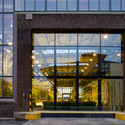
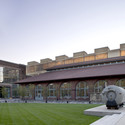
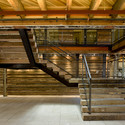
Urban Outfitters Corporate Campus, designed by Meyer Scherer & Rockcastle transformed four dilapidated historic buildings in Philadelphia’s Navy Yard, into an award winning adaptive reuse headquarters. The Anthropologie, Free People, and Urban Outfitters retail brands’ design studios and offices are housed within each building. A campus commons and services’ offices are efficiently shared among the different divisions of the company. This project received a 2010 AIA Honor Award for Architecture.
Follow the break for a video discussing the site and design featuring Urban Outfitters, Inc company founder Dick Hayne. More photographs, drawings, and project description after the break as well.
Architects: Meyer, Scherer & Rockcastle, Ltd.
Location: Philadelphia, Pennsylvania, USA
Principal-in-Charge: Jeffrey Scherer, FAIA
Project Manager: Josh Stowers, AIA, LEED AP
Interior Designer: Leanne Larson, CID, IIDA, LEED AP
Client: Urban Outfitters, Inc
Total construction cost: $100 million
Project Area: 285,000 sqf
Project Year: 2006
Photographer: Lara Swimmer Photography


Site
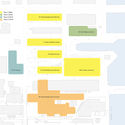
Located at the confluence of the Delaware and schuylkill Rivers, the Navy Yard served as a ship building and repair facility from 1868 through 1996. Decommissioned, it’s 187 buildings were abandoned. in 2004, the 1,000-acre National Historic District was master planned for redevelopment an evolution from public ownership to private use.
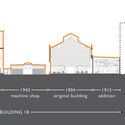
When Urban Outfitters, inc., first considered the site, the existing structures were dilapidated. Despite the decay, the soul of the Navy Yard spoke to the company’s founder, Dick Hayne. He purchased four historic buildings, with an option on one, that were constructed from 1880 through 1939.


Project
Urban Outfitters, a clothing and housewares retailer, was the first major non-ship building corporation to move to the Navy Yard. The design including building documentation and renovation was completed within 23 months. Using the Federal Historic PreservationTax incentive Program,the client invested over $100 million in the 285,000 square-foot project.


Outcome
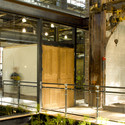
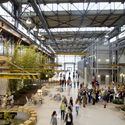
The buildings once operated to produce naval vessels, alternating between construction, repair, and even scrapping decommissioned ships.The design centers on utilizing the factory characteristics of the buildings industrial materiality, open volumes, and access to daylight to repurpose the buildings’ major function from production to creativity. The synthesis of four measures art, culture, economy, and environment results in the transformation from a public, production based yard to a private, creativity based one.


Project Team: Garth Rockcastle, FAIA, Principal, Tom Meyer, FAIA, Principal, Will Jensen, AIA, Alan Hillesland, AIA, Dan Vercruysse, LEED AP, Coco Dugan Early, CID, IIDA, Carla Gallina, Brig Balgobin, Lynn Barnhouse, CID, LEED AP, Kate Bergquist, Julie Elsenpeter, Olawale Falade, Carl Gauley, Alex Haecker, AIA, Jessica Harner, LEED AP, Brent Holdman, Bill Huntress, AIA, Byoungjin Lee, LEED AP, James Moore, Jack Poling, AIA, LEED AP, Steven Rothe, CID, Michael Stickley, Kristilyn Vercruysse, Mark Whitenack, Sousan Yaghi
On-site Representation, Associate Architects: H2L2 Architects Planners, LLC
Interior designer: Meyer, Scherer & Rockcastle, Ltd.
Mechanical/Electrical Engineers: Paul H. Yeomans, Inc.
Structural Engineer: Meyer, Borgman, and Johnson, Inc.
Civil Engineer: Advanced GeoServices
Landscape: D.I.R.T. Studio
Lighting: Meyer, Scherer & Rockcastle, Ltd.
Detailing Consultant: Jim Larson
General contractor: Blue Rock Construction, Inc.
Renderings: Meyer, Scherer & Rockcastle, Ltd.
- © Lara Swimmer Photography
- section
- diagram
- diagram
- diagram
- floor plans
- urban context


This is a dream office…..
nice to see that historic substance is preserved –
but pumping a huge 100 mio. dollars into this just to show how trendy this company is , having a few hip girls running around with the rest of the space just stuffed with fancy furniture .. this really annoys me!
It’s nice to see that although this is an expensive proposition, you’re providing a work space that inspires creativity and is true to your brand. The decorating, meeting spaces, filing systems, etc scream free people. I bet URBN is a good company to work for. Kudos for creating this work space while preserving it’s historical presence.
The corner solution is not clean plus the woodplanks are getting wet, why to show such an immage?
What do the knock off Eames chairs say about the Urban Outfitters corporate culture?
This is textbook stuff about refurbishing without destroying… both the original industrial architecture and the Urban Outfitter culture are so strong – here they each exist with clarity and I suppose one could say that the eclectic ethos of Urban Outfitter is quite suited to the strangely eclectic freneticism of the building snaking services and industrial necessity. Very refreshing to see the corporate world lay provision and comfort for their staff, like Vodafone, Santander, etc.. and maybe Bourneville and Port Sunlight before them. What is more it is visually stunning and stimulation… nice one…
Well deserved winner of the Building of the Year award!
Projects like this the re-energize and give new life to old buildings are the future of our industry. Our building stock will inevitably age and how we deal with it as a culture will shape our society.