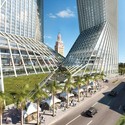
The mixed-use Campus Center designed by Oppenheim Architecture + Design for Miami Dade Community College will make a statement within the skyline of the tropical city. Popular for its flowing spaces from interior to exterior, the architects capitalized on Miami’s climate creating an open-aired campus design complete with arcades, quads, and plazas. The design incorporates a variety of materials and sustainable practices including a steel frame exo-skeletal system, clad and aluminum with clear glass aluminum window wall system, solar panels in portions of the roof, and vertical shafts wind turbines.
Here you can check out our interview with Chad Oppenheim founding partner of Oppenheim Architecture + Design featured last week on ArchDaily.
More details, drawings, and photographs about the Campus Center by Oppenheim Architecture + Design after the break.
Architects: Oppenheim Architecture + Design Location: Miami, Florida Project Team: Chad Oppenheim, Carl Römer, Eduardo Quintero, Carlos Ramos, Germán Brun, Juan López, Sebastian Velez, Robert Moehring, Gianpaolo Pietri, Helen Zhao, Hugo Mijares, Joshua Sacks, Lizmarie Esparza, Francisco Llado, Piero Valtolina, and Santhosh Shanmugam Developer: Gregg Covin Development Client: Miami Dade Community College Project Area: 2,500,000 sqf Project Year: Estimated Completion 2012 Renderings: Dbox and Olalekan Jeyifous
From the architects:

‘The dramatic design set forth for Campus Center is visually daring and bold; yet upon further introspection, inherently elemental and concise in its organization of the complex programmatic mix. The proposed LEED® certified structure is conceived of as a portal comprised of a base and a top supported by two towers that allow large exterior public spaces at ground and in sky. The project is to serve as a catalyst-exasperating significant enhancement to the campus experience and image through a local revitalization of the surrounding neighborhood.
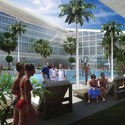
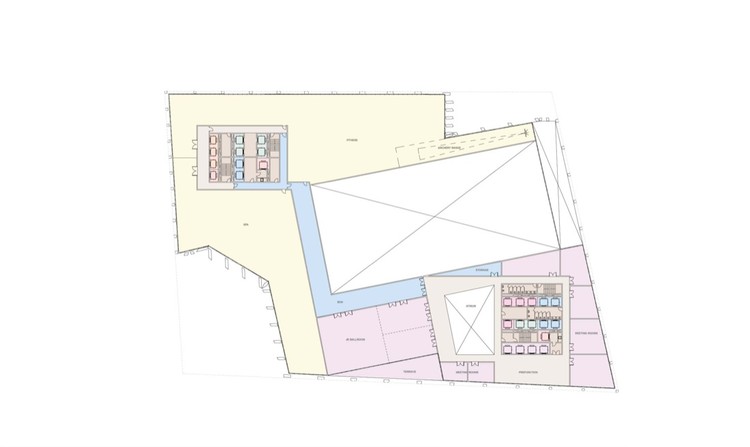
The project’s mass is sensitively sited to respect its immediate context– establishing a friendly pedestrian experience of plazas, quads, and arcades that provide space for the enjoyment of life. The form, an extruded quadrangle, is carved to maximize openness, flow of activity, and views through the large contoured center. The proposed project is a mix-use building that, in addition to housing the College’s 250,000 SF Center, will include 146,400 SF of two-level street fronting commercial space wrapping the entire base of the building as well as a 41,000 SF open-air campus “Arts Quad” on the third level– that serves as the main distribution level to various programmatic components of College. The project also incorporates a 250,100 SF office component; a 60,000sf meeting facility, a 40,000 SF athletic center, a 798,551 SF residential component with 1,142 small studio, and one-bedroom rental units; and a 300 key, 268,400 SF full service mid-range hotel. The parking garage is proposed to be completely underground, innocuous to the above ground functions. The underground parking structure accommodates 1,700 vehicles in 428,289 SF including the loading/ service zone for a total project area of 2,504,912 SF.

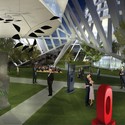
To enhance and support the activity and excitement of the campus “Arts Quad”, pedestrian entrance points are accessible via minimal ground floor lobbies and monumental stairs (and adjacent escalators). These access points lead to the central “Quad”, where the urban fabric and the fabric of the campus are stitched together in a dynamic public space of grand yet humane proportion. Vibrancy at the street level is supported by the proposed Bookstore, House of Blues Restaurant, House of Blues Theater and other significant retail stores that ensure a seamless continuity of street level shops and businesses support a continuous stream of pedestrian interchange. The underground loading/service zone for direct and discrete access limits noise, odors, and interference with non-service related functions.

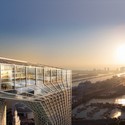
The Campus Center is fully integrated with the building and serves as the projects heart and soul. Organized around the 3rd level Quad-the various cultural components (Museum, Sculpture Garden and Theater) of the College are fully engaged from this vantage point. A sloping landscaped plan provides a natural auditorium and opportunity for various cultural activities (spontaneous concerts, and nighttime cinema). Additional college program is stacked directly above the quad with large exterior congregational terraces serving to activate the overall collegiate experience. The size and proportions of the two 35-level towers are dictated by the inherent requirements of residential and office typologies above. An Athletic Center and Meeting Facility are located on the 40th Level and unite both the East and West Towers at the top. Above the meeting rooms is the “Sky Quad” (Lobby) that additionally serves all programmatic elements within the complex. Organized around this garden in the sky are 3 levels of Hotel and 2 levels of large residential Penthouses. Located above the Penthouses are the building’s mechanical areas with farms of wind turbines and solar hot water collectors that provide the tri-generation power system and add to the overall sustainability of the project.


The buildings exterior is a pure expression of structure where veins of steel create an elegant exoskeletal system increasing building efficiency while eliminating the need for massive shear walls aside from the core. The skin of the building is an impact resistant, energy efficient glass window-wall system that provides ample daylight and the opportunity to appreciate the natural and manmade beauty.’