


Business School and Teaching Complex / FJMT + Archimedia

Uploaded by — Filed under: Educational ,Selected , , , ,
 

© John Gollings

Architects: Francis-Jones Morehen Thorp in association with Archimedia
Location: Auckland, New Zealand
Project Manager: Beca
Builder: Fletcher Construction Company
Structural & Civil Engineering: Beca
Façade Engineering: Connell Wagner
Project Area: 84,000 sqm
Project Year: 2007
Photographs: John Gollings & Andrew Chung

Our inspiration for this project was drawn directly from the fusion of natural landscape, urban form and heritage of cultural exchange and flow that characterise this beautiful site at the edge of the campus, overlooking Auckland Harbour and the Auckland Domain. Prior to modern development this landscaped valley used to be known for the stream, Waipapa that flowed directly into the Harbour, and it was near this stream that early European settlers traded with the Ngati Whatua tribes. An equal inspiration was the ambition of the University to create a new centre for learning, innovation, a place of knowledge exchange and collaboration for future leaders.

level 02 plan

© John Gollings

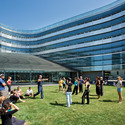
We developed architectural forms that open through a series of organic flowing ribbons in a gesture of invitation, outreach and optimism, gathering the energy of the site into a major new public square. These layered glass and stainless steel planes are carefully composed to orientate and join the forms and internal volumes of the new building to significant landscape elements. The central atrium and internal gathering space is directed out between the two largest ribbons to connect with the natural landscape of the Auckland Domain, the northern figural ‘head’ is turned to look directly towards the Harbour and Rangitoto Island while terminating the axial vista of Wynyard Street.

These organic and flowing forms are suspended above a solid podium that anchors the building and reinterprets the natural topography of the immediate sloping site. This counterbalancing podium form is joined spatially with the suspended ribbons at the atrium heart of the new complex, interconnecting the shared teaching spaces with the workplace, learning and social spaces of the Business School.

© John Gollings

The fluid and open architectural expression provides a strong contemporary counterpoint to the traditional insular European buildings that characterized the beginnings of the University. A powerful new symbol of research and knowledge, it provides an appropriate international projection for the School that values excellence, innovation, progress, and openness, welcoming and embracing the Auckland community.

The ribbon forms are created through layers of stainless steel and glass, incorporating a suspended external, glazed shade-panel of titanium inter-layers. This layered façade system ventilates, shades and mediates glare while orientating the internal workplaces to light and views of the Harbour and landscape.

© John Gollings

Within the solid podium are the principal teaching spaces and computer labs, with the main publicly accessible lecture theatres placed in a position of prominence at the podium edge. The podium of basalt and pre-cast panels provides appropriate screening and insulation to these sensitive areas, filtering controlled natural light through protected openings and skylights to characterise and articulate the learning experience.

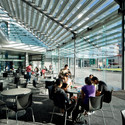
At the centre of complex are two interconnected spaces that create a sense of scholarly community. A welcoming forecourt or open square that is defined through the gentle curve of the embracing forms, and the central atrium which connects vertically all levels of the building complex. Suspended within this atrium are the social-hub bridges that form the collegial focus for informal gathering and exchange on platforms that are busy points of interaction looking out to the beautiful natural landscape of the Auckland Domain.

* Location to be used only as a reference. It could indicate city/country but not exact address.
 
 
Thumb up Thumb down 0
Archie Tecture says:

As an architecture student at this university, the Business School is a poor copy of the successful Kate Edgar Commons on campus. The outside courtyards are barren and often empty and the building turns its back on Grafton Street with a monolithic podium with no reference to any scale. Disappointing…

 
# May 6, 2010 at 07:39
Thumb up Thumb down 0
Luis says:

I saw that building, i was living there when it was made.

 
# May 6, 2010 at 08:49
Thumb up Thumb down 0
TM says:

“Almost cool” building in my opinion. I don´t know New Zeland landscape, but I guess good attention to the outside areas lacks in this building. I like the plans and good points of view could have been explored. Don´t like the middle roof for the cafe and the amount of glass seems kinda oppressive.
It´s a pity, as I first looked at the small picture and thought it was a great building. Almost there.

 
# May 6, 2010 at 10:05
Thumb up Thumb down 0
Yorik says:

Of course I don’t know about the surroundings and the scale is certainly huge, but the overall “movement” of the thing is pretty cool… A good proof of the importance of dynamics in architecture… The energic “waves” of the plan are very present in the interior spaces, if you look through the windows you feel it all around, at least looking at the pictures it appears so

 
# May 6, 2010 at 10:27
Thumb up Thumb down 0
c-dub says:

Yorik, how is this a “proof of the importance of dynamics”? I agree, this a very dynamic design, but how does it prove the IMPORTANCE of dynamics? In other words, do you think this building somehow makes the point that less dynamic buildings are less important?

 
# May 6, 2010 at 11:51
Thumb up Thumb down 0
isometric boy! says:

40-50 mm focal lenght please!

 
# May 7, 2010 at 01:57
    Thumb up Thumb down 0
    c-dub says:

    Great comment.

     
    # May 7, 2010 at 14:13
      Thumb up Thumb down 0
      HAG says:

      in fact, there is not 90° angles there, so, the main photography its not so much distorted

       
      # May 7, 2010 at 19:49
      Thumb up Thumb down 0
      c-dub says:

      @HAG: Look at the elevations. All right angles.

       
      # May 7, 2010 at 19:53
    Thumb up Thumb down 0
    jj says:

    I think the outreaching glass flanges are impressive, but nonetheless excessive. It seems the emphasis is put on the form and expression of details rather than quality of space. When walking through, you don’t feel the grandeur of a ‘business school’ instead you get lost in a the scaleless and mundane interiors.

     
    # May 7, 2010 at 19:15
Thumb up Thumb down 0
arnold says:

a huge complex of glass and steel. the architects had realy good and nice Idea; but after all realization, the Idea has lost somewhere between glass and steel walls.

some views of this building are realy very good, but some of them.. well in some points of perspective, the building looks too much heavy (massive) like steel and glass monolith.

but generally this building is interesting. very good advertisement for glass factory :-).

 
# May 7, 2010 at 06:12
Thumb up Thumb down 0
Alexander says:

Nowadays everyone is a hater…hey the simple fact that architecture is beginning to grow out of the box and is starting to free-flow is reason enough to give thunmbs up to these architects…but noooo there’s gonna be always someone to be a smartass about things….

 
# May 7, 2010 at 10:09
Thumb up Thumb down 0
nibe says:

what about the cost? tons of expensive details everywhere. can this world still afford this luxuries?

 
# May 7, 2010 at 13:06
    Thumb up Thumb down 0
    HAG says:

    no, where moving again to the caves

     
    # May 7, 2010 at 19:48
Thumb up Thumb down 0
kevin c says:

I agree with TM-almost there
based on the provided photographs
the surroundings seem to be pretty bland in contrast to the building-a lost chance for some superior landscape architecture. Though the run-off materials at the edges help to reduce scale by blurring -this must have been challenging to get past the value engineering process-not to mention the maintenance people. Probably required a zillion detail drawings, hope it was fun…
still seems to look better from a distance

 
# May 7, 2010 at 21:10
Thumb up Thumb down 0
alec c says:

The UOA business school (won as a result of a limited competition in 2004-2005, i think) is a pre-conceived Australian design foisted onto a NZ context. The site, sadly, is not a great one and the immediate surroundings are a motorway to the east and a hodge-podge of small and large scale UOA buildings on the other 3 sides. Look carefully at the site photo above. It’s like a corporate office building looking for a green-field site. Most of the time the ‘public spaces’ are wind swept and empty. The hint about the maintenance are correct. It is costing a fortune both to clean and to operate. NZ’s ‘green’ image exposed again. Such a wasted opportunity. The unsuccessful Architectus scheme should have won but NZers too insecure to accept that a NZ firm could have won a competition.

 
# May 8, 2010 at 03:00
Thumb up Thumb down 0

2:44 PM Sep 14th

Reading: "Business School and Teaching Complex / FJMT + Archimedia | ArchDaily"( http://twitthis.com/m77uev )

Thumb up Thumb down 0

8:27 PM Dec 7th

Business School and Teaching Complex / FJMT + Archimedia | ArchDaily http://t.co/4Wke6mn via @archdaily

Thumb up Thumb down 0

11:25 PM Dec 25th

Business School and Teaching Complex / FJMT + Archimedia | ArchDaily http://t.co/31X0lea via @saree_arth

Thumb up Thumb down 0

6:28 PM Apr 11th

Love the architectural movement of this Business School of the future #architecture #design http://t.co/un7zSmx via @archdaily

Leave a Reply »


Latest Comments »

Viipuri Library[+]
The building is an essay in how not to design a civic...[+]
one of the best of him.. but a huge complex needs more images & details.[+]
Riola Parish...[+]
Hey even i want to visit this place.[+]

Upcoming Architecture Events »

got events? invite us! click here

Architecture Books & Magazines »

Combinatory Urbanism: The Complex Behavior of Collective Form

Combinatory Urbanism: The Complex Behavior of Collective Form

Thom Mayne recently sent us his latest book, Combinatory Urbanism: The Complex Behavior of Collective Form.  MIT Professor of Urban Design and Landscape Architecture, Alan Berger, hails this book as “nothing short of a tour de force and should be…


A Peripheral Moment

A Peripheral Moment

This book is an account of the highly productive decade of architectural experimentation in Croatia lodged between the violent break-up of Yugoslavia and their slow integration into the EU. Ivan Rupnik guides the reader through the emergence of this


Strategy Space / a+t: Landscape Urbanism Strategies

Strategy Space / a+t: Landscape Urbanism Strategies

Landscape Urbanism is the new black in architecture and this magazine, part of a+t strategy series, has heads turning. There are a dozen projects and hundreds of ideas in this edition. A recurring them is the manipulation of time…


Our partners »

AD on iPad via Pulse

Browse by date »

Browse by category »

Friends »