





- Area: 325 m²
- Year: 2007
-
Photographs:Kurt Hoerbst
Text description provided by the architects. Context: Bangladesh is a fertile alluvial land in the Gulf of Bengal and the land with the highest population density in the world. On average nearly 1000 people live in every square kilometre and over 80% of the population live in rural areas. Much of the vernacular built tradition uses earth and bamboo as a building material, however, construction techniques are error-prone and many buildings lack foundations and damp proof coursing. Such buildings require regular mainte- nance, are often prone to damage and last on average only 10 years.

Project aims: It is particularly important to improve the quality of living in the rural areas in order to counteract the continuing popula- tion migration to the cities. The primary potential for developing building in the rural areas is the low cost of labour and locally available resources such as earth and bamboo.
The project’s main strategy is to communicate and develop knowledge and skills within the local population so that they can make the best possible use of their available resources. Historic building techniques are developed and improved and the skills passed on to local tradesmen transforming in the process the image of the building techniques.

Concept and Design: METI aims to promote individual abilities and interests taking into account the different learning speeds of the schoolchil- dren and trainees in a free and open form of learning.
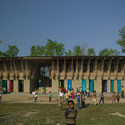
It offers an alternative to the typical frontal approach to lessons. The architecture of the new school reflects this principle and provides different kinds of spaces and uses to support this approach to teaching and learning. On the ground floor with its thick earth walls, three classrooms are located each with their own access opening to an organically shaped system of ‘caves’ to the rear of the classroom. The soft interiors of theses spaces are for touching, for nestling up against, for retreating into for exploration or concentration, on one’s own or in a group.
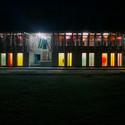
The upper floor is by contrast light and open, the openings in its bamboo walls offering sweeping views across the sur- roundings, its large interior providing space for movement. The view expands across the treetops and the village pond. Light and shadows from the bamboo strips play across the earth floor and contrast with the colourful materials of the saris on the ceiling.

Building construction and techniques: The building rests on a 50cm deep brick masonry foundation rendered with a facing cement plaster. Bricks are the most common product of Bangladesh’s building manufacturing industry. Bangladesh has almost no natural reserves of stone and as an alternative the clayey alluvial sand is fired in open circular kilns into bricks. These are used for building or are broken down for use as an aggregrate for concrete or as ballast chippings. Imported coal is used to fire the kilns.
Aside from the foundation, the damp proof course was the other most fundamental addition to local earthen building skills. The damp proof course is a double layer of locally available PE-film. The ground floor is realised as load-bearing walls using a technique similar to cob walling. A straw-earth mixture with a low straw content was manufactured with the help of cows and water buffalo and then heaped on top of the foundation wall to a height of 65cm per layer. Excess material extending beyond the width of the wall is trimmed off using sharp spades after a few days. After a drying period of about a week the next layer of cob can be applied. In the third and fourth layers the door and window lintels and jambs were integrated as well as a ring beam made of thick bamboo canes as a wall plate for the ceiling.

The ceiling of the ground floor is a triple layer of bamboo canes with the central layer arranged perpendicular to the layers above and beneath to provide lateral stabilisation and a connection between the supporting beams. A layer of planking made of split bamboo canes was laid on the central layer and filled with the earthen mixture analogue to the technique often used in the ceilings of European timber-frame constructions.
The upper storey is a frame construction of four-layer bamboo beams and vertical and diagonal members arranged at right angles to the building. The end of the frames at the short ends of the building and the stair also serve to stiffen the building. These are connected via additional structural members with the upper and lower sides of the main beams and equipped with additional windbracing on the upper surface of the frame. A series of bamboo rafters at half the interval of the frame construction beneath provide support for the corrugated iron roof construction and are covered with timber panelling and adjusted in height to provide sufficient run-off.
Finishes and fittings: The exterior surface of the earth walls remains visible and the window jambs are rendered with a lime plaster. The framework constructon of the green façade to the rear is made of bamboo canes seated in footings made of old well pipe and with split horizontal timbers as latticework. The interior surfaces are plastered with a clay paster and painted with a lime-based paint. The ‘cave’s are made of a straw-earth daub applied to a supporting structure of bamboo canes and plastered with a red earth plaster. The upper storey façades are clad with window frames covered with bamboo strips and coupling elements hung onto the columns of the frame construction. A fifth layer of cob walling provides a parapet around the upper storey forming a bench run- ning around the perimeter of the building and anchoring the upper storey frame construction and roof against wind from beneath. A textile ceiling is hung beneath the roof is lit from behind in the evening. The cavity behind the textiles ventilates the roof space.

On-site labour using and training the local workforce: The masonry foundation was constructed by a company from the regional capital Dinajpur around 20km from Rudrapur. The earth building works and bamboo construction was undertaken by local labourers. The building techniques were implemented and developed on the job together with architects and tradesmen from Germany and Austria. 25 local tradesmen from the vicinity were trained during the building works creating new jobs and providing professional “help for self-help”.
Exemplary nature, transferability, follow-on projects: School handmade showcases the potential of good planning and design, from the arrangement of the building on the site to the realisation of aspects in detail. Furthermore it demonstrates the possibilities of building with earth and bamboo using simple methods as the continua- tion of a local rural building tradition and can serve as an example for future building developments in the area.

A stable foundation and a damp proof course are the primary technical prerequisites for building with earth, making the buildings last longer and reducing maintenance requirements. For smaller room spans, the newly developed bamboo ceiling construction can be made entirely out of local materials using handmade jute rope and bamboo dowelling.

METI, Modern Education and Training Institute: METI enables children and young people in the region to take classes up to the age of 14 and provides workshops for trade-oriented professions. The idea is to provide the rural population with access to good, holistically-oriented educa- tion. The children and young people are encouraged to develop into responsible, motivated and creative personalities and to use their skills to improve and develop their immediate rural environment. Reading, writing and arithmetic as well as languages are offered in a free environment and through open forms of learning. Meditation, dance and creative writ- ing are part of everyday learning at the METI School as are discussions, learning as part of a group and self-critical and social behaviour.

Dipshikha, Bangladesh: Dipshikha is an NGO dedicated to supporting development in the particularly poor regions of northern Bangladesh and has been active in this area for nearly 25 years. Paul Tigga, director of Dipshikha explains that the aim is to open up pos- sibilities in the villages to make people aware of the potential at home in an attempt to strengthen the region and reduce outward migration to the cities.
Shanti e.V. has been the German partner for Dipshikha since its foundation and supports the financing, planning and implementation of development and educational work. A central aspect of their work is the implementation of integrated village development programmes for education, health, strengthening the position of women in society, nutrition, agricul- ture and trade skills. Shanti also provides support in emergency situations and exchange and volunteer programmes. The PMK has supported METI for many years and was a partner for the school building together with Shanti and Dip- shikha.


