
M3/KG / Mount Fuji Architects Studio

Uploaded by — Filed under: Featured ,Houses ,Selected , , , ,
 

© Ryota Atarashi

Architects: Mount Fuji Architects Studio
Location: Meguro, Tokyo,
Site area: 177.27 sqm
Building area: 106.33 sqm
Total floor area: 259.72 sqm
Project Year: 2006
Photographs: Ryota Atarashi & Satoshi Asakawa

This is a house to be built in Tokyo, for a movie producer couple.

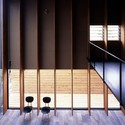
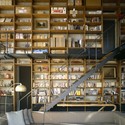
This architecture is consisted by combining L-shaped blocks of reinforced concrete and sequential frames of box-shaped engineer-. We put bedrooms, film archive and galley in solid concrete part for security, and living room in engineer- part for openness. As material that consist an open space that is 6m in height, 5.5m in width, 14m in depth, we choose thin engineer- (38mmx287mm).

exploded axo

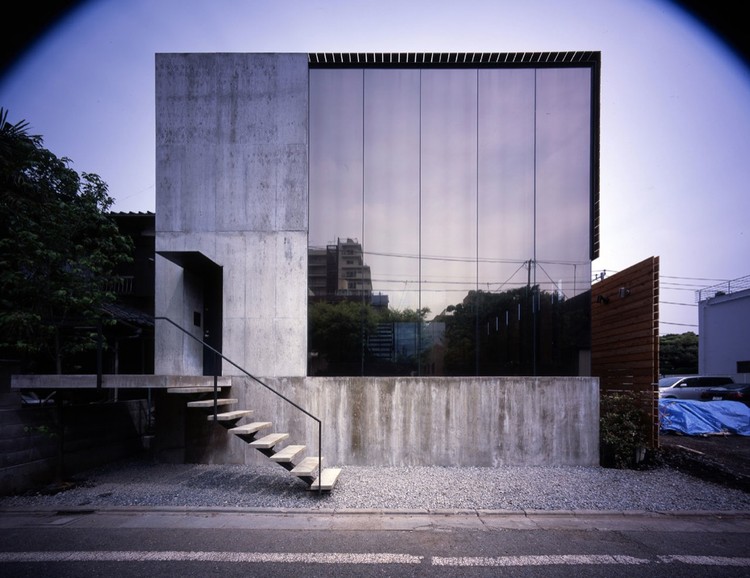
Main theme for this architecture is to bring out a sense of mass and material, which were denied by modern architecture which pursued “white, flat wall” as a style. We intentionally left the wood grain of mold on the surface of concrete, and choose textured stones and irons.

It goes without saying that a house is a relaxing place. A house like a white-cube, surrounded by flat, white walls everywhere, gives a person very abstract image. But that image could only be sensed when we use intellective part of our brain. The problem is that we’re not all-intellective-creature. For the people like this client, who do enough intellectual labor on a daily basis, white-cube would only bring sense of fatigue. The role of architecture, especially the ones for living, is to soothe the sensory side of people, not to stimulate the intellectual side. That’s my take.

© Ryota Atarashi

Sure, intellectual living would have got some meaning as a fashion at the time when modern architecture was born. However, now that it became a part of everyday life, its identity has been lost. We have to examine whether our approach is rational or not every time we build architecture.

Architecture as Dialogue

We do not subscribe to the assertion that “the city is a problem and architecture is the answer”. That point of view is a pure product of modern architectural theory, which as such weighs very heavily on today’s architectural education programmes: What are the problems running through the city? What answers can architecture offer them? School trains us in the acquisition of this method of questioning. Student evaluation is based on this conceptual and rational system of question and answer. And it is doubtlessly relevant, if limited to academic training; architecture on paper, devoid of substance, remains at a level of abstract purity that allows it to theoretically resolve the problem posed by the city.

© Satoshi Asakawa

But with real architecture it is quite anther matter. Indeed, even when it is designed as a pure answer, architecture realized, from the moment it imposes “mass” and becomes a built object, never manages to get beyond the “city=problem” equation. Because many architects have not grasped the obviousness of this, an incalculable number of buildings have sprouted in the urban landscape through the conscious application of the lesson learned: “problem-solution.” Unfortunately, the legitimate and equitable “answer” expected often winds up being nothing more than deplorable “urban filler”. For in using this approach, the concrete situation of the city is rendered abstract, theorised and formalised as problem and turned into a set of logical systems which will in turn administer a logical architectural answer. It is useless and unsightly to reintroduce these relationships defined through the filter of conceptual labels into the material world in the form of buildings. the resulting built architecture is merely a superfluous residue.

© Ryota Atarashi

We are doubtless the first generation to become aware of the reality of modernism’s limits. We sincerely and conscientiously avoid dealing with architecture through concepts as much as possible. For us, the city is from the outset imbued with “substance,” and the architectural process is the creation of “substance”.

© Ryota Atarashi

Therefore, we seek to manipulate these concrete relationships, as they are, in all their concreteness. The relationship between pre-existing city and future architecture is never envisaged in a unilateral way, as one would do when bringing an answer to a question, but rather as a continuous and balanced “dialogue” between the old and the new “substance.”
This is what makes our point of view so childlike.
To act upon things simply, so they will actually become what one would wish for.


Thumb up Thumb down 0
Michael says:

It must be my jaded ArchDaily eyes, but why do natural materials in a building seem so shocking these days?!
Ah, timber and stone. I’ve missed you.
Where have you been?

Seriously though, this is a fantastic little house.
Not just the materials, which are delightfully tactile, but also the volume and the structural expression.
It’s lovely.

 
# February 10, 2010 at 23:31
Thumb up Thumb down 0
CMO ARCH says:

Wonder how much each of those panes of glass costs?

 
# February 10, 2010 at 23:44
Thumb up Thumb down 0
SPUD says:

i agree, the honesty of the materials is refreshing.

 
# February 11, 2010 at 03:26
Thumb up Thumb down 0
... says:

I just want to point to the different qualities of the pictures:
- Ryota Atarashi: the classical photos of architectural composition > the elegance of architecture > (eventually) the beauty
- Satoshi Atarashi: the photos look like they’ve been taken by an amateur and that quality is all to rarely visible nowadays; I find this day-to-day-architecture quality visible in those photos may be more useful than the beauty… under present conditions anyway?

 
# February 11, 2010 at 05:03
Thumb up Thumb down 0
lunafuga says:

Soothing, beautiful and exciting at the same time.

I truly envy those who get to experience this piece of architecture.

 
# February 11, 2010 at 05:42
Thumb up Thumb down 0
kudz says:

awesome…BUT, toilet next to the kitchen?? c’mon japan, that aint a good look.

 
# February 11, 2010 at 05:59
    Thumb up Thumb down 0
    yeah says:

    Sorry to burst your bubble but this IS an individual single-family home = statistic rules of floor planning don’t apply here. I know many people who would prefer toilet next to kitchen and while I wouldn’t design it in a multi-family house I can totally understand such a wish from an individual client.

    BTW – those glass panels are simply incredible.

     
    # February 11, 2010 at 07:51
    Thumb up Thumb down 0
    Leonardo Ximenes says:

    Bundling wet spaces together saves money in plumbling and labor, and it’s an acceptable solution to smal areas.

     
    # February 11, 2010 at 13:02
      Thumb up Thumb down 0
      gk says:

      bundling wet spaces is fine, but the bathroom opens directly into the kitchen which is a big no no! would also have loved to see the bedroom connect with the open living space

      it is however fantastic project!

       
      # July 28, 2011 at 19:51
Thumb up Thumb down 0
Eddie McFuzz says:

nice project but the description could do without things like “Main theme for this architecture is to bring out a sense of mass and material, which were denied by modern architecture which pursued “white, flat wall” as a style”.

this a total mis-representation of modern architecture and it suggest great ignorance of the the subject. what modern architecture are you talking about? your accusation would apply to a handful of architects of the 20′s and 30′s and no more than that. your encompassing definition applies to nothing done from the end of WW2 up to now.

i suggest looking at the architecture and not to what critics say.

 
# February 11, 2010 at 08:48
    Thumb up Thumb down 0
    GT says:

    McFuzz, I think by “white, flat wall” as a style” maybe means the popular style in Japan now.

     
    # February 12, 2010 at 09:20
Thumb up Thumb down 0
randy says:

A very very nice project. real material, that age gracefully … i like this project on a lot of levels but its “denial” of industry construction technique is really my favorite. great project.

 
# February 11, 2010 at 09:07
Thumb up Thumb down 0
deZavent says:

i love that timber-glass combination…

 
# February 11, 2010 at 12:12
Thumb up Thumb down 0
Wes says:

The project has a really nice feel. The explanatory text is laughable. If they can render a building in concrete terms, why not be more verbally concrete? The text they wrote could apply to nearly any project on this website. I wonder why they felt this project needed such a verbal prop or crutch?

 
# February 11, 2010 at 12:24
Thumb up Thumb down 0
arnold says:

very interesting work. it’s architectural concenptual minimalism, who is characteristic in nowaday modern Japan architecture and architectural phylosophy.

The only one remark: the glass wall in the daylight (or in the daytime) looks very massive and cold. Yes, in the paper these drawings looks good, but.. in the reality this building too much cold and a bit disproportionate(!) when you look at it from the perspective or another angle of view.

The interior spaces are interesting and individual, fitted to individual persons who live and work here.

But exterior.. suggestive. a bit monotonous, a bit “cheap”, a bit too high with its closed planes (glass and wood).

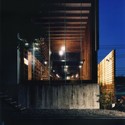
Otherwise it’s GOOD and INTERESTING work. Especialy it looks very good in the night with its inside lighs.
Respect to Architects.

P.s.: in Tokyo are many interesting modern architecture. This is one example.

 
# February 12, 2010 at 06:01
Thumb up Thumb down 0
that's what she says:

must feel really nice

 
# February 12, 2010 at 08:10
Thumb up Thumb down 0

Nicely Designed: M3/KG. http://bit.ly/cDQzgX

 
# February 12, 2010 at 10:01
Thumb up Thumb down 0
CRISTIAN says:

WHAT AN ELEGANT HOUSE, BEAUTIFUL SPACES THE LIVING PICTURE FEELS ALMOST MELANCHOLY..
4 R2D2 AND 5 C3PO`S!!!

 
# February 12, 2010 at 12:41
Thumb up Thumb down 0
hafiz says:

great work

 
# February 12, 2010 at 21:52
Thumb up Thumb down 0
squidly says:

More proof to ignore what architects say, and only look at what they build (or draw).

this is a nice project, but i wonder about solar control. In one of the pictures the sun blinds the space, which may be tolerable in winter, but what about summer?

 
# February 13, 2010 at 18:30
Thumb up Thumb down 0
laar says:

It is very unique, in the context of Japanese architecture – where many architects prefer to use the language of white boxes. The concept is simply beautiful, and the composition of materials is well thought.

 
# February 14, 2010 at 23:54
Thumb up Thumb down 0
t vyas says:

neat.

 
# March 30, 2010 at 17:04
Thumb up Thumb down 0
Araj says:

very good and very easy and … good luck :)

 
# July 4, 2010 at 08:12
Thumb up Thumb down 0
Eric Zhang says:

Love it

 
# July 4, 2010 at 08:47
Thumb up Thumb down 0

Hey there, You have performed an incredible job. I’ll definitely digg it and in my opinion suggest to my friends. I’m sure they will be benefited from this website.

 
# January 13, 2012 at 01:04
Thumb up Thumb down 0

12:05 AM Aug 12th

Mon genre d'architecture. Pas de chichis. J'm. My type. #architecture. Raw. Voted ! http://is.gd/88ghJ @plethoraapp

Thumb up Thumb down 0

3:12 PM May 4th

material hat-trick http://t.co/qdi0Yfe

Thumb up Thumb down 0

8:53 PM Jul 28th

M3/KG / Mount Fuji Architects Studio: © Ryota AtarashiArchitects: Mount Fuji Architects Studio Location: Meguro,… http://bit.ly/pWWOqQ

Thumb up Thumb down 0

8:56 PM Jul 28th

Via @ArchDaily – M3/KG / Mount Fuji Architects Studio http://dlvr.it/cyhM8 #architecture

Thumb up Thumb down 0

8:59 PM Jul 28th

#Arquitectura M3/KG / Mount Fuji Architects Studio http://t.co/3LYrDxq RT @ArchDaily

Thumb up Thumb down 0

8:59 PM Jul 28th

M3/KG / Mount Fuji Architects Studio http://archdai.ly/p8z5e2 #architecture

Thumb up Thumb down 0

8:59 PM Jul 28th

M3/KG / Mount Fuji Architects Studio | ArchDaily http://t.co/1pzBpoi via @archdaily

Thumb up Thumb down 0

9:02 PM Jul 28th

M3/KG / Mount Fuji Architects Studio http://archdai.ly/p8z5e2 #architecture

Thumb up Thumb down 0

9:05 PM Jul 28th

M3/KG / Mount Fuji Architects Studio http://archdai.ly/p8z5e2 #architecture

Thumb up Thumb down 0

9:09 PM Jul 28th

M3/KG / Mount Fuji Architects Studio via ArchDaily – © Ryota Atarashi Architects: Mount Fuji Architects … http://tinyurl.com/3rhz7m7

Thumb up Thumb down 0

9:13 PM Jul 28th

M3/KG / Mount Fuji Architects Studio via ArchDaily – © Ryota Atarashi Architects: Mount Fuji Architects … http://tinyurl.com/3rhz7m7

Thumb up Thumb down 0

9:26 PM Jul 28th

M3/KG / Mount Fuji Architects Studio http://archdai.ly/p8z5e2 #architecture

Thumb up Thumb down 0

9:35 PM Jul 28th

M3/KG / Mount Fuji Architects Studio http://archdai.ly/p8z5e2 #architecture

Thumb up Thumb down 0

9:41 PM Jul 28th

M3/KG / Mount Fuji Architects Studio | ArchDaily http://t.co/e7Nb1m8 via @archdaily

Thumb up Thumb down 0

9:44 PM Jul 28th

M3/KG / Mount Fuji Architects Studio: Architects: Mount Fuji Architects Studio Location: Meguro, Tokyo, Japan Si… http://bit.ly/pWWOqQ

Thumb up Thumb down 0

9:51 PM Jul 28th

M3/KG / Mount Fuji Architects Studio: © Ryota Atarashi Architects: Mount Fuji Architects… http://goo.gl/fb/z4R1u

Thumb up Thumb down 0

2:20 AM Jul 29th

M3/KG / Mount Fuji Architects Studio | ArchDaily http://t.co/Azajsh6 via @archdaily

Thumb up Thumb down 0

2:21 AM Jul 29th

arquitectura como dialogo
http://t.co/YxK79yZ

Thumb up Thumb down 0

2:21 AM Jul 29th

RT @archdaily: M3/KG / Mount Fuji Architects Studio http://archdai.ly/p8z5e2 #architecture

Thumb up Thumb down 0

5:52 AM Jul 29th

M3/KG / Mount Fuji Architects Studio http://t.co/uxBX0Lp via @archdaily

Thumb up Thumb down 0

6:35 AM Jul 29th

Tha

M3/KG / Mount Fuji Architects Studio http://fb.me/17osAznTT

Thumb up Thumb down 0

6:51 AM Jul 29th

M3/KG / Mount Fuji Architects Studio http://archdai.ly/p8z5e2 #architecture

Thumb up Thumb down 0

6:52 AM Jul 29th

http://t.co/fNlV9IG – I love the way this house reflects the environment and becomes hidden, the huge interior space is not that bad aslo.

Thumb up Thumb down 0

10:14 AM Jul 29th

M3/KG / Mount Fuji Architects Studio http://t.co/20gflr1 #Architecture #Japan #modern

Thumb up Thumb down 0

10:36 AM Jul 29th

M3/KG / Mount Fuji Architects Studio | ArchDaily http://t.co/Fq8zdcR via @archdaily

Thumb up Thumb down 0

1:37 PM Jul 29th

M3/KG / Mount Fuji Architects Studio | ArchDaily http://t.co/HPx760A via @archdaily

Thumb up Thumb down 0

1:15 AM Jul 30th

#CoupDeFoudre: M3/KG / Mount Fuji Architects Studio http://t.co/jb8NvWe

Thumb up Thumb down 0

12:00 AM Aug 1st

M3/KG / Mount Fuji Architects Studio http://t.co/s2QTQLH vía @archdaily #Arquitectura

Thumb up Thumb down 0

12:17 AM Aug 1st

RT @jhoncordoba M3/KG / Mount Fuji Architects Studio http://t.co/s2QTQLH vía @archdaily #Arquitectura: M3/KG / M… http://bit.ly/qt5kaN

Thumb up Thumb down 0

7:43 PM Aug 1st

M3/KG / Mount Fuji Architects Studio | ArchDaily http://t.co/Qf5JG6b via @archdaily

Thumb up Thumb down 0

3:24 AM Aug 2nd

y esta……… M3/KG / Mount Fuji Architects Studio http://t.co/HdlOxwc vía @archdaily

Thumb up Thumb down 0

7:49 AM Aug 2nd

M3/KG / Mount Fuji Architects Studio | ArchDaily http://t.co/JXlL3gs via @archdaily I LOVE THIS BUILDING!!!!!

Thumb up Thumb down 0

8:16 PM Aug 12th

Such pure forms: M3/KG / Mount Fuji Architects Studio | ArchDaily http://t.co/5z1iPxc via @archdaily

Thumb up Thumb down 0

8:19 PM Aug 12th

Indeed! RT @onearchitects Such pure forms: M3/KG / Mount Fuji Architects Studio | ArchDaily http://t.co/akdZN2s via @archdaily

Thumb up Thumb down 0

10:40 AM Aug 18th

M3/KG / Mount Fuji Architects Studio | http://t.co/9if4sVJ #Architecture #Architettura

Leave a Reply »


Latest Comments »

Try to look at it this way, and understand that the larger revenue (thru AR services)...[+]
Pretty uninformed article. Sure Architecure School provides a great...[+]
I’m sure this post made sense in your head.[+]
Looks like an upscale version of a Coop...[+]
Jen Camp on TuboHotel / T3arc
It’s not hot and muggy! it’s at an altitude of about 8,000 feet. It’s a very...[+]

Upcoming Architecture Events »

got events? invite us! click here

Architecture Books & Magazines »

A Peripheral Moment

A Peripheral Moment

This book is an account of the highly productive decade of architectural experimentation in Croatia lodged between the violent break-up of Yugoslavia and their slow integration into the EU. Ivan Rupnik guides the reader through the emergence of this


Review: De Stoel van Rietveld: Rietveld’s Chair, book + film by Marijke Kuper & Lex Reitsma

© Jules Gianakos

“It is hard to tell what the value of something eventually will be”
– Gerrit Rietveld, 1937.
This new insight into a classic illustrates Gerrit Rietveld’s transition from humble cabinet maker’s son to Architect and leading designer in the De…


Cebra Files 02

Cebra Files 02

We recently received a monograph of Cebra’s work. This young firm is energetic, pushes the boundaries, goes after competitions, and has been successful in pushing many projects into reality. We are fan their work and have featured Cebra 16…


Our partners »

AD on iPad via Pulse

Browse by date »

Browse by category »

Friends »