
School of Music, Arts & Crafts / Contemporânea

© FG+SG – Fernando Guerra, Sergio Guerra
Architects: Contemporânea / Manuel Graça Dias + Egas José Vieira
Location: Chaves, Portugal
Coordination: Luís Torgal, Architect
Collaborators: Duarte Correia, Amílcar Duarte, Mihai Varzan, Sara Baptista, Marta Quinaz, Sofia Sanches, Sara Rodrigues, Architects
Client: Câmara Municipal de Chaves (Chaves City Council)
Models: José António Aires Pereira
Project Year: 2004-2008
Photography: FG+SG – Fernando Guerra, Sergio Guerra
We developed the school as a long strip aligned with former railway station building, inflecting it slightly, in the middle, towards the north, to meet the locomotive repair workshop we intended for the bar/restaurant of the whole.
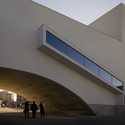
At this point of change in direction, that coincides with the entrance to the school atrium, was inserted, almost in the perpendicular, the auditorium, crossing the site. Taking advantage of the incline of the amphitheatre – which will descend, from the first floor towards the ground -, a generous half arch was created that, simultaneously marks, covers and protects the entrance, permitting the visual continuity of the volumetric progression of the building.
This axis, deep and complex, continues the alignment begun by the recent recuperation of the former station and goods platform that dramatized the space between the aforementioned pieces: the arch under the auditorium contributing to the continuation of a “metaphysical” atmosphere that the other arches – those of the station —, formerly announced.
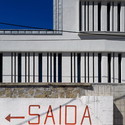
The exterior arrangement will explore the sense of a “street” with the creation of stone pavements and with the painting of concrete walls, in dark red, so as to reinforce the longilinear dimension of the place.
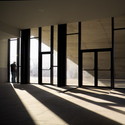
The south windows will be apertures in a “bar code” sequence, filling the corridors with striped lighting.
At the west end there will be two metallic pavilions, with the same section of an existing stone building that housed the Historical Archives. They are “carriages”, slightly disordered, that will house a future Railway Museum.
- © FG+SG – Fernando Guerra, Sergio Guerra
- situation plan
- underground & ground floor plans
- first floor & roof plans
- north & west elevations
- south & north elevations
- east elevation & section 01
- sections


The first picture is so good, it hurts.
the interior image is: A MASTERPIECE…
love the interior, not too crazy about the exterior
Portugese architecture hurts
obviously there is good and bad architecture in portugal as in the rest of world! this one seems really bad! but check other portuguese architects before saying such things otherwise you look just ignorant!
The interiors : AUSCWITZ !
LA TRISTEZA PORTUGA, no conoce límites !
Mais um paulista preconceituoso e enrustido
A prisao da Musica!
…Ja agora…Eu sou Tuga e tb nao gosto.
E somos dois. Boring!
First, let me explain you that architecture is something you have to experience in loco. Images of architecture are not the experience of architecture, just as seeing pictures of food is not the same thing as eating.
Have you ever been to Auschwitz? Auschwitz has never been architecture. It was a machine for mass murdering and one of the lower points in the History of Man. Your comparison, between Auschwitz’s and this buildings’ interiors, is both stupid and idiotic.
Get on a plane and go to Auschwitz. And next, go to Chaves and see a building that, whether or not takes to your liking, is a work of Architecture: a building for the growth, inspiration and benefit of those who use it and visit it.
When you return from your travels, go back to your computer and create a blog, comparing both buildings a explain everyone the abject thing you once said.
Words aren’t meaningless. Learn that in the first place. Secondly, use your head the next time you think out aloud.
portuguese architecture is really, really starting to bore me…
they have been doing the same things for decades now!!
seems like only a few architects like souto moura try to explore outside this already-over-used style.
and do you think portuguese architecture should amuse you?
Another question.
Anyone viewing this page with a Mac and Safari? I always have problems on Archdaily. Some of the images have grey areas, which are not loaded. The pictures are incomplete.
Same problems out there? What is wrong? Thanks.
Not with this one, but I do know what you’re talking about!
Anyway, I don’t think it’s Archdaily’s fault… but probably a Safari bug!
@David
the images are greyed out for me too… IE8 with WindowsXP
Agora of Lelystad – Ben van Berkel : The same program.
Other way of re-thinking a small theatre.
For Netherlands architect each project is a new possibility
What year was this building built ? 1980..1990..2000, or 2010 ?
1938
I really like this building but I’m wondering how long it will stay looking like that? Looking at the images I don’t see any control joints anywhere. How long can the building last before the cracks appear?
This building is in Portugal so it doesn’t have to deal with the winter freeze/thaw cycle but if I’m not mistaken Portugal is siesmically active. with so many height changes, even the slightest ground tremor will have a tremendous effect.
there are some elastomeric coating that can expand/contract without cracking but ti doesn’t appear that they used those here.
perhaps it’s their plan to simply patch cracks as they appear but over time as the building weathers and discolors it’s impossible to make a patch blend.
Chas, you have a good point.
I’d guess that the Structures engineer indicated as little joints as necessary for the structure’s needs (considering its dilation/contraction).
Excluding apparent masonry walls,for centuries architecture in Portugal has been clad with lime-based stucco, and covered with successive coatings of whitewash paint. Maintenance and repair works naturally mingle with the rest of the wall, and light reflects beautifully.
Today, common practice is easier to work cement-based stuccoes coated with different types of paint. Seismic activity is an issue, although violent quakes are very rare (though we are all biting our nails waiting for a catastrophe to happen like the one in 1755). As you know, cracks also happen because of the chemical behaviour of the stuccoes and their drying processes, and also, in old buildings, because of shifting foundations. Budget issues usually have a big saying (more expensive materials sometimes make way for cheaper ones, say cheaper paints instead of elastomeric paints), meaning that the architect sometimes has to compromise. Some choices are imposed…
The interior stairwell is crazy! I really enjoy the skylight, but some of the more technically-minded posters have brought up some great points (where are the control joints?!). I was surprised to see the thought given to how the building receives light, as the initial photograph presents the building as a foreboding, windowless box. Lots of negative comments on the project, but you cant discount the work. If this building is normal and boring to you, you live way too exciting of a life haha…
Shoe´s Box…
One more horrible white Shoe´s box in Portugal.
…” Tristeza nao tem fin
Felicidade siiiiiiim….”
Please : close all the architecture school in Portugalias !
I have the same complaint. I remember sitting in Mykonos and looking out at all of that architecture that just looks so similar. What I wouldn’t give for a mock Tudor or some blobitecture contraption to be stuck in the middle of that to just kind of mess up the aesthetic. After all, every single thing an architect does has to be different because, without that, how could the ego be gratified? How could anyone go on to celebrate narcissistic individuality to the point of absurdity. Indeed, enough of competent modern architecture. Like our friends at Diesel are saying “Be Stupid”.
kudos for that lovely spill of irony…
completely agreed….
The town of Chaves was a fortress and a stronghold for much of its history.
It is characterised by tough-looking buildings with white walls, loggias and red roofs.
This building is a thoughful interpretation of that tradition.
If only all the digi-blob manufacturers put as much thought into their ‘architecture’.
Do you think that there is a role to be played here though? by the architect, for providing consistant spaces for all of the egos inhabiting the building?
The rational organisation for me highlights absurdity more than funky shaped masterbatory architecture where only the architect is engaged?
I think the portuguese architecture is well thought out and planned so the school is as efficient as possible. With the schools design it can still be efficient and it can still look presentable. The outside needs some work as far as presentability but the inside is more presentable and better looking. If the outside could be like that then it would be a lot more presentable and more people would be interested in it.
The pictures of the Architecture pretty cool looking. The school seems to be designed not only for a school but also to draw the eye into the cool shapes and angles that they worked into the design. The shapes that they worked into draw the eye to look at the shapes. The interesting shapes on a flat wall seem to make the building to almost pop out. The use of mostly white was interesting as the viewer was not distracted by crazy colors but drawn to the simplicity of the shapes of the buildings. I would have liked Darien High school to be designed more along the lines of these interesting buildings. It would have made our high school a more interesting place and would not have been nearly as boring as the current building. The interesting shapes are a way to make the building feel more like a home and less like a boring place that you have to go to. Overall the design of these buildings is very interested, and I would be a cool model for new buildings to come.
I cannot understand the artificial (but in some way, very fashion!) idea that white walls are boring, mainly in portuguese architecture. What a bored image would arabic mosques and our manors, palaces have(?), only due to its specific feature – white walls. Spraying dogmas like these – “White is bore”- is something very dangerous before study and understand the meaning (even historically) of the architectural choice for white color to cover (our) the buildings. The architecture’s panoply of artifices to solve all problems that the creation of a new device to receive people and them activities generates, must be adjusted to the site conditions and to the cultural platform where we built – and there are so many potentialities in the use of “white”, that it would be a title of a great thesis . The conscience about the transformation of one exterior environment and the relation with the new imagined ambience is so notable here, that the preconception about the “white walls” deviates the attentions from the most important to extract in this particular building. The facilitated idea that a white building is bored hide for example the good resolution of the urban situation, always with a transforming attitude (non passive) – the building which interacts physically and in a unexpectedly way with public space. The articulation of this attitude with a creation of a architectonic image for the building (concordant with his program) is thought on the idea of urban landscape, previously so BORED. this involving site apparently so BORED was requiring a new attitude, materialized in a building. And there it is! I think that the main goal of architecture of improving the spaces surrounding was achieved and surpassed. Something bored turns into something more worthy and joyful.
Maybe we are prisoners of fashion updates when we criticize architecture. Maybe we are suffering from a lack of appreciation about the intensity of life and the colors , the HAPPINESS it emanates. The builiding could receive and value so many dense and lived matter wandering in the city, like people’s clothes (are highlighted), voices ,(etc) – the white wall could play an important role on this kind of attitude! One thing everybody knows from science – the white reflects immensely the sun light. This feature in relation with the city events could bring us HAPPINESS. LESS-WHITE is Bore. From Venturi to the true popular portuguese culture, sometimes HAPPY , sometimes SO BORED in thinking.
Hugo Barros
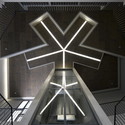
I really like how well the school is designed- it’s very modern and stylistic looking just from the stucco walls with regular windows on it. Then as you look further through the school it really looks like a school one would definitely want to attend to. I really like the simple, but changing sequence of the school. At first one sees just white walls with windows but then one goes to another part of the building and they see the barcode windows and red painted walls which really lure one’s eyes. The big arch that hangs adjacent to the building is also very cool because it holds a long window going along the side of it that is very distinct compared to many windows one might see for instance in the U.S. Under the long arch is a wall entirely covered with windows that let in lots of light which is very environment-friendly. One thing one might not know for someone who didn’t go to the school is that this arch is used for an amphitheatre, a very futuristic and cool one with many windows and adolescent lights on the ceiling. My favorite part of this school is the main stairway leading upstairs- the ceiling is lighted with crossing lights that send a good vibe to students, and I like how much of the part is designed with steel and glass- very good complexion.
Manuel da Graça dias is not a mark in portuguese architecture, plz dnt judge us by this exceptions. Most of our architects are incentived by foreign anrchitecural theories. by the way i advise you to judje portuguese architecture by our more cultural architects like siza, távora or souto moura.
Manuel Graça Dias IS, indeed, one of the most important portuguese architects. All architects are influenced by foreign AND/OR local architecture (if you live in it, you are influenced).
Siza and Souto Moura are well-known abroad, but their work is very different, actually, and there are a lot of younger, internationally unknown, portuguese architects doing good. It’s a diverse country, producing diverse architecture.
6:40 AM Feb 8th
School of Music, Arts & Crafts / Contemporânea http://bit.ly/cQRDPB
7:29 AM Feb 8th
School of Music, Arts & Crafts / Contemporânea: © FG+SG – Fernando Guerra, Sergio Guerra
Architects: Contemporân… http://bit.ly/bX9rqa
7:31 AM Feb 8th
RT @homedecornews: School of Music, Arts & Crafts / Contemporânea http://bit.ly/cQRDPB
7:37 AM Feb 8th
from archdaily: http://bit.ly/9f8E3B
11:31 AM Feb 8th
ArchDaily: School of Music, Arts & Crafts / Contemporânea http://bit.ly/cp6ZHc
11:38 AM Feb 8th
School of Music, Arts & Crafts / Contemporânea: © FG+SG – Fernando Guerra, Sergio Guerra Architects: Conte.. http://tinyurl.com/ygqjyfr
9:40 PM Mar 26th
School of Music, Arts & Crafts / Contemporânea: http://tinyurl.com/ybay7m7
3:02 PM Apr 7th
Architecture #Architecture: School of Music, Arts & Crafts / Contempora?nea… http://bit.ly/9AWQ6k
3:15 PM Apr 7th
RT @t_architecture: Architecture #Architecture: School of Music, Arts & Crafts / Contempora?nea… http://bit.ly/9AWQ6k