
• Share
  • share this article via emailshare by email
  • Share
  • share this article via emailshare by email

Nanjing Performing Arts Center / Preston Scott Cohen

By Nico Saieh — Filed under: Cultural , Educational , Featured , Public Facilities , Selected , , ,
 

© Iwan Baan

Architects: Preston Scott Cohen, Inc. (Design Architect); Institute of Architectural Design and Planning with Atelier Zhang Lei (Chinese architect of record)
Location: Nanjing, China
Client: Nanjing University
Project Area: 16,000 sqm
Budget: RMB 3,000/sqm
Design Year: 2007
Construction Year: 2008-2009
Photographs: Iwan Baan

context plan

© Iwan Baan

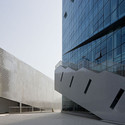
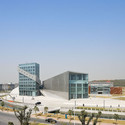
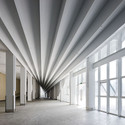
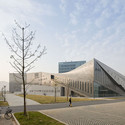
Located centrally in the new Nanjing University Campus in Xianlin, this building aims to offer a singular expression of the dialogue between two opposing paradigmatic forms of symbolic significance: a curving roof that appears to be related to the landscape of the larger campus context, and a tower which acts as a beacon and observation point. The design exploits the techniques and economy of local construction practices as a means to develop an exceptional form. The interior follows an exceedingly compact plan of different types and sizes of rooms and auditoriums.

© Iwan Baan

© Iwan Baan


5 reactions on Twitter »

8:00 PM Jan 28th

Nanjing Performing Arts Center / Preston Scott Cohen http://bit.ly/bbkiGV

8:41 PM Jan 28th

Nanjing Performing Arts Center / Preston Scott Cohen | ArchDaily http://bit.ly/bHKzel

1:49 AM Jan 29th

난징대 캠퍼스 건물. 외국건축가의 작품들을 빠르데 흡수하고 있는 중국은 곧 설계시장에서도 세계중심이 될듯 Nanjing Performing Arts Center http://bit.ly/9sVKLF http://twitpic.com/109xrc

3:17 AM Jan 29th

RT @archdaily: Nanjing Performing Arts Center / Preston Scott Cohen http://bit.ly/9eN2QI

8:20 AM Jan 29th

Nanjing Performing Arts Center / Preston Scott Cohen: http://url4.eu/1GLlU

29 comments »

Thumb up Thumb down 0
Christian says:

Lovely. Very well use of materials. Cohen makes it seem effortless. Great entrance.

 
# January 28, 2010 at 16:40
Thumb up Thumb down 0
Michael says:

‘this building aims to offer a singular expression of the dialogue between two opposing paradigmatic forms of symbolic significance’

The end result, in my opinion, is a visually jarring and disharmonious whole.
There are too many languages and shapes competing for attention and the result is uncomfortable and awkward.

 
# January 28, 2010 at 18:44
    Thumb up Thumb down 0
    spongebob says:

    yeah thats exactly what’s happening to almost every new architectures in China. They always mix everything together and call it “abundence”.

     
    # January 28, 2010 at 23:13
Thumb up Thumb down 0
p says:

oh.

 
# January 28, 2010 at 20:22
Thumb up Thumb down 0
hernin says:

brilliant & tranquil

 
# January 28, 2010 at 21:10
    Thumb up Thumb down 0
    Michael says:

    Hernin,

    What makes you say this is brilliant and tranquil?
    What elements appeal to you?
    Is it the planning, the materials, the siting?

    As you can see from my post earlier, I don’t like it. I think it is a clunky sculpture sitting in a completely inhospitable plaza.

    But I am genuinely interested in hearing other points of view…. anybody else got an opinion? This one really fascinates me…..

     
    # January 28, 2010 at 21:41
      Thumb up Thumb down 0
      GG says:

      Michael, if he likes it, why the f*** does he has to agree with you?!

      you bla bla about hospitality etc. you never been to this place, i guess, and you still critisize :)

      oh boy, so many haters on the web 2.0

       
      # January 29, 2010 at 00:13
      Thumb up Thumb down 0

      Actually, I think that it stands apart from other big boxes in China that are just cardboard models scaled up. The level of detail of the different pieces of the facades reveal a conscious work behind this project, standing apart from the rest of the context.

       
      # January 29, 2010 at 07:47
      Thumb up Thumb down 0
      Qiu Kuai says:

      Sorry to tell you that this building is said to be the only building worth seeing in the new campus of Nanjing University.I learned it from my friend in the University.

       
      # February 18, 2010 at 07:18
      Thumb up Thumb down 0
      stephanie says:

      I’m a student of NJU and I major in architecture. in my opion, the building is beautifully done.

       
      # April 11, 2010 at 21:56
Thumb up Thumb down 0
QIDI says:

There are many good things about this project, but I can’t get over that massive plaza/parking lot!

 
# January 28, 2010 at 22:18
Thumb up Thumb down 0
joe shmoe says:

i like it for what it is… Doesn’t seem like too many things going on – in fact I feel like most things reinforce the concept – perspectival distortian elongation. The spaces are dramatic – wouldnt call them sculptural at all.. as for sitting in an inhospitable plaza – look you can look at architecture through a perfect lens of your own imagination – or through reality and actual inevitable circumstance – architects dont build on their on terms in china… especially for a public building of a high profile. 2nd the idea of public outdoor space does not really exist in china – not that i dont think it shouldn’t or not that it wouldnt be great if a rebelious architect somehow sneaked a small piazza into a building in china – but theres a reason you dont see renzo building in china and why spaces are a little oppressive .. i like the ceiling of the lobby – its simple yet gives the space a nice intimate scale and follows a trajectory of cohen’s work.

 
# January 28, 2010 at 23:32
Thumb up Thumb down 0
brian says:

Some of it has potential, but the detailing looks like an LDI did it and is indicative of someone not yet ready to handle the scale jump away from single family homes. Interesting play on the Baker House though.

 
# January 29, 2010 at 00:03
    Thumb up Thumb down 0
    David says:

    This is a very low budget building that manages to come through quite well. The corners are beautifully handled, actually. The glass and tile too. What details do you object to? The railings look poor. Sure, it is not boutique residential architecture and also not the much higher budget of PSC’s other projects, the Museums where the construction looks far superior. But, still, this is unlike the typical Chinese university building, too. This looks MUCH more controlled.

     
    # January 29, 2010 at 03:45
      Thumb up Thumb down 0
      brian says:

      The shadow box is junk. It would be a whole lot cleaner if it didn’t look like they just sealed it up with exposed steel framing. And the beam to column connection detail in the one interior shot is also junk. I think it’s pretty clean overall, but spending a portion of the “very low budget” on a folded surface while punting on the simple tectonics is lame.

       
      # January 30, 2010 at 22:58
    Thumb up Thumb down 0
    David says:

    “spending a portion of the “very low budget” on a folded surface but punting on the simple tectonics is lame”, you say. I disagree. It was smart that the architect knew to accept certain basic things, due to the budget limitations, but not others. He chose to use extreme shapes and the common Chinese craft of tile to achieve something modest but good. If he had tried to make the beam to column connection special, we would have a debased Swiss tectonic and he would have had too little to spend on making the spatial impact he was after. He had to choose between modifying the basic tectonics vs modifying the basic spatial design. I think he made the right choice under the circumstances in China today.

     
    # February 1, 2010 at 00:23
Thumb up Thumb down 0
Michael says:

GG,

It seems that you are the ‘hater’ in this situation.
Where did I say that Hernin had to agree with me?
I just asked him to elaborate because I can’t understand his comment. It seems rather meaningless to type two adjectives and leave it at that.
Just because I have a valid point of view doesn’t make me a ‘hater’.
I think it is fairly defensible to say that a huge paved plaza with nothing in it is ‘inhospitable’.
Do you have a point of view?
Or is it your job to police Web 2.0 and make sure people only say nice things?

 
# January 29, 2010 at 00:28
Thumb up Thumb down 0
chicago_g says:

agree with Michael. i do not see the tranquility of the building…. only showing photos without any people in doesnt mean “tranquil” of architecture. on the contrary, the massing is a kind of noisy to me, to some certain extent.
i like metal finish on the facade though, the Iwan captured some good moments of lighting effectively unveal the material quality.

 
# January 29, 2010 at 01:58
    Thumb up Thumb down 0
    Ivan says:

    It is not metal; it is tile. That is one of the great things about this building. It fools you! Iwan captures that beautifully. Problem is that I bet his pictures are better than the real thing. How much do you want to bet on it?

     
    # February 1, 2010 at 00:27
Thumb up Thumb down 0
Dan Stillerman says:

This is an incredibly exciting piece of work not only for its overall form and complexity of interior planning but also for its sensuous exterior finish, the reflective tile that gives it a luminous affect which makes it seem like metal rather than clay. Really stunning.

 
# January 29, 2010 at 03:39
Thumb up Thumb down 0
Rembo says:

Scotty, baby. Only 1 interior shot? Give me more.

 
# January 29, 2010 at 08:35
Thumb up Thumb down 0
frank says:

There are some very nice moments within the project, but I can’t get past some of the late 80’s handling of collided, canted forms. Where the stair is integral to the form I think it is quite nice and achieves the stated aims; where the solid stair wraps the glass box, along with the angled punched openings, its gets very awkward..

 
# January 29, 2010 at 18:37
    Thumb up Thumb down 0
    Ivan says:

    But it is much more unified than the colliding forms that you are talking about. This is all unified by two materials – tile that looks like metal and Glass. That’s it. The angles are awkward in a very intentional way, creating unexpected effects (look at that courtyard) but ultimately they hold everything together.

     
    # February 1, 2010 at 00:09
Thumb up Thumb down 0
KPF says:

looks really nice like a KPF project, late 90s gestural corporate expressionism!

 
# January 30, 2010 at 14:13
Thumb up Thumb down 0
wartian says:

the cleft like staircase!

 
# January 31, 2010 at 10:15
Thumb up Thumb down 0

Nicely Designed: Nanjing Performing Arts Center. http://bit.ly/cIOUOx

 
# February 2, 2010 at 00:01
Thumb up Thumb down 0
afshin says:

بسیار عالی

 
# March 4, 2010 at 20:28
Thumb up Thumb down 0
afshin says:

thats exactly what’s happening to almost every new architectures in China. They always mix everything together and call it “abundence”.
very good

 
# April 25, 2010 at 03:52
Thumb up Thumb down 0
debesiu says:

the photographer did a great job!

 
# May 12, 2010 at 01:40

Links to this article »

Leave a Reply »

Want to have your own avatar? Get yours at Gravatar.

Latest Comments »

Please describe the heating and cooling of the home. Include insulation...[+]
Brilliant!!! What a great piece of Public Zoo Architecture!!! Love the...[+]
Most of these are really uninspiring. Half of them look like...[+]
Desire to go green is getting more and more crazy…[+]
All I could say is that this guy is really something else! The sphincter house!...[+]
Sorry, Moshe Safdie, I like the interiors, they are outstanding, and I...[+]
R Goldschmidt on Prefabricated Nature / MYCC:
Simple, great material, easy to made and nature friendly![+]
I don’t understand why bad critique is not accepted on...[+]
果然是野心勃勃的煤老 板的房子。[+]
I like this renovation. The idea of using...[+]

Links Recommended about Architecture:

Architecture Books & Magazines »

Habits, Patterns, Algorithms: 1998-2008 / Stephan Jaklitsch

Habits, Patterns, Algorithms: 1998-2008 / Stephan Jaklitsch

Stephan Jaklitsch is the architect behind Marc Jacobs’ stores around the world, with ongoing projects in Tokyo, Chicago, Macau, Singapore, Mexico City, Thailand and Hong Kong. On this book you will find several store designs (for Marc Jacobs and…


DETAIL Magazine 2/2010

DETAIL Magazine 2/2010

Detail is one of my favorite periodic publications in terms of construction inspiration. The reason? It’s packed with highly detailed drawings of contemporary projects.
Each volume features a specific building system (concrete in this case), presented in the form…


Expanded Practice: Höweler + Yoon Architecture / MY Studio

Expanded Practice: Höweler + Yoon Architecture / MY Studio

The title “Expanded Practice” comes from how Höweler + Yoon Architecture / My Studio have named their design methodology. And in this book it’s not just a title, as the book is really a guide on how this young…


Our partners »

Browse by date »

Friends »