


137 Housing / H Arquitectes

Uploaded by — Filed under: Housing ,Residential ,Selected , , ,
 

1

Architects: H Arquitectes / David Lorente, Josep Ricart, Xavier Ros, Roger Tudó
Location: Granollers, Barcelona,
Colaboradores: Anna Bullich, architect, Ramon Anton, technical architect, Jordi Velazquez, structure (MVA, arquitectura y estructura), Otger Sala, geologist (Granollers 2002, estudis geològics, SL), NADICO, engineering, ESTRATS, archeologist
Promotor: Promo E.S. March S.L.
Project Year: 2006-2008
Project Area: 1,086.05 sqm
Photographs: H Arquitectes

2 4 5 10

The Urban Planning for ‘Plaça de l’Església’ in Granollers intends to regain the role of this square within the old part of town. Our plot is the key factor for the consolidation of this centrality, due to it occupies the space that gives continuity to Barcelona Street and connects with ‘Plaça de la Porxada’.

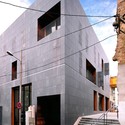
The three facades of the building become a single skin that, thank to the continuous use of the even in the shutters, unifies the volume and consolidates the characteristic predominance of the massive-wall facades in the old quarter.

elevations

elevations

Basalt stone has been used due to the fact that because of its porosity and texture constantly changes in colour and reflection according to the different degrees of humidity. Besides, print inscriptions and ornamental recessed caps remind us of a tattoo that reinforces the perception of skin and gives a personal and human touch to the building. The changing rhythm of the shutters that appear and disappear, as they are open or closed, project on the façade the interior life of the dwellings. The entire building captures the passage of time and transmits an alive and organic atmosphere.

3

shutters details

shutters details

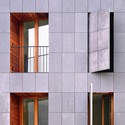
The exterior coating of the shutters consists of VIROC panels made up of cement and wood fibres which have similar colour and texture as the basalt stone of the façade though it is a much lighter material and withstands the impacts by opening or closing the shutters. When the shutter is closed it keeps flush with the external stone coating and visually disappears in the modulation of the ventilated façade. In the inside, the shutters are wood-panelled and, once open, evolve from their anonymous presence towards singularity.

The only exceptions of this dark and massive uniform treatment will be the large windows of the business premises on the ground floor and the great wooden cavity terraces that emphasize inside out the interior layout and give relief and volume to the building.

first floor plan

first floor plan

The dwelling typologies are based on the L shaped continuity between the living and the kitchen so as to create a space that goes through the building and connects both façades by piercing them in an explicit way. Besides, this strategy allows every dwelling to have a visual connection with the square and the church.

12

The layout of the upper floor dwelling is reversed so as the living room, the dining and the kitchen could be related to the perimeter terrace from where to enjoy the views over the old part of town.


Thumb up Thumb down 0

137 Housing / H Arquitectes: Architects: H Arquitectes / David Lorente, Josep Ricart, Xavier Ros, Roger Tudó Locat… http://bit.ly/7tqFot

 
# December 24, 2009 at 23:02
Thumb up Thumb down 0

ArchDaily: 137 Housing / H Arquitectes http://bit.ly/4WjK98

 
# December 24, 2009 at 23:02
Thumb up Thumb down 0

137 Housing / H Arquitectes http://bit.ly/7wPhmb

 
# December 24, 2009 at 23:11
Thumb up Thumb down 0

137 Housing / H Arquitectes: Architects: H Arquitectes / David Lorente, Josep Ricart, Xavier Ros, Roger Tudó Lo.. http://tinyurl.com/ydjfmr9

 
# December 25, 2009 at 00:29
Thumb up Thumb down 0

RT @archdaily: 137 Housing / H Arquitectes http://bit.ly/8bxmcs

 
# December 25, 2009 at 09:53
Thumb up Thumb down 0
Mr. Cheap says:

Too little focus on plans. Would like to see a more developed idéa of how the appartment is to live in. It is difficult to understand the primary quality of the living space. But the volume/body approach is clear and well executed.

 
# December 25, 2009 at 09:43
Thumb up Thumb down 0

I'd Live Here: 137 Housing. http://bit.ly/6BeP8J

 
# December 25, 2009 at 16:31
Thumb up Thumb down 0
thomas foral says:

137 Housing / H Arquitectes-ArchDaily – http://shar.es/aOF4E

 
# December 25, 2009 at 17:16
Thumb up Thumb down 0

4:02 AM Dec 25th

137 Housing / H Arquitectes: Architects: H Arquitectes / David Lorente, Josep Ricart, Xavier Ros, Roger Tudó Locat… http://bit.ly/7tqFot

Thumb up Thumb down 0

10:58 PM Dec 27th

RT @farquitectura Viviendas 137, Barcelona, H Arquitectes: … http://www.archdaily.com/44674/137-housing-h-arquitectes (Via @noticiasarq)

Leave a Reply »


Latest Comments »

Murcia| property for sale Murcia on Ibermutuamur Building / DENORTE
You are in reality a excellent webmaster. The web site...[+]
Really? That’s what you feel the need to...[+]
Awesome stuff – What are those funky lamps called? I’d like to use...[+]
The interesting thing about the interior is the way the...[+]
Julius Jääskeläinen on Raakspoort Haarlem / BOLLES+WILSON
Sensitivity to context and human scale is so boring, but then again...[+]

Upcoming Architecture Events »

got events? invite us! click here

Architecture Books & Magazines »

Golconde: The Introduction of Modernism in India

Golconde: The Introduction of Modernism in India

Sited on the coastal edge of the Bay of Bengal, Golconde, a dormitory for the Sri Aurobindo Ashram in Pondicherry, India, was designed by architects Antonin Raymond and George Nakashima. Golconde is a remarkable architectural edifice, seemlessly negotiating between


Architectural Modelmaking

Architectural Modelmaking

“The representation of creative ideas is of primary importance within any design-based discipline, and is particularly relevant in architecture where we often do not get to see the finished results, i.e. the building, until the very end of the…


Thermally Active Surfaces in Architecture / Kiel Moe

Thermally Active Surfaces in Architecture / Kiel Moe

Departing from the simple question Why do we heat and cool buildings with air?, this book focuses on the technique of thermally active surfaces. This technique uses water in building surfaces to heat and cool bodies – a method


Our partners »

AD on iPad via Pulse

Browse by date »

Browse by category »

Friends »