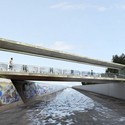
Art Bridge / wHY Architecture

By — Filed under: Architecture News ,Infrastructure , , , , ,
 

under

wHY Architecture has shown us their expertise on cultural projects at different scales: the Grand Rapids Art Museum (the first LEED Gold certified museum) on the large scale in one side and the Royal/T Gallery on a smaller scale, among other cultural projects shown on their website.

And now they share with us a cultural project on the infrastructure scale that I had the chance to see when I visited their office early this year, which got green light and enters construction phase in 2010: the Art Bridge.

The project is located over the river and it’s very related to it, as most of its structure will be built from trash salvaged from the river itself.  This project will achieve what many have been looking for, and that is to reconnect with the river that crosses LA. And I think that it will make it.

You can also watch our interview with Yo-ichiro Hakomori from whY Architecture, filmed at Postopolis! LA earlier this year.

Project description and more images after the break:

actual state

actual state

Design: 2007-2008
Construction: 2009-2010

The Art Bridge is a product and a reflection of the Los Angeles River, which in turn is the reflection of Los Angeles history. The bridge structure will be built substantially from trash salvaged from the river itself; concrete walls cast with bottle glass, cans, Styrofoam, dirt and debris; floor and pavement made from recycled tires, tennis balls and scrap metal; bridge guardrail made from recycled parts of shopping carts scattered in the riverbed as a symbol of regeneration and sustainable design. Photovoltaic panels on the canopy will generate electricity for lighting at night.

sky_cam

Spanning across the LA River, the Art Bridge not only serves as a pedestrian bridge for the college and school in the community, but also as an interpretative station for viewing and understanding the significance of the Great Wall of Los Angeles mural by artist/muralist Judith Baca. The slit in the bridge floor reveals the river beneath, symbolizing the scar in the landscape manifested by the concreted river, and the division it ultimately created in the community. Walking across this bridge, visitors may experience the time makers, reading about the history of the city as told by the river and by the mural. The bridge will not only serve as a physical connection from the school to the community, but it will also make a connection for the visitor between the history of the river and Los Angeles, and the void in knowledge and awareness of events depicted in the Great Wall of Los Angeles.

roof plan

roof plan


Thumb up Thumb down 0
Małgorzata says:

Bridge -yes, Art-no

 
# December 16, 2009 at 07:04
    Thumb up Thumb down 0
    Tanja says:

    Agree

     
    # December 16, 2009 at 13:08
Thumb up Thumb down 0

The Art Bridge. On my list of the top 20 of 2009. This project contains the NDA of new thinking.

http://bit.ly/5UwNfa

 
# December 16, 2009 at 09:54
Thumb up Thumb down 0

The "Art Bridge". On my list of the top 20 of 2009. This project contains the DNA of New Thinking.
http://bit.ly/5UwNfa

 
# December 16, 2009 at 09:57
Thumb up Thumb down 0
monkey says:

not so bad。

 
# December 16, 2009 at 09:17
Thumb up Thumb down 0
asdfaf says:

i like this formally and conceptually, but why would you take something that is so dependant on clean lines and the techtonics of the wrapper and muck it up with these bottles and things? thats not sustainable.

 
# December 16, 2009 at 10:25
Thumb up Thumb down 0
the mob says:

Why muck it up with bottles and things?

Well, because formally it is the same open box shape that has been the default shape of every avant garde house, bridge, museum, pavillion, etc for the last 5 years or so. I give them credit for looking for ways to reinvest achitecture with something beyond formalism.

If you you continue to cling to formalism it needs to at least be new. But that’s exactly the problem with formalism. . it’s never new for more than 5 minutes and then it’s just another tired shape.

 
# December 16, 2009 at 12:07
    Thumb up Thumb down 0
    plots says:

    spot on.

     
    # December 16, 2009 at 14:07
Thumb up Thumb down 0
INawe says:

I like it. Take all the trash out of the river and make a bridge. Put some program on it and you’ve got yourself a great project. Otherwise it just becomes another beautiful formal gesture without any real value in my opinion.

 
# December 16, 2009 at 12:47
Thumb up Thumb down 0
cad says:

Perfect for Westside Eastside bridge rumble

 
# December 16, 2009 at 14:34
Thumb up Thumb down 0
Matt says:

Great way to make a social/environmental statement and bring people into connection with the concrete river at the same time.

 
# December 17, 2009 at 15:12
Thumb up Thumb down 0
Polina says:

Just love the bridge and the idea. Simple & cool.

 
# April 5, 2010 at 15:03
Thumb up Thumb down 0

10:50 AM Dec 16th

RT @nicdesign The "Art Bridge". On my list of the top 20 of 2009. This project contains the DNA of New Thinking.
http://bit.ly/5UwNfa

Thumb up Thumb down 0

1:49 PM Jan 2nd

RT @nicdesign: The "Art Bridge". On my list of the top 20 of 2009. This project contains the DNA of New Thinking.
http://bit.ly/5UwNfa

Leave a Reply »


Upcoming Architecture Events »

got events? invite us! click here

Architecture Books & Magazines »

Louis Kahn Drawing to Find Out / Michael Merrill

Louis Kahn Drawing to Find Out / Michael Merrill

We recently featured the companion to this book, Louis Kahn On the Thoughtful Making of Spaces. This large format book draws together over two hundred—mostly unpublished—drawings of Kahn’s Dominican Motherhouse. It offers a fascinating look into Kahn’s design process…


After Crisis

After Crisis

“‘After Crisis’ concentrates around the new conditions for architectural practice and around the new epistemologies that may inform it in the next future. That is, in the period after the financial bubble has collapsed and living and working conditions


Review: De Stoel van Rietveld: Rietveld’s Chair, book + film by Marijke Kuper & Lex Reitsma

© Jules Gianakos

“It is hard to tell what the value of something eventually will be”
– Gerrit Rietveld, 1937.
This new insight into a classic illustrates Gerrit Rietveld’s transition from humble cabinet maker’s son to Architect and leading designer in the De…


Our partners »

AD on iPad via Pulse

Browse by date »

Browse by category »

Friends »