

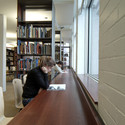


Waterloo School of Architecture / Levitt Goodman Architects

Uploaded by — Filed under: Educational ,Selected , , ,
 
© Ben Rahn/A-Frame

© Ben Rahn/A-Frame

Architects: Levitt Goodman Architects
Location: Cambridge, Ontario,
Client: University of Waterloo School of Architecture
Design Team: Janna Levitt, David Warne, Greg Latimer, Daniel Bartman, Veronica DelGuidice
Construction Manager: Alberici Constructors, Ltd.
Structural Engineering: Blackwell Bowick Partnership Limited
Mechanical & Electrical Engineering: Keen Engineering
Code Consultant: Arencon Inc.
Lighting consultant: Gerry Cornwell Lighting Design
Millwork consultant: Henderson & Associates Inc.
Project Area: 7,897 sqm
Budget: $8,200,000
Project Completed: 2004
Photographs: Ben Rahn/A-Frame

ground floor plan

ground floor plan

Relocating from the University of Waterloo campus to the century-old Riverside Silk Mills in Cambridge Ontario, the new School of Architecture has repositioned itself as a model for the instruction of architecture, sustainable design and urban renewal.

Anchored on the bank of the Grand River, the School is a beacon within Cambridge’s downtown core. A formal rhythm between the regular brick and masonry piers of the historic façade and the new steelframe windows is emblematic of the architectural strategy of re-presenting the existing structure with contemporary details that redefine the building.

© Ben Rahn/A-Frame

© Ben Rahn/A-Frame

On the interior, the former factory’s expansive floorplate translates into dynamic, open studios and critique spaces. The architects carved out a central atrium that establishes an airy, three-storey hub punctuated by blackened-steel cantilevered staircases, providing sweeping views of the river and the surrounding activities. Adjacent to the atrium are key amenities such as the ground floor auditorium, the second floor library and mezzanine lounge and the third floor critique space. Since it is impossible to move through the School without passing through the atrium, this space continuously offers itself as a place of interaction and collaboration. The School’s “students first” philosophy manifests itself in the privileged positioning of student spaces such as the café, gym and library overlooking the river.

By design, the School of Architecture is a didactic model of building assembly. Exposed connections and mechanical systems demonstrate their own utility and construction. Porous spaces frame views of things being made. A conscious decision “not to design too much” renders most surfaces raw and durable, suited to exhibition, intervention and creativity. Even bathroom stalls are fabricated from pin boards. Distinctive spaces such as the auditorium and the library are elevated by employing finer materials and craftsmanship.

© Ben Rahn/A-Frame

© Ben Rahn/A-Frame

Waterloo’s emphasis on the craft of architecture is highlighted though select details such as the custom-designed glass canopy over the main entrance that casts the word “ARCHITECTURE” underfoot and along the old masonry wall, the reverse treads cut into the feature staircases that emphasize a sense of descending into the sunken auditorium and the new fenestration and concrete panel exterior at the river face.

© Ben Rahn/A-Frame

© Ben Rahn/A-Frame

Practicality and sustainability were driving factors for all design and material selections, reinforcing the notion that quality design can no longer be skin deep. This also minimized the amount of new material required and construction waste produced. A budget of $30/m2 and 14 months to design and construct, established a “maximum reuse” architectural parti, allowing construction to begin immediately while the design was still underway.

Funded by local businesses as well as all levels of government, the project is a model for public-private partnerships. It augments the University’s facilities and serves as an instrument of knowledge and experience for the profession. It has enabled Cambridge to remediate a prominent brownfield site, extend its downtown core, reconnect its “Riverwalk” promenade and provide the public with access to a riverfront café, a design gallery and an auditorium that hosts community functions. The staff and students have instantly invigorated the local economy and since the school operates day and night, it continuously animates the City.

 
 
Thumb up Thumb down 0
Wuxus says:

Ok… since I was in my first year of college…I’ve seen this school and fall in love with it! I Want to study my master in there!!!!!

 
# December 19, 2009 at 10:28
Thumb up Thumb down 0
Benny says:

Home sweet home

 
# December 19, 2009 at 15:02
Thumb up Thumb down 0
Dave says:

Best school ever!

 
# December 19, 2009 at 15:29
Thumb up Thumb down 0
scottmft says:

take that sci-arc!

 
# December 20, 2009 at 01:18
Thumb up Thumb down 0
Fudge says:

I love the ‘didactic building’ concept, a building for teaching that can actually teach through its architecture. Marvelous. I would love to study there!

 
# December 20, 2009 at 07:45
Thumb up Thumb down 0
victor says:

‘day and night’

 
# December 20, 2009 at 07:50
Thumb up Thumb down 0
Michael says:

um, i hate to disagree, but this looks like a 1960′s functionalist diagram, not a c21st school of design.
don’t get me wrong, i love simple. i love good parti. i just don’t think this has any magic at all. david chipperfield does this kind of thing a zillion times better.

 
# December 20, 2009 at 19:31
Thumb up Thumb down 0
Andrés says:

Agree with Michael. This looks like a boring school. Architecture is creative, is passion, is city. This building doesn’t show any of that

 
# December 21, 2009 at 00:17
Thumb up Thumb down 0
moop says:

agreed, it feels more like a business school than an architecture school… but then again, I’m basing my assumptions from the photos…

 
# December 21, 2009 at 23:11
Thumb up Thumb down 0
anonymousbecauseihaveto says:

Michael is right on about the building being extremely boring and unmotivating, and it reflects most of the work going on inside.
Not to mention that it is located an hour bus ride away from the main UWaterloo campus, and that it’s a 30 minute bus ride up to Home Depot to get modeling supplies.
It should have been a business school because the whole premise of its siting was based on a business deal, and definitely not the best interest of architecture students.

 
# December 22, 2009 at 13:27

Leave a Reply »


Latest Comments »

Does the architecture world like the tent I pitched?[+]
the future is now[+]
im sure you are not biased…MOHSEN![+]
im sure you are not biased MOHSEN![+]
…inspiration in PRADA’s models[+]

Upcoming Architecture Events »

got events? invite us! click here

Architecture Books & Magazines »

Structures of Utility / David Stark Wilson

Structures of Utility / David Stark Wilson

It is such a great pleasure for ArchDaily to promote David Stark Wilson’s photographic exploration Structures of Utility. We have feature Wilson’s firm WA Design… on ArchDaily, but this book offer something uniquely different. Wilson traveled the back roads


MARK Magazine #35

MARK Magazine #35

As you well know already we love MARK Magazine, and this issue fails to disappoint. It has projects from many of the architects we have featured here on ArchDaily such as, StudioGreenBlue, Heri&Salli, Clavel Arquitectos, Kengo Kuma, Colboc Franzen, Studio Velocity, Takeshi Hosaka, Fuhrimann Hachler, Toyo Ito, Nieto Sobejano, L3P Architekten,…


Mark Magazine #37

Mark Magazine #37

We recently received the latest issue of Mark Magazine, one of our favorites. If you’re bored of cubic architecture, Mark #37 (April-May) includes amazing work by Jurgen Mayer H and Jesko Johnson-Zahn built in Georgia (the country, not the state).…


Our partners »

AD on iPad via Pulse

Browse by date »

Browse by category »

Friends »