
Project: Infiniski Manifesto House
Architects: James & Mau
Location: Curacaví, Chile
Built Area: 160 m2 ( + 15 m2 terraces 2nd floor)
Landscaping: Infiniski
General Contractor and manager: Infiniski
Renewable strategy: Infiniski + Geotek
Project year: 2009
Execution Time: 90 days
Total Cost: 79.000 €
Photograph: Antonio Corcuera
Furniture: Cómodo Studio, gt_2P


Infiniski designs and builds eco-friendly houses and buildings based on the use of recycled, reused and non polluting materials and the integration of alternative and renewable energy. The Infiniski projects are designed by James&Mau – Architects and designers, Jaime Gaztelu and Mauricio Galeano, founders and partners of Infiniski. James & Mau offer Innovative and contemporary designs based on bioclimatic and modular architecture. Infiniski is not only green, it is cheaper and faster … it tries to think the values of architecture and construction differently; a contribution to the needs of our changing environment.


- © Antonio Corcuera
- Lower level plan
- Upper level plan
- Section
- Elevaciones


Nice woman on the pics :)
u just said what i want to say
chilean architecture is nice and well done but thats all, it is tendentious and with a big lack of character, this kind of houses seem to come more from a norweigian fiord instead from the place they are build.
what makes the this house/cottage eco-friendly ? all that I can see is some used pallets and a rainwater storage container on the roof there seems to be no insulation so heating it wouldn’t be very efficient.
no need in Chile, not every house is in nothern hemisphere.
that’s a very good question, where’s the insulation. for your information pappoqula, houses in chile do need insulation, as a matter of fact, unless you have such a nice weather, with conditions that make the exterior temperature good enough for day&night/summer&winter comfort, you need insulation. and by the way, I’ve spent winters in curacavi(the place where this project is located) and let me tell you… it can be freezing cold.
in my opinion, this project is just “green”, meaning trendy and fashionable, but not bioclimatical at all.
i don’t get it, why is the house shown with two facades? no mention in the article, confusing.
The two facades are two separate elevations. You can see this in the internal central staircase image. In response to ‘g dehis’ – it is also constructed from used shipping containers which would certainly reduce it’s embodied energy.
if that was so, then the photos of one of the facades would be mirror reversed. but i believe its not this way, because the front window beneath the cantilevered part is always the same – the opening part on the left side… makes no sense
Yes I hear you. Perhaps the photo was flipped? The image I referred to certainly shows two different cladding materials (crates and battens) to the flip up screens.
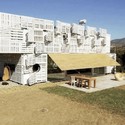
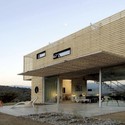
The wooden skin can be changed thanks to a fixture system on the facade. The house is shown with the 2 options for the facade.
Right, they must have simply changed the siding. I mean, those white crates are rather cheeky. The sustainable wood slats look much better, calmer.
adollable!
what’s the point of the sheep?
Sheep=Eco lawn mower!
Il manque une vue, celle de la douche !
Both photos of both facades are from the same point of view, I don’t understand it either…
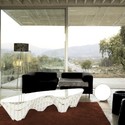
The interior looks like a trailor house with mod furniture.
what does it suppose to manifest?
more building, less models peoples!
More models! less sterile architecture!
yummy yummy, im coming to bed in a sec honey!
lets all be fertile!
I’m tired of seeing this type of “cool”(?) architecture. In the end, behind a fancy name and a not-so-convincing “manifesto” there is only a really ugly house. A real shame considering the apparently amazing characteristics of the site.
This house rocks with both facades. Want to live in there/around it.
how does the pallets connect the container?? does anyone have detail drawing??