Dee and Charles Wyly Theatre / REX | OMA
Architects: REX | OMA
Location: Dallas, USA
Key Personnel: Joshua Prince-Ramus (Partner-in-Charge) and Rem Koolhaas, with Erez Ella, Vincent Bandy, Vanessa Kassabian, Tim Archambault
Executive Architect: Kendall/Heaton Associates
Client: The AT&T Performing Arts Center
Consultants: Cosentini, DHV, Donnell, Front, HKA, Magnusson Klemencic, McCarthy, McGuire, Pielow Fair, Plus Group, Quinze & Milan, Theatre Projects, Tillotson Design, Transsolar, 2×4
MEP/FP Design Engineer: Transsolar Energietechnik, Germany
MEP/FP Engineer of Record: Cosentini Associates, New York
Structural Engineer of Record: Magnusson Klemencic Associates, Seattle
Theatre Design: Theatre Projects Consultants, Connecticut
Acoustics: Dorsserblesgraaf, Netherlands
ADA: McGuire Associates, Massachusetts
Construction Management: McCarthy Construction
Cost: Donnell Consultants, Florida
Facades: Front, New York
Furniture: Quinze & Milan, Kortrijk Belgium
Graphics/Wayfinding: 2 x 4, New York
Life Safety: Pielow Fair, Seattle
Lighting: Tillotson Design Associates, New York
Vertical Transport: HKA, California
Project Area: 7,700 sqm
Project year: 2006-2009
Photographs: Iwan Baan, Tim Hursley, Jeffrey Buehner
The Dallas Theater Center (DTC) is known for its innovative work, the result of its leadership’s constant experimentation and the provisional nature of its long-time home. DTC was housed in the Arts District Theater, a dilapidated metal shed that freed its resident companies from the limitations imposed by a fixed-stage configuration and the need to avoid harming expensive interior finishes. The directors who worked there constantly challenged the traditional conventions of theater and often reconfigured the form of the stage to fit their artistic visions. As a result, the Arts District Theater was renowned as the most flexible theater in America. The costs of constantly reconfiguring its stage, however, became a financial burden and eventually DTC permanently fixed its stage into a “thrust-cenium.”
Imagining a replacement for DTC’s old house raised several distinct challenges. First, the new theater needed to engender the same freedoms created by the makeshift nature of its previous home. Second, the new venue needed to be flexible and multi-form while requiring minimal operational costs.
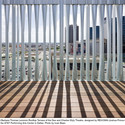
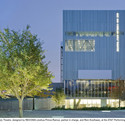
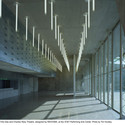
The Dee and Charles Wyly Theatre overcomes these challenges by overturning conventional theater design. Instead of circling front-of-house and back-of-house functions around the auditorium and fly tower, the Wyly Theatre stacks these facilities below-house and above-house. This strategy transforms the building into one big “theater machine.” At the push of a button, the theater can be transformed into a wide array of configurations—including proscenium, thrust, and flat floor—freeing directors and scenic designers to choose the stage-audience configuration that fulfills their artistic desires. Moreover, the performance chamber is intentionally made of materials that are not precious in order to encourage alterations; the stage and auditorium surfaces can be cut, drilled, painted, welded, sawed, nailed, glued and stitched at limited cost.
Stacking the Wyly Theatre’s ancillary facilities above- and below-house also liberates the performance chamber’s entire perimeter, allowing fantasy and reality to mix when and where desired. Directors can incorporate the Dallas skyline and streetscape into performances at will, as the auditorium is enclosed by an acoustic glass façade with hidden black-out blinds that can be opened or closed. Panels of the façade can also be opened to allow patrons or performers to enter into the auditorium or stage directly from outside, bypassing the downstairs lobby.
By investing in infrastructure that allows ready transformation and liberating the performance chamber’s perimeter, the Wyly Theatre grants its artistic directors freedom to determine the entire theater experience, from audience arrival to performance configuration to departure. On consecutive days, the Wyly Theatre can produce Shakespeare on a proscenium stage or Beckett in a flat-floor configuration silhouetted against the Dallas cityscape. Both learning from, and improving upon, DTC’s original Arts District Theater, the Dee and Charles Wyly Theatre will restore Dallas as the home of the most flexible theater in America, if not the world.
- © Iwan Baan
- © Tim Hursley
- © Tim Hursley
- © Tim Hursley
- © Tim Hursley
- © Tim Hursley
- © Iwan Baan
- © Iwan Baan
- © Iwan Baan
- © Iwan Baan
- © Iwan Baan
- © Iwan Baan
- © Iwan Baan
- © Iwan Baan
- © Iwan Baan
- thrust floor plan © REX
- proscenium floor plan © REX
- flat floor plan © REX
- eight floor plan © REX
- concept diagram © REX


Glad to see the theater has finally been professionally photographed. The building looks excellent.
this is stunning. absolutely love it
I really like this. Box of tricks in a very cool exterior. What is that cladding, some system of metal fins?
those aluminium extrusions…specially devised for this project..smart stuff….
cant believe its bulti already…still feel like these are renderings…. awesome…! way to go!
Interesting building,lots of concepts and materials (perhaps too many), nice photos too, but at the end though the info and images presented don´t explain how it actually works, what about acoustics, daylight coming in, the relationship between the Pompidou style gradient plaza and the building, the overstated green terrace,how to clean the aluminium facade, etc?
this is fantastic, love it. saw the drawings a while back, glad it is built.
It’s really impressive that this project was completed. The landscaping of the ramp is o.k. considering the crowd it’s supposed to handle, but I don’t know if I’d want to spend any time there…
I’d love to see the glass up, air flowin’ through presentation mode for the theatre hall!
I wonder if that means there’ll be tight security at grade to keep the generous patrons separate from the riff raff
Sorry, hate to be the bearer of bad news, but due to budget cuts they only built “two pivoting” doors. In other words the glass enclosure will not open up completely as it is shown in the initial renderings. None the less, this is one of those rare occasion where a whole profession is elevated by one building.
Yes, absolutely love it!
Amazing proyect!
OMA OMA OMA!
Joshua Prince Ramus explain it on TED talks:
http://www.ted.com/index.php/talks/joshua_prince_ramus_on_seattle_s_library.html
freshhh…like it’s wrapped in plastic!
very nice
i like how the opening revealed in back of this alu. cladding
fudido!
i WANT this elevation, looks awesom!
Rem, even i dont find his hand in this project, is just the B E S T O F A LL !
This project is wonderful because it reflects the rationalistic canons of architecture that you start growing the pure essence functional and formal
This project was so heavily plagirised by someone at my university it is beyond belief!!
TO ALL ARCHITECTURE STUDENTS
There is no creativity in copying someone elses design!!
“Good artists borrow, great artists steal.”
Be mindful of giving credit where it is due though.
On a side note, this is a purely REX project. Though JPR was a member of OMA, Rem had nothing to do with this project.
Cheers
This is truly an amazing project. Congratulations to REX/OMA. Inspiring.
very nice! one of the best new theater i have seen.
Having used this building and seeing two shows there it is not that successful. The seats are flimsy and not comfortable. the view angles from the third level sides are too steep and you have to lean over to see anything. also the sound booth and stage manager computers are out in the open creating distracting light during a play.
The stairs up are congested and no one knows where the seats are. it takes the whole intermission just to walk down the stairs to the tiny bathroom and never get to use it. also the concrete steps down to the entrance are slippery when wet.
may look nice but a design fail. any questions?
Im a stage design student and as far as i am concerned this project is really amazing! the uncomfortable seats in your opinion does not make this design a failure!
I spent years doing theater and from that aspect yes the flexibility is incredible but if the sight lines are so blocked you can’t comfortably enjoy the show that it is not that successful. No matter how cool a design or idea works the space has to work for the intended purposes. I have seen two shows here now with different stage configurations and one was more successful than the other based on where you seat. The top tier of seats can hardly if at all see the stage.
I concur with your comments. The building does look amazing from outside -especially in Texas as there are really only a few noteworthy buildings around unfortunately-. But the whole idea of theater being flexible etc. is not really working. I suggest everyone to see a play in there before talking about the great this experimental theater space is. Overall, it is a great success that they were able to convince the client to do this building, I have to say, however I dont think it is working very well in terms of how people engage with the play. Inside the theater it feels like as if it is just a former lobby space which was renovated to become a theater, as opposed to being designed to be the great space that you comfortably enjoy the show.
what is a movement of a theater ? late modern or modern
I just had the pleasure of visiting this project weekend before last. Did this just open? If so I’m glad I got to visit when I did. Granted I did not have the opportunity to see the inside but did get off many shots of the exterior of the building, ramp/plaza, and the context as it relates to the Performing Arts Center across the way by Foster. A really nicely done part of Dallas.
Anyone know what project right next door is being built right now? It appears to be a performance type project but I did not see any signs indicating what it is to be.
I would really like for Arch Daily to start including construction costs, cost/SF, etc. Great project but seems like the cladding system was quite sophisticated. I wonder what other options they looked at before settling on that. Certainly spent most of the budget on it.
The cladding was actually very cheap per sf. From what I understand most of the money went toward the equipment facilitating the reconfiguration of the theater.
This building is a $75 million dollar mistake. Find somebody who works there and ask them.
11:12 PM Oct 2nd
Dee and Charles Wyly Theatre / REX | OMA http://t.co/4sW7kDh via @archdaily #architecture
10:38 PM Oct 24th
Dee and Charles Wyly Theatre / REX | OMA #architecture http://t.co/mgAwzFe via @archdaily
3:58 AM Nov 17th
Los 10 mejores edificios 2009-2010 según la revista La Tempestad: I. Teatro Dee Y Dallas (Rex/Oma) http://tinyurl.com/yztp7yn
3:04 PM Nov 30th
AT&T Performing Arts Center http://bit.ly/hcOUnn のダイヤグラムの意味がやっと分かった。 http://on.ted.com/8jie
11:32 PM Jul 5th
Dee and Charles Wyly Theatre / REX | OMA | ArchDaily http://t.co/umo5VO6 via @archdaily
1:44 PM Jul 13th
Dee and Charles Wyly Theatre / REX | OMA: Architects: REX | OMA Location: Dallas, USA Key Personnel: Joshua Prin… http://bit.ly/43oOci
1:45 PM Jul 13th
Dee and Charles Wyly Theatre / REX | OMA http://bit.ly/nisdCv
1:54 PM Jul 13th
Dee and Charles Wyly Theatre / REX | OMA http://archdai.ly/r21j4G #architecture
1:59 PM Jul 13th
Dee and Charles Wyly Theatre / REX | OMA http://archdai.ly/r21j4G #architecture
2:09 PM Jul 13th
Dee and Charles Wyly Theatre / REX | OMA via ArchDaily – Architects: REX | OMA Location: Dallas, USA … http://tinyurl.com/62uwyx2
2:13 PM Jul 13th
Dee and Charles Wyly Theatre / REX | OMA via ArchDaily – Architects: REX | OMA Location: Dallas, USA … http://tinyurl.com/62uwyx2
9:01 PM Jul 13th
Dee and Charles Wyly Theatre / REX | OMA | ArchDaily http://t.co/H8Djx44 via @archdaily #architecture #design
3:57 PM Jul 28th
I love how much flexibility this has to offer – Dee and Charles Wyly Theatre / REX | OMA | ArchDaily http://t.co/knObwBT via @archdaily