

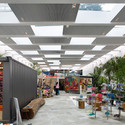

Havaianas Store / Isay Weinfeld

By David Basulto — Filed under: Retail , Selected , , ,
 
© Nelson Kon

© Nelson Kon

Architect: Isay Weinfeld
Location: Sao Paulo, Brazil
Area: 300sqm
Year: 2009
Photos: Nelson Kon

© Nelson Kon © Nelson Kon © Nelson Kon © Nelson Kon

Havaianas Sandals, created in 1962, drew their inspiration from the “zori”, traditional Japanese slippers made of rice straw. A product of extremely low cost, for many years they were just rubber flip-flops, a long way from the fashion icon they are today.

© Nelson Kon

© Nelson Kon

To design a store at one of the world’s most expensive addresses (Rua Oscar Freire, in São Paulo) to sell products that cost from € 2.30 to € 10.00 – and not more than that – was, at one time, the excitement and the joy of the work.

This is Havaianas’ first store in Brazil.

Our greatest challenge was to cast onto the architecture the climate the brand inspires: freshness, casualness, comfort, ease, well-being, Brazilianness.

© Nelson Kon

© Nelson Kon

The shop has a very informal atmosphere and the outcome is nearly a square – a space fully opened onto the street, practically an extension of the sidewalk, without doors or window displays, with lush greenery and intense natural lighting, only covered by a metal grid alternating glass/wooden closures and openings for ventilation and irrigation.

© Nelson Kon

© Nelson Kon

The building develops in descending levels. At street level, just a small lounge area, a mezzanine overlooking the whole store; the store per se, one level below, occupies an ample clear span featuring double-height ceilings, marked by independent elements: a street market stand reminds of the origin of the sandals, initially sold at the city’s free markets; a container displays the ” export” models, so far unseen in Brazil; a transparent cylinder features the so-called “new products” (bags, socks, towels, etc.); and a high-tech cube tells the story of Havaianas. Amidst all that, a lowered area for customization services and featuring displays for the children’s product line. At the back of the store, on a half-raised level, there is a small garden for exclusive use by staff; the underground houses offices and storage areas.


20 comments »

For such a sleek, uncluttered outward form, the interior is remarkably busy, what with the perimeter plantings, partially-screening ceiling, and merchandise-display system.

In any event, it works; I particularly appreciate the discreet inclusion of a shipping container as a semi-enclosed place for certain products. It seems like more other examples of shipping-container architecture always lack a similar sense of moderation; here, it is allowed to coexist in an otherwise “permanent” structure.

 
# September 3, 2009 at 16:03
Joseph says:

Superb!!!!

 
# September 4, 2009 at 14:03
Karen says:

What a beautiful work!
Nice connection with the city and pedestrians. very repectful.
I’m looking foward to see more projects of mr. Weinfeld.

 
# September 4, 2009 at 14:49
john wayne says:

fantastik plastik… it’s just i don’t like turbo consuming artificial non-degradable stuff

 
# September 6, 2009 at 07:22
aa says:

weinfeld is so good. This is not particularly his best… but he’s so good

 
# September 6, 2009 at 10:41

oh, i absolutely adore this!

 
# September 21, 2009 at 04:44
Ill says:

One does wonder why he didn’t make the connection to the street “stronger” by making the whole building 2 storeys high above ground – and the differences this would or would not imply.

 
# December 23, 2009 at 11:49

Links to this article »

Leave a Reply »

Want to have your own avatar? Get yours at Gravatar.

Latest Comments »

I like the overall design of it, but in combination with the abandoned dessert location...[+]
Don’t ask… you’ll just get some lengthy BS answer.[+]
Yes, this is clearly a yourt inspiration :rollseyes:[+]
I like this building … but the pretentious,kitchy heart? …why?[+]
I like the project… a lot. Reading the description, however, makes me want to...[+]
jurgen meier called, he wants his design back.[+]
El Centro Pompidou fue terminado en 1977…[+]
I agree with the comment of ema, any architect should take...[+]
The archetype form they show for a yurt doesn’t even look correct. It looks more...[+]
a Beaubourg coming a little bit late[+]
kudos for that lovely spill of irony…[+]
I can not realize that, how architects can still design useless rooftops in a city like...[+]

Browse by category »

Our partners »

Browse by date »

Friends »

Proudly hosted at »