




-
Architects: José Marini Bragança
- Year: 2008
Text description provided by the architects. The Boavista School is located on the outskirts of the city of Leiria, in a rural atmosphere, between a forest and a road. There were two buildings, side by side, which occupied half of the land. The first was constructed in the 50's, and the second is 20 years old, and was designed by the architect José Marini Bragança. There is now a third building, projected by the same architect.
The new building was developed with the intent to be used by the students of the Boavista School and also by other students from neighboring schools. The building had to respect the following criteria: a kitchen, toilet areas divided by the age and gender of the students and another for the staff, a cafeteria, a multifunction room and an area of leisure.

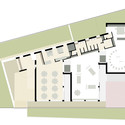
When entering the new gate, we face the three buildings; the first two are aligned and the third is further back. The second building has the highest ceiling height. Since the first two existing buildings were aligned and parallel, the architect decided to design the new building in fragments, thus balancing the unit proportionally, in detriment of a single block. The new school was divided according to functional aspects: the entrance, the kitchen and the cafeteria are located in the first block, the multifunction room and the toilets are located in the second block and the leisure area and the teachers' offices in the third block.

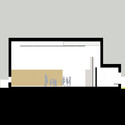
The architect was concerned with the interior of the building and its divisions, taking into account the diverse needs of the students. Small corridors between the rooms help to organize the space and since the ceiling height of the corridors is inferior to those of the classrooms this enhances the grandeur of the latter. The corridor ceilings were lined with wood grids and the walls lined with a cupboard made of the same wood grids. This cupboard occupies one of the walls without obscuring the natural light.
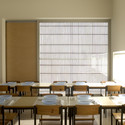
A bench on a porch marks the entrance of the building. The entrance hall is made up of a corridor with another bench which precedes the kitchen and cafeteria area. It is also the place where students from the neighbouring schools can keep their school bags. The cafeteria is spacious and well illuminated. The larger windows face a narrow interior court-yard.

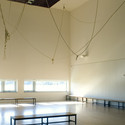
The ceiling height of the multifunctional room is twice the average altitude. This space has a strong connection to the exterior due to its wide windows facing the playground and the horizon.
José Marini Bragança lined the larger wall with bleachers which extend to the other two rooms and serve as cupboard doors that cover most of the wall. Above the bleachers hangs a lamp in the shape of a full moon. Another recreational feature is the ropes which dangle from the ceiling swaying back and forth, giving a charming effect.
The versatility of the room is also reinforced by its location. This area was built in between the three rooms because of the fact that the number of students can vary due to the support given to the children from the neighboring schools. This way it is possible to extend momentarily the cafeteria or the leisure area whenever necessary into this area.
The area of leisure is the most secluded. The soft natural light filters through the wooden grids of the windows, resulting in a serene atmosphere. The court-yard which follows along the glass façade creates a barrier with the playground and protects the room from children's play. The connection to the exterior is softened by the court-yard which is surrounded and partially covered by the wood grids. This way it becomes a natural extension of the interior whenever the sliding doors are open.

"One of the reasons I enjoyed working on this project was the concept of scale; designing for children is different than designing for adults. The children are the main focus of this project. The space is theirs; therefore all of the objects are proportional allowing children to naturally identify with them. There is also a relation between the visual aspect and the landscape. The adults control the playground whereas the students enjoy the landscape." This is why throughout the building the entries of light come from large windows or through long and low horizontal windows.
The service area faces north, whereas the areas of leisure face south. For this reason, the lining materials chosen are different. On the north side, prefabricated cement panels were used, thus reinforcing the protection. This material has an interesting aging process. On the south side, the finishing is done with paint. With time the contrast will accentuate, highlighting the aesthetic features of the building, as natural elements such as moss overtake the structure.
Initially, both schools were separated by walls and the entry was divided by two different gates. In order to unify the space, the architect decided to demolish the walls. Now, all school activities are performed in one single space.

A set of pergolas in the area which surrounds the building unifies the different constructive phases. One interesting detail is the elevation of the lawn next to the wall, which diminishes the height, resulting in a scale proportional for children.
A parking lot was built in front of the new school. The reason why the school area does not extend to the main road is to avoid joining the playground to a neighboring house. By creating this public area, the entire playground is confined to the forest and the nearest house only joins the public area.
This equipment was intended for the use of youngsters, and the original solutions proposed by the architect work in order to differentiate the school atmosphere from the one at home, thus expanding their horizons.


