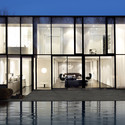
House 60 / gh3
Architects: gh3
Location: Toronto, Ontario, Canada
Design Team: Pat Hanson, Diana Gerrard, Raymond Chow, Liza Stiff, Vivian Chin
Structural Engineer: Blackwell Bowick
General Contractor: Blue Springs Construction
Project year: 2008-2009
Budget: CAD$800,000
Constructed Area: 315 sqm
Photographs: Carlyle Routh
House 60 is a renovation and addition to a 50’s suburban house on a large lot in Toronto, Canada.
The existing house was largely introverted—small windows, low ceilings—with a traditional plan—living room, separate dining room and cramped kitchen on the ground floor, and a maze of bedrooms on the second. An undistinguished building from the exterior—brick with a shallow sloping roof—adorned over time with a wrought iron front porch and aluminum awnings. However underwhelming, the existing house was considered by gh3 as a material resource to be reused, rather than abandoned, a position consistent with first principles of sustainability.
Additions were made to both the front and rear of the house resulting in 2 new facades and accomplishing the re–imaging of the house. Much of the house was re–skinned. This, in combination with the installation of significant interior insulation, greatly reduced the energy requirements of the house. The existing pitched roof was removed and a new flat roof, insulated well beyond code requirements, completed the new high performing envelope.
A 2–storey glass wall at the rear of the house, a 1–storey glass wall at front, and multiple skylights maximize the admission of daylight and facilitate passive ventilation. The extensive use of glass at the rear allows for the greatest number of views to the garden and at the front, serves as a modern day front porch, reconnecting the building with its site and the city.
The ground floor of the house is organized as a continuous open space to allow for the changing patterns of use of a growing family. The principle living space is flanked longitudinally on both sides with service zones containing storage, media units, a pantry, stairs and mechanical spaces, set behind full–height pivoting wall panels. Floor-to-ceiling glass panels are strategically positioned on the ground and second floors to provide safety for young children while allowing views through all of the principle living spaces. Glass panels and walls are selectively fritted with a super–scaled flock pattern, which amplifies the whiteness of the interior.
- ground floor plan
- second floor plan
- elevations 01
- elevations 02
- sections
on the
-- 


20 comments »
for me is more a yes than any other thing.
Just amazing. Clean, sleek, and savvy.
that is all.
that is all.
Why is architecture becoming so vague and uninteresting. Yes it clean and sofisticated but wheres that sparkle in its eye, wheres the little elements that you always remember. this is just another house entirley done in Viz or another computer program….great to get perspectives and reflections…but its NOT a home, its a capsule to keep your expensive furniture in
These spaces are exceptionally well planned, but the whole comes off rather tepid. My guess is that this is a consequence of the detailing which, seems to lack the courage to be truly minimal or not.
Neither do I have anything against the use of bold pattern. Here, though, the reference to flocked wallpaper just looks like yuppie kitsch to me.
There are great artistic surfaces out there in the world to use. For instance I recall that the Osler residence in Brasilia by Marcio Kogan, here published http://www.archdaily.com/6446/osler-house-marcio-kogan/ made outstanding use of the designs of artist Athos Bulcão whose materials are still available http://www.fundathos.org.br/
Why not use real artists to make interesting surfaces?
Finally, I really do question the appropriateness of some of these choices for a house with growing children. Particularly the use of features like the glazed divider in the photograph don’t seem very well thought out. At least the kids might smear the walls with chocolate and give this structure some gestural life.
Terry Glenn Phipps
first good “box architecture” seen a wile
i reaaaallly ike the textures mixing, this shows how there’s not everything said in box houses, and how architecture can be reinvented. for those hwo said “stop builoding those boring box houses, this ain’t boring at aallllllllllllll
Very nice. The subtle textures are wonderful as is the hardwood floors and clean interior spaces.
In the external view we see the curtains open to expose the rooms. But in all the internal shots the curtains are closed. The view out must be horrendous. Mrs Smythe, are you putting washing on the line in the nuddy again?
A little hint of colour in the furnishings would have been nice.
hey rek, what’s the funny architceture that you love?those funkies designs that emulate in a horrible way the traditional old style made in plastic, or those things that pretend seem like a cell or something organic?i don’t know why the architecture has to be like a circus ore ridiculous multy curves or others like bugs.the architecture doesn’t have to seem like any other thing.it’s a house, period, nothing else.dont’t get confuse.
Elegant but sad.
who says minimalism is boring? so clean and elegant in its finishes.
i bet there is a lot more color when the camera is not around with kids toys etc etc.
Tiene la elegancia del Pabellón de Barcelona…
White box architecture done right. I like this project.
It would be nice to see some exterior photos in the daytime, I would interested to see how it sits in its context.
boring, like hundreds of other box houses
looks coporate and very cold, a lot of superfluous interior design. A nice generic box.
some time that i didn’t see a house with curtains…
it’s nice to see a home with the true way of occupy.
Links to this article »