

Support on the -- Click here to nominate us for Best Online Magazine!Close
Become a fan of ArchDaily on Facebook!

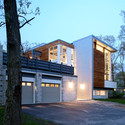
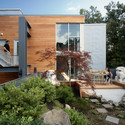
Big Dig House / Single Speed Design

By Nico Saieh — Filed under: Houses , Selected , , , ,
 

The Big Dig is the most expensive highway project in the history of the US. The project included rerouting the Central Artery into a tunnel under the heart of Boston, requiring a tremendous engineering work due to underlaying metro lines and pipes and utility lines that would have to be replaced or moved. Tunnel workers encountered many unexpected geological and archaeological barriers, ranging from glacial debris to foundations of buried houses and a number of sunken ships lying within the reclaimed land.

The Big Dig House by Single Speed Design reutilizes materials from the Big Dig. In that aspect, it´s a remarkable example of recycling in architecture. Project description by the architects after the break.

Architects: Single Speed Design
Location: Lexington, MA, USA
Programme: Private House
Completion year: 2008
Site Area: 1,784 sqm
Constructed Area: 353 sqm
Photographs: Single Speed Design

As a prototype building that demonstrates how infrastructural refuse can be salvaged and reused, the structural system for this 3,400sf house is comprised of steel and concrete discarded from Boston’s Big Dig utilizing over 600,000 lbs of salvaged materials from elevated portions of the now dismantled I-93 highway. Planning the reassembly of the materials in a similar way one would systematically compose with a pre-fab system, subtle spatial arrangements are created from the large-scale highway components.

installation sequence animation

These same components however are capable of carrying much higher loads than standard building materials, thus easily allowing the integration of large scale planted roof gardens. Most importantly, the project demonstrates an untapped potential for the public realm: with strategic front-end planning, much needed community programs including schools, libraries, and housing could be constructed whenever infrastructure is deconstructed, saving valuable resources, embodied energy, and taxpayer dollars.


31 comments »

too much structure and then what?
it seems it is unnecessary, and it doesn’t create the impact that it may.

i don’t understand why loads of metal and then this minimum result. i think the architects didn’t realy know what they wanted to project!

 
# June 24, 2009 at 15:39
ptrlng says:

This house looks great. I love the coloring of the exterior wood.

 
# June 24, 2009 at 15:43
shreyank says:

i wish it was so easy to use steel structures…. lucky folks…

 
# June 24, 2009 at 16:40
shreyank says:

there’s something nostalgic about this building… cant really get to a particular conclusion…

 
# June 24, 2009 at 16:41
susanna says:

the house is ok, but the interior…

 
# June 24, 2009 at 16:52
kd says:

I just watched an episode of e2, a PBS series, based on this house and the adaptive reuse concept. It’s available to stream online on netflix if anyone’s interested. I believe it’s e2 season 1, episode 5.

 
# June 24, 2009 at 18:44

Please note that the structure was recycled from elements used on the Big Dig, one of the largest infrastructure projects in the world, a urban case study.

The steel structure you see, was formerly a temporary support holding up the elevated Central Artery during construction.

http://en.wikipedia.org/wiki/Big_Dig_(Boston,_Massachusetts)

 
# June 24, 2009 at 18:50
viniruski says:

Nico: Would using recycled steel/precast assemblies be cheaper than say light woodframe? Is all that structure, even though re-used adaptively, overkill for a house?

 
# June 24, 2009 at 19:50
dustin says:

@themirrorballman, if you read the text you will realize that all the steel used is recycled, the are not only using this to make a recycled house but this way the hay a very strong structure to support some future trees on the roof terrace, please read before an unfundamented negative criticsm, I would love to own this house…

 
# June 24, 2009 at 19:54

maybe i didn’t explain myself really well, or maybe is my knowledge of english that didn’t fit my critics (cause i’m spanish) sorry
i wasn’t talking about if the steel was recycled or not, a thing that i find quite interesting, i was talking about the roll of the structure in that house, a roll that i still can understand. if we have a look to the Hemeroscopium House we can see that the structure is the main character of the house. About the Big Dig House, we can see that the architects were trying something like these, a thing that we can see in the constructions photos.
We can see a house which takes a big quantity of steel and the result is a house that could be built with all the structure hidden. The structure plays a confusing roll, and more remarkable is that it’s recycled!! it’s roll must be so much important than it’s now.

You’ll understand me if you have a look to the Hemeroscopium house (only to contrast the use of structure and the results).

 
# June 24, 2009 at 20:32
ricardo says:

sujeiraaa acumula nas estruturas… não acho funcional

 
# June 24, 2009 at 20:55
castilleja says:

well ‘themirrorballman’ and ‘ricardo,’ the structure clearly plays a role aesthetically as well as functionally. to support this argument, all one needs to do is to read the text that the architects have supplied as well as to look at the images shown. the exterior structure is intertwined with the views on the interior and plays an integral part in keeping the visual rhythm and datum; not to mention future necessities of the structure and program of the house. I think it a very well thought out solution to a design problem.

 
# June 24, 2009 at 21:15
Fino says:

I think this is pretty amazing. I most often find aesthetics in structurally bold architecture….especially with steel. I love the bridge-like elements and those massive steel girders in the living room…….oh so sexy.

that is all.

 
# June 24, 2009 at 22:24
dustin says:

@themirrorballman, esta casa y la casa hemeroscopium utilizan metodos de diseño y conceptos muy distintos, y por lo tanto no son comparables. La decision de dejar la estructura visible fue sin duda una solución pensada y razonada. Si se hubiera escondido la estructura no tendria mucho extraordinario la casa, pero al dejarlo visible no solo estas enseñando la pureza de los materiales, sino aparte se muestra una estructura que ya tiene otra historia contada. Siento que hubiera sido un pecado tener como concepto principal la reutilización de materiales simplemente para posteriormente esconderlos.
El proceso de diseño fue al revez en este caso, primero se contó con los materiales prefabricados y despues se diseño el espacio de acuerdo a estos. por lo tanto la estructura que puede parecer sobrante, en realidad es una expresion viva de su anterior uso. Los arquitectos aprovechan esta estructura de una manera muy inteligente para hacer un jardín superior. Los árboles y su basamento necesitan mas que una simple estructura convencional.

 
# June 25, 2009 at 02:24
Themirrorballman says:

Sigo sin entender la casa asi como el papel que juega la estructura, mas bien secundario
sigo viendo dos casas distintas, y un uso de estructura poco fundamentado

aun asi muchas gracias dustin

ps. Cite la casa hemeroscopium solo para contrastar, sin duda es otro concepto

 
# June 25, 2009 at 05:33
malgorzata boguslaw says:

THe exterior steel strucure looks very nice and makes this house different then other ones.I love the exterior stair leading to he roof garden. The interior is a little bit dissapointing ant too minimalistic.But the hole project is very interesting, which cant’t be said of majority of projects shown here.

 
# June 25, 2009 at 05:56
Gallego says:

Well, I’m confused by this project.. from one point of view it’s great: if the challenge is to take some leftovers and make a house of them, then the result is brilliant… but when you look at it the other way round, i.e. from the result point of view, then you see a plenty of purposeless elements, that wouldn’t be there if the creator had more freedom.. I mean, you cannot fully appreciate the house without the background story… it’s like art today: you take a piece of scrapmetal and to give it a meaning, you write the meaning on a label next to it. but if the meaning isn’t obvious without the label, then it’s a piece of scrapmetal, not art! and the background story of this house is this kind of art-piece label..

 
# June 25, 2009 at 06:06
Gravy says:

What is art anyway?

 
# June 25, 2009 at 09:34
Joshua says:

@ Gravy

lmfao

 
# June 25, 2009 at 11:09
whistler says:

Nice strategy and very relevant, but the execution IMO is confusing and not as clear as the original conceptual Idea.

 
# June 25, 2009 at 11:50
LV says:

I want to go to there!

 
# June 26, 2009 at 13:23
Lucas Gray says:

I am interested to see what this will look like in 5 years when the wood has aged and is a dull gray. Not that it will be bad. Often aged wood introduces a new layer of time and interesting color and texture to a project (especially in conjunction with concrete). However, here it seems the aesthetic is reliant on the warm bright natural wood color to contrast with the coldness of the steel structure.

 
# June 26, 2009 at 15:36
Joshua says:

@Lucas

Totally agree. I want to see it with the steel rusted, the bolts fused permanently, the cladding splintering and sagging, the roof trees fully grown and the other vegetation overgrown.

Like so much of America’s infrastructure. Ever read ‘Monuments of Passaic’ by Robert Sullivan?

 
# June 26, 2009 at 15:48
Buzz says:

nope, some of you are wrong. interiors are money, just like the exteriors. pretty solid solution for a lucky inspiration. i’d set up shop inside this place in a heart beat

 
# July 2, 2009 at 14:33
PICASSO_BMT762 says:

I LIKE IT VERY MUCH.

 
# July 20, 2009 at 09:00

Links to this article »

Leave a Reply »

Want to have your own avatar? Get yours at Gravatar.

Latest Comments »

Little girl on Turtagro Hotel / JVA:
Tough it is some kind of out of fasion,it conveies us a simple style...[+]
Too much is going on here… Too many stories...[+]
i thought it was a post office so lame the nightlife is...[+]
a bold project. has a lot to say about...[+]
beautiful project. very generous interior...[+]
Are there any lists that go deeper than 10? I...[+]
here’s a suggestion: how about if...[+]
i think it would be inappropriate to say...[+]
Mmmh, is this is 1993 and this is Culver City?...[+]
I like the intervention. The previous building was a dog...[+]
Beautiful landscaping. The house has a nice...[+]
I want to take a bottle of tomato...[+]

Browse by category »

Our partners »

Browse by date »

Friends »

Proudly hosted at »