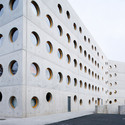
Research Library in Hradec Kralove / Projektil Architekti

Uploaded by — Filed under: Museums and Libraries ,Selected , , ,
 

Architects: Projektil architekti s.r.o., Roman Brychta, Adam Halíř, Ondřej Hofmeister, Petr Lešek
Location: Hradecká 2, Hradec Králové, Czech Republic
Investor: Studijní a vědecká knihovna v Hradci Králové, Ministerstvo kultury ČR
Collaborators: Markéta Jurečková, Jan Kolář
Graphic design: grafické studio Kultivar – Zuzana B.Horecká, Jana Honecová, Jean-Marie Delafontaine, grafické studio Pixl-e – Ondřej Doležal, Pavlína Doležalová, Filip Mont
Art work: Martina Novotná
Planning: PRO KIC – sdružení ateliérů s.r.o. a / Deltaplán s.r.o.(ing. Miloš Kosek, ing. Petr Kniha)
Costs: CZK 394,5 mil.
Constructed area: 2,920 sqm
General contactor: VCES a.s.
Design year: 2002-2004
Project year: 2004-2008
Phorographs: Andrea Lhotakova

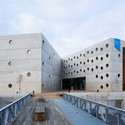
The Research Library in the Czech Republic was designed by the Prague-based architectural studio Projektil architekti.

Opened in September 2008, the new library is the result of the winning proposal in an open architectural competition in 2002. It is situated on a river bank in the Eastern Bohemian town of Hradec Králové, near the secondary school building designed by famous Czech architect Josef Gočár (1880-1960).

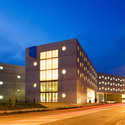
The five-storey building represents a construction with the final visual in the form of a monolithic façade. The original shape of the building is the precast letter “X”.

fourth floor axo

The building is cut through in the parterre. One can walk through the building without entering the institution – library. The building creates an open public urban space, which complies with the ideas of architects (Projektil) about openness of public buildings, as far as architecture is concerned.

From the path, one can enter the library, the café (on the south side), and the exhibition hall (north side, by the river).

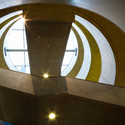
Entry library hall is situated in the center of the X-shaped building. There is the main vertical communication (open stairways, and elevator) illumination by a circle roof light. The distribution of visitors, librarians, and books takes place from the central vertical point to the four wings of the X building.

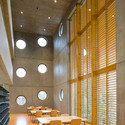
Public space is located in the two eastern wings and occupies three floors. There are bookshelves, study rooms, individual study rooms, and a service counter. In other wings there are offices, storage and on the fifth floor of office wings there is a conference hall.

The interior is also made from concrete. The colored floor plays an important role for the indoor atmosphere. Each floor has a different color. Architects invited artists and graphic designers for collaboration on the interior design. Inside, there are two big wall paintings and a new navigation and information system.

The structure is made from in situ cast concrete – both inside and outside. For heating we use the BKT system (radiant/ concealed heating/cooling inside the concrete construction). Interior finishes are made from exposed concrete, colored floors, colored doors, white or maple acoustic panels, wooden tables and chairs, and the bookshelves are made from galvanized sheet.

The concept of the building is the energy-saving building.


Thumb up Thumb down 0
CMO ARCH says:

Wouldn’t mind a site plan, otherwise I think this is great! Facade work looks very nice and simple. But the site plan might help me make sense of the overall shape.

 
# June 3, 2009 at 23:06
Thumb up Thumb down 0
viniruski says:

Massing and form loses conviction of a potentially strong central space where various elements converge. Perhaps an atrium space smack in the middle? Or have configure circulation to establish view lines from one end of the floor to another? Plans look really fragmented without any tying elements. But it’s nice to see a concrete facade with subtle nuances on each face.

 
# June 4, 2009 at 00:00
Thumb up Thumb down 0
Lucas Gray says:

There is an atrium right in the middle with nice spiraling stair cases. Not sure what the question is, viniruski. I do agree that a site plan with some context would give a better understanding to its form.

I love the facade and the interior spaces seem open, well lit and comfortable. Elegant materials and nice detailing.

 
# June 4, 2009 at 02:45
Thumb up Thumb down 0
viniruski says:

Lucas:

I’m thinking a grander atrium like Sharon’s library in Berlin, or OMA’s library in Seattle where there are numerous atria penetrating through the floors ties all the spaces together.

The axos shown here seem appropriate given the stretched ‘x’ cruciform, but they don’t really show any hierarchy of spaces or elements as any architectural eye desires to see, and as a result looks like some legacy of Czech communism. The form has the potential for something really significant: an intersection? a meeting place? or even a means of emphasizing contrast or contradiction. I don’t know. Too early in the morning.

Any thoughts?

 
# June 4, 2009 at 10:06
Thumb up Thumb down 0
Dustin says:

looks a lot like the Mexico City airport.

 
# November 9, 2009 at 16:16
Thumb up Thumb down 0
Frank says:

It is a warehouse for books: no facade, no piece of art, with security guard in the black uniform right at the entrance, bad lighted working spaces for staff, no meeting place for visitors, separated entrances for café and gallery, no arrangement for cleaning the windows…
As a user I enjoy using the selfservice arrangement of periodicals and dislike daily light from the top in the reading room.

 
# June 27, 2010 at 11:06

Leave a Reply »


Latest Comments »

Not to take away from Switzer or...[+]
ArchDaily features nice projects. But is obviously run by morons.[+]
They thought about the scale of wood. The intent is to use Trestlewood, which is wood...[+]
So creepy![+]
why is heidi montag in every swimming pool project? nice[+]

Upcoming Architecture Events »

got events? invite us! click here

Architecture Books & Magazines »

Passive Solar Architecture / David A. Bainbridge and Ken Haggard

Passive Solar Architecture / David A. Bainbridge and Ken Haggard

David Bainbridge, founder of the Passive Solar Institute, recently sent us his book Passive Solar Architecture. The book is a great introduction for anyone interested in passive solar architecture. The content is kept simple and straightforward. It allows any…


KieranTimberlake: Inquiry

KieranTimberlake: Inquiry

We recently received KieranTimberlake’s newest book, Inquiry. Instead of listing one project after the next, as in most monographs, this book is organized around ten gerunds: bending, coupling, filtering, inserting, offsetting, outlining, overlapping, puncturing, reflecting, and tuning. This is…


Mark Magazine #33

Mark Magazine #33

We recently received the newest edition of Mark Magazine. Number 33 offers in depth looks of several  projects ArchDaily has previously featured such as: Sunset Chapel by BNKR Arquitectura, iGuzzini Illuminazione Spain Headquarters by MiAS Arquitectes, Villa Geldrop by Hofman Dujardin…


Our partners »

AD on iPad via Pulse

Browse by date »

Browse by category »

Friends »