
CCT Building / Saucier + Perrotte architectes

Uploaded by — Filed under: Educational ,Selected , , , ,
 

Architects: Saucier + Perrotte architectes
Location: Mississauga, Ontario, Canada
Project team: Alain Desforges, Andrew Butler, Thomas Balaban, Anna Bendix, Nathalie Cloutier, Dominique Dumais, Éric Dupras, Louis-Philippe Frappier, Darrell de Grandmont, Louis-Charles Lasnier, Christine Levine, Jean-François Mathieu, Claudio Nunez, Benjamin Rankin, Pierre-Alexandre Rhéaume, Samantha Schneider
Structural Engineer: Quinn Dressel
Mechanical & Electrical engineer: RYBKA, SMITH AND GINSLER
Landscape & Interiors:
Contractor: Ellis Don
Client: of Toronto at Mississauga, Mississauga
Constructed Area: 10,800 sqm
Project year: 2004
Photographs: Marc Cramer

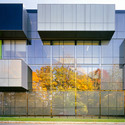
Located at the edge of the Campus, the new Communication, Culture and Technology Building assumes the role of an interface. Organized along the principal façade, the building is closely bordered by a park on one side and a new courtyard garden on the other. Its main circulation creates a linear public space that provides a line of connection between the Student Centre and the future library as well as between the landscape and the building’s public and educational spaces. CCT becomes a place of transition, adjacency and inhabitation all at once.

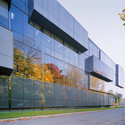
The glazed vertical surface of this connection acts as a thickened membrane which becomes a technological filter between the existing, natural material of the forest and the tamed, controlled environment of the building and its garden. At the level of the ground, the membrane is completely transparent; the line between exterior and interior disappears. The earth plane forms a continuous public room that slips into the building, flows through it toward the courtyard, onto the landscaped roof of the garage and into the campus beyond.

The offices and most of the classrooms are oriented either towards the park or the courtyard garden. Operable windows allow significant cross-ventilation of all common areas and provide a controlled passive cooling system for the offices.

east elevation

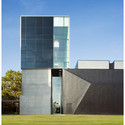
The elevation plays between the rational and the intuitive, interfering with the integrity of the planar surface, not allowing the impression to coalesce easily into one image or a definable whole.

Like the bark of the London Plane trees conserved on the site, the layers of landscape detach and lift, establishing a new topography from which grow both the building and its garden landscape. Nestled into this landscape are the building’s ‘mineral’ public functions (Multi-Media Studio Theatre, the E-Gallery and the Image Bar), each with its own identity yet tied together by the new terrain. Continuous, interwoven strands of this topography lift and wind vertically through the structure, connecting spaces between the shifting program elements, which puncture the vertical façade membrane at its upper levels. This in-between space, occupied by platforms, bridges, stairs and ramps, fosters openness and interaction between the occupants, program and the outside environment, each allowed to flow through the envelope by means of the shifting solids. Fluid public space is thereby created, reinforcing the uniqueness of the campus.

 
 
Thumb up Thumb down 0
elvaquero says:

…Although this might probably be one of their most “boring” projects [formally speaking; it's kind of boxy], it’s still an amazingly detailed and executed buidling. The use of natural light is impresive.

 
# April 13, 2009 at 10:33
Thumb up Thumb down 0
Lucas Gray says:

They do have nice elegant detailing on all of their projects. This is very nice for a large institutional project!

 
# April 13, 2009 at 14:38
Thumb up Thumb down 0
sgurin says:

Мне нравится.
I like it. Good.

 
# April 14, 2009 at 00:39

Leave a Reply »


Latest Comments »

Coffee with an Architect has got to stop; it’s pathetic.[+]
Has archdaily started a new...[+]
I’ll add one, based on these comments: Architects are easily offended.[+]
Just something he learned from Rem Koolhaas, again and again...[+]
Why not try and improve the existing...[+]

Upcoming Architecture Events »

got events? invite us! click here

Architecture Books & Magazines »

Golconde: The Introduction of Modernism in India

Golconde: The Introduction of Modernism in India

Sited on the coastal edge of the Bay of Bengal, Golconde, a dormitory for the Sri Aurobindo Ashram in Pondicherry, India, was designed by architects Antonin Raymond and George Nakashima. Golconde is a remarkable architectural edifice, seemlessly negotiating between


OFIS_open archive files 98-11 / OFIS Arhitekti

OFIS_open archive files 98-11 / OFIS Arhitekti

Our friends over at OFIS Arhitekti recently sent us a copy of their latest book that showcases their work, which includes a foreword from David Basulto, Founder & Editor of ArchDaily. We have featured a good deal of the…


Combinatory Urbanism: The Complex Behavior of Collective Form

Combinatory Urbanism: The Complex Behavior of Collective Form

Thom Mayne recently sent us his latest book, Combinatory Urbanism: The Complex Behavior of Collective Form.  MIT Professor of Urban Design and Landscape Architecture, Alan Berger, hails this book as “nothing short of a tour de force and should be…


Our partners »

AD on iPad via Pulse

Browse by date »

Browse by category »

Friends »