

Musical Instrument Museum / RSP Architects

Uploaded by — Filed under: Cultural ,Museums and Libraries ,Selected , , , ,
 

© Bill Timmerman

Architect: RSP Architects
Location: ,
Project Year: 2010
Project Area: 190,000SqFt
Client: Musical Instrument Museum
Design Team: RSP Architects with Rich Varda, FAIA
General Contractor: Ryan Construction
Engineer: Meyer, Borgman and Johnson
Photography: Bill Timmerman


© Bill Timmerman

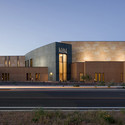
The new $150 million, 190,000 sf Musical Instrument Museum (MIM), designed by RSP Architects opened in April 2010 on a 22-acre site in north Phoenix. Designed by RSP Architects with Richard Varda, FAIA, MIM was completed in 39 months. The modern massing and mix of simple forms recalls the mountainous desert landscape. The solid volumes of the galleries and theater form a wall against the harsh desert climate, penetrated by courtyards that invite patrons to enter the museum and partake in a wide spectrum of musical performances. The central circulation space, which cuts north-south through the solid masses of the museum, acts as the primary organizing element. It gracefully connects the theater, galleries and courtyards. The intentional simplicity contrasts with the vast complexity of the musical instruments contained within the galleries.

© Bill Timmerman

MIM’s structure of reinforced concrete with exterior materials of Indian teak sandstone and stucco creates a distinctive architecture that evokes the topography of the Southwest. Sustainable features include an exterior sunscreen wall application for the stone, fly ash in the concrete, 25,000 sf of photovoltaic solar panels on the second-story roof areas, a chemical-free chilled water system and a grey water irrigation system. The museum’s location in a desert climate necessitated extensive xeriscaping and sophisticated mechanical systems to maintain stringent temperature and humidity levels for the instruments.

© Bill Timmerman

The two-story museum structure includes 75,000 square feet of gallery space, with a 450-foot-long flowing river-like corridor called “El Rio” that creates the spine of the museum, links the central atrium to the interior galleries, and offers changing views of the space. Wall finishes in Venetian plaster create patterns that evoke geological striations of the Arizona cliffs and canyons and allude to the rhythms of musical composition. Diffused daylight illuminates the galleries and public spaces through a ribbon of windows and skylights in an abstract pattern much like piano keys. With a dynamic spiral staircase, featuring a unique floor mosaic map of the world created with multi- colored stones from around the world and topped with an oculus skylight, connects the two floors of galleries.

© Bill Timmerman

The world map concept was developed by RSP Architects, as part of the overall stair design. The original ideas focused on how the floor could add to the visitor experience. The circular stair form suggests a compass or world map. As the design developed, the idea of repeating the gallery world map came forward. This is the same map used throughout the galleries that depicts the various geographic regions used to display the instruments.

© Bill Timmerman

MIM’s has approximately 3,000 of their 12,000 instruments and objects collection on display in galleries that focus on five global regions. There is also a special Artist Gallery that features noteworthy instruments played by many of the world’s leading musicians.

© Bill Timmerman

The second floor is devoted to MIM’s extensive core collections, arranged in five Geo-Galleries that feature soft maple wood flooring and cherry wood doorway portals, hinting at the transition between geographical regions as guests pass through the galleries.

© Bill Timmerman

The 300-seat state-of-the-art music performance theater is integral to the MIM visitor experience. It was designed expressly for the acoustic performances to showcase exotic instruments from around the world. The theater includes audio, visual, recording and production capabilities as well as high definition projection capabilities to capture, broadcast, and/or reproduce content for distribution. In addition to acoustic performances, the theater is designed to support dance, choral and amplified and spoken word presentations.

© Bill Timmerman

MIM enriches the world community by collecting, preserving, and making accessible high-quality musical instruments, images, and music from every country in the world. The museum celebrates the world’s diverse musical cultures and fosters global understanding by offering visitors an incomparable interactive experience in a welcome and fun environment with dynamic programming and exceptional musical performances.
* Location to be used only as a reference. It could indicate city/country but not exact address.
 
 
Thumb up Thumb down 0
Chiaro Scuro says:

When I looked at the plan, I never realized how much space is needed for administration over gallery space in a museum. Is this common for most museums?

 
# November 13, 2011 at 09:36
Thumb up Thumb down 0
Chavo says:

I have visited this museum and I can say that although the exhibits are fantastic, the architecture is really bad. The facade makes it look more like any other of the crappy institutional buildings around the area. Some of the spaces are awkward, and a lot of space is wasted. If you look at it in terms of urbansim, the museum is in a very remote area of north phoenix, and can only be arrived to by car.
When I left the museum, I was disappointed to see that such a great idea ended up in such a poor building. I know this makes me sound very snobbish, but it honestly was a very bad design.

 
# November 13, 2011 at 11:07
Thumb up Thumb down 0
Jason says:

I’m not 100% sure but I think that area might include storage for what’s not on display, and workshops for working on the instruments and stuff like that. It would also include all the different support spaces for the theater. There’s probably not much office space.

 
# November 13, 2011 at 14:48
    Thumb up Thumb down 0
    Chiaro Scuro says:

    I also suspect that the Architects left out the other plan. From the pictures, I noticed that there is another floor.

     
    # November 14, 2011 at 09:03
Thumb up Thumb down 0
rich says:

The second floor is almost all gallery space and is 2/3 the size of ground floor.

 
# November 14, 2011 at 11:47
Thumb up Thumb down 0
Luciano says:

Yeah, it’s missing another plan. Maybe more of one. That’s sad, ‘cos I prefer to analize the plans even before the facade of the buildings. However, it’s certain that administration areas are large at the most buildings. Even in a Theater, the administration area can reach 50% of the total area…

 
# November 14, 2011 at 11:52
Thumb up Thumb down 0

10:21 AM Nov 14th

@PuaKim @CaptainJaxe @iamfionash http://t.co/VcY4wKHv i thought it was you guys….#Doppelgänger

Thumb up Thumb down 0

4:10 PM Nov 14th

#Musical #Instrument #Museum / RSP #Architects http://t.co/71eDDLfK via @zite

Thumb up Thumb down 0

4:39 PM Nov 14th

Musical Instrument Museum / RSP Architects http://t.co/VgUm0wpK #architecture

Thumb up Thumb down 0

12:48 AM Nov 15th

Musical Instrument Museum / RSP Architects http://t.co/QmI1bm3N

Thumb up Thumb down 0

3:38 AM Nov 15th

Musical Instrument Museum / RSP Architects http://t.co/4m9YMgt0 via @archdaily

Thumb up Thumb down 0

5:10 AM Nov 15th

Musical Instrument Museum / RSP Architects
http://t.co/7Xd7ISOQ
#architecture #museum #interiordesign

Thumb up Thumb down 0

6:54 AM Nov 15th

Musical Instrument Museum / RSP Architects | ArchDaily – http://t.co/BXRJhhmf

Thumb up Thumb down 0

7:22 AM Nov 15th

Musical Instrument Museum / RSP Architects http://t.co/pyxjigaJ

Thumb up Thumb down 0

3:10 AM Nov 19th

Musical Instrument Museum / RSP Architects http://t.co/VgUm0wpK #architecture

Thumb up Thumb down 0

5:12 PM Nov 19th

Musical Instrument Museum / RSP Architects http://t.co/VgUm0wpK #architecture

Leave a Reply »


Latest Comments »

This summit20 gonna be very knowledge sharing. discussion on immediate and long...[+]
very beautiful structure have been shared. i like second one from the...[+]
silly but wishful thinking. also, I believe that...[+]
It has to be...[+]
very good .[+]

Upcoming Architecture Events »

got events? invite us! click here

Architecture Books & Magazines »

This is Hybrid / a+t research group

This is Hybrid / a+t research group

Following years of research, a+t publishers presents the first theoretical-practical book on hybrid buildings. Taking its inspiration from the four issues of a+t magazine’s Hybrid series, the book takes a look at the theories and projects which have had…


Strategy Space / a+t: Landscape Urbanism Strategies

Strategy Space / a+t: Landscape Urbanism Strategies

Landscape Urbanism is the new black in architecture and this magazine, part of a+t strategy series, has heads turning. There are a dozen projects and hundreds of ideas in this edition. A recurring them is the manipulation of time…


Work Environments / DETAIL

Work Environments / DETAIL

We recently got to preview the newest addition to In DETAIL’s typological series, Work Environments: Spatial concepts, Usage strategies, Communications. It will be available next month (August 2011), and it is great for anyone who is interested in improving…


Our partners »

AD on iPad via Pulse

Browse by date »

Browse by category »

Friends »