
Petter Dass Museum / Snøhetta

Uploaded by — Filed under: Museums and Libraries ,Selected , ,
 

Architects: Snøhetta
Location: Alstahaug,
Project year: 2001-2007
Collaborators: Kjetil Traedal Thorsen, Tarald Lundevall, Astrid Renata Van Veen, Jim Dodson, Bartek Milewski, Maria Svaland, Jenny B. Osuldsen, Lars Jørstad Nordbye, Heidi Pettersvold
Client: Alstahaug kommune
Constructed Area: 1350 sqm
Photographs: Snøhetta, Aake E. Lindman, Inge Ove Tysnes

Introduction

The project involved designing a new 1350m2 museum building, a landscape plan for the surrounding site, parking facilities and a service building. The project was financed by Alstahaug kommune, Nordland fylkeskommune, Kultur- og kirkedepartementet and commercial contributions. Snøhetta have continuously been involved in the process since 2001 and until the opening of the museum on October the 20th 2007.

Building in a mountain

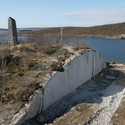
Petter Dass is one of Norways most important and beloved National poets. He was also the Vicar at Alstahaug church from 1689 until his death in 1707. The strong historical importance of the surroundings made the task of locating and designing a new building on the site sensitive and very challenging. Snøhetta´s team decided to make a new site by making a cut in the landscape.

This cut allows a freestanding building which in volume balances the mass removed. This bold solution creates a new but humble relationship to the historical sites, as well as allowing an expressive architecture. In this way the new museum contributes to visualise the historical span from the origin of the church to our time.

The site is defined by two 70 meter long wire-cut rock walls 15.5 meters apart. Between these walls a new ground level is established. The museum itself is 11.5 meters wide creating a 2 meter clearance to the rock wall on ether side. This open space reviles a new sightline and allows the visitors to circulate between the building and the rock walls.

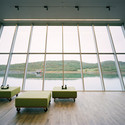
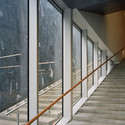
Snøhetta’s overall intention has been to integrate the building with the landscape by letting the roof section relate to the section of the terrain. The transparent walls of the museums ground floor emphasizes the relationship between the landscape and building. At both ends of the closed and “floating” volume there are large glass surfaces, offering views towards the church on one side and towards the sky on the other.

Though this visual contact the building represents a relationship between the historical site representing the past, and the view towards the sky represents the future. The museum building itself represents the present and links Petter Dass´s achivements to our time, 300 years after his death.


Thumb up Thumb down 0
Archenx says:

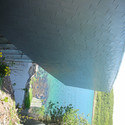
Nice project, I like the idea of integration with the existing landscape. And it would be great if more details could be provided and some of the photos could get reversed.

 
# May 30, 2008 at 18:22
Thumb up Thumb down 0
Erling says:

Fantastic view from those windows.

 
# February 18, 2009 at 12:50
Thumb up Thumb down 0

Just desire to say your article is as surprising. The clearness to your submit is just excellent and that i can think you are an expert on this subject. Well together with your permission let me to grasp your RSS feed to keep up to date with imminent post. Thank you one million and please keep up the gratifying work.

 
# November 16, 2011 at 01:29

Leave a Reply »


Latest Comments »

Has archdaily started a new...[+]
I’ll add one, based on these comments: Architects are easily offended.[+]
Just something he learned from Rem Koolhaas, again and again...[+]
Why not try and improve the existing...[+]
What even is that lake room oval thing!!?? I still don’t know…[+]

Upcoming Architecture Events »

got events? invite us! click here

Architecture Books & Magazines »

KieranTimberlake: Inquiry

KieranTimberlake: Inquiry

We recently received KieranTimberlake’s newest book, Inquiry. Instead of listing one project after the next, as in most monographs, this book is organized around ten gerunds: bending, coupling, filtering, inserting, offsetting, outlining, overlapping, puncturing, reflecting, and tuning. This is…


Passive Solar Architecture / David A. Bainbridge and Ken Haggard

Passive Solar Architecture / David A. Bainbridge and Ken Haggard

David Bainbridge, founder of the Passive Solar Institute, recently sent us his book Passive Solar Architecture. The book is a great introduction for anyone interested in passive solar architecture. The content is kept simple and straightforward. It allows any…


Thermally Active Surfaces in Architecture / Kiel Moe

Thermally Active Surfaces in Architecture / Kiel Moe

Departing from the simple question Why do we heat and cool buildings with air?, this book focuses on the technique of thermally active surfaces. This technique uses water in building surfaces to heat and cool bodies – a method


Our partners »

AD on iPad via Pulse

Browse by date »

Browse by category »

Friends »