






-
Architects: Carroquino Finner Architects: Carroquino Finner Arquitectos - Santiago Carroquino Larraz, Hans Finner
- Year: 2005
Text description provided by the architects. The nursery school Sta. Isabel in Zaragoza (Spain) is one piece in a major public building operation. Together with the nursery schools in the districts Oliver, La Paz and Actur (all redacted by C|F) Sta. Isabel completes the educational core of that program.

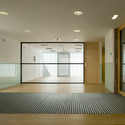
We approached every project conscious of the fact that the main occupants will be infants. Therefore we tried to give special sensibility to the needs of the very young boys and girls. The concerted results are austere spaces, luminous and fluid. Comfortable and protective at the same time.

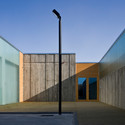
This project is conceived as two boxes of concrete and glass. One contains the educational program (classrooms, sleepingrooms and multipurpose hall) while the other incorporates the serving functions (kitchen, teachers room, technical installations).

The boxes are shut to the north protecting from the meteorological inconveniences and the street just to open up to the playground and the light in the southern direction with the entire facade composed of U-Glass. The main entrance is situated in the joint between the two pieces in the western façade.

In the interior the measure 1,20m defines the limit between the adapted childrens´ world and the adult ambit. Apparent for example in the 1.2m high wash-board that allows "infantile creativity" without prejudice for the building-maintenance. All child-inappropriate devices are collocated always above that line.

Three age groups divide the educational box into units. Small patios are annexed to every unit and act as separations. Within the units the use of operable walls between classrooms allow their union and variation in case of a changing educational practice. The attached bathrooms and sleepingrooms adapt to both dispositions.

Wood is given prominence in the composition of materials. Not only by the use in carpentry and flooring but also in the memento or absence - manifested in the timber formwork texture on the concrete walls. The idea of rhythmic alternations in the surface of the façade gets continuity in the parcels enclosure made of folded, perforated steel sheets.

The school design was made up from a paternal point of view. The first, rough impression in the exterior contrasts with the materialisation of light in the interior where the subtle variations of illumination, a play with longitudinal visions and the rhythm of patios refocus the ensemble towards the protected yard.


