
Peace Peres House / Massimiliano & Doriana Fuksas

Architect: Massimiliano & Doriana Fuksas
Location: Jaffa, Tel Aviv, Israel
Programme: Auditorium, Offices, Library, Cafe, Lobby
Construction year: 2008
Interior Design: Fuksas
Site work supervisor: Michal Schaffer
Client: Pares Centre for Peace
Landscape Architects: TEMA
Art Work: Mimmo Paladino
Site Area: 7.000 sqm
Constructed Area: 2.500 sqm
Photographs: Moreno Maggi
A home port for all sailors and a haven for the shipwrecked. To imagine a place that is not virtual, but real. To be dedicated to Peace, is an immensely taxing undertaking of profound ethical significance.
Peace is a spiritual condition, an aspiration: tension and utopia.
The projection of will into the future is also an expression of hope that our children and future generation will live in a better world. Peace cannot be enclosed in wrapping: it’s, rather, a sensation of fullness and serenity that can be communicated through a place, or through architecture.
I have thought of a series of layers, a building that represents TIME and PATIENCE in strata of alternating
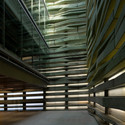
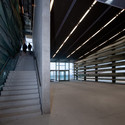
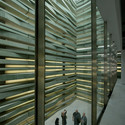
materials representing places that have suffered heavily. Concrete composed of alternating and superimposed types of sand and aggregate. A stone basement to raise the building, a meeting place from which two long staircase lead to a place of “rest”, whose size and height, full of light from above, helps us to forget the troubles of the world, and fill us with the positive attitude that is needed for our meeting with other men and other women. The outside of the building has alternate layers of concrete and translucent glass. The transparency of the glass will filter the light through to the inside during the day, and by night will send it back outside, entrusting this magical image with the spiritual and concrete message the site will inspire.
Architecture today must set itself as an aid, a hand to help us cope with the difficulties of understanding. This project represents the venue of an encounter, a debate, reasoning and solutions.
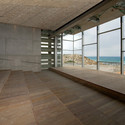
The Peres Centre for Peace is a parallelepiped. Obtained by irregularly shaped glass and concrete layers standing on a monolithic base: at one end of the building is the entrance to the car park, at the other the pedestrians entrance. At this point the basement becomes a large plaza, an empty space dissected lengthwise by two symmetrical ramps leading inside. This dark and low-ceilinged area leads to the inside of the well of light that is open for the whole height of the building, where is situated the Library. From here the alternating light and dark layers are visible; the former, in glass, lit from the outside and the latter, in concrete mixed with other materials and local earth.
The rest of this floor is designed to house various activity of the Peace Peres House.
The remaining three floors, each covering a space of 600 sqm and a height of 3,4 m., that are accessible with stairs and lifts, and contained a auditorium, intended to 200 persons, and offices of the Peace Peres House and spaces for meeting.
- plan 01
- plan 02
- plan 03
- plan 04
- plan 05
- roof plan
- elevation 01
- elevation 02
- elevation 03
- elevation 04
- section 01
- section 02
- section 03
- section 04


12 comments »
Amazing. The scale is rather deceptive!
Fuksas is a great example to contemporary architects. He has no need to repeat himself for establishing some kind of brand, and his projects are always of great quality.
agree with DCV
As a regular archdaily reader I’m severely disappointed that you’ve chosen to feature work from the colonial, apartheid state of Israel.
This temple to ‘peace’ is in fact built on land usurped from a violated, indigiouness people.
How can you be blind to both history & irony? Why don’t you read Michael Neumann’s ‘The Case Against Israel’:
http://www.akpress.org/2005/items/caseagainstisrael
just to continue the discussion:
http://www.guardian.co.uk/artanddesign/2009/feb/17/peace-house-israel-architecture
I like the building, political commentary aside.. reminds me of Kengo Kuma’s slatted structures.
A site plan or panoramic picture would be nice. The building is quite beautiful, appart from the fact that its sorroundings aren’t really understandable in any picture or plan, as if they were simply overlooked… It looks very symptomatic of a particular approach to pacification: we’ll be at peace, with ourselves, regardless of what’s around us.
http://www.peres-center.org/index.html
Why do people think it necessary to bring politics into an architecture site? If i wanted to hear abuse against israel I would go to any university campus in the UK. And stop trying to sell us your books! So as to redress the balance I will also post a link to a book:
http://www.amazon.co.uk/Why-Blame-Israel-Behind-Headlines/dp/1840466243/ref=sr_1_1?ie=UTF8&s=books&qid=1235842369&sr=8-1
so if people actually get these books they will have both sides of the arguement!
ps. the architecture is nice. lol.
I totally agree with DCV, i’m still a student but reapinting myself even in school projects seems pathetic for any architect who has self respect.
fuksas is amazing the use of outer concrete/glass skin is outstanding
I am out of the mainstream with my feelings re this building. I do wonder if this building were put up before a panel who knew nothing of it’s history and the explanation of the concept, how many would have described it as a building representing Peace?
It is a matter of great disappointment and disrespect to humanity to present work from the colonial, occupying and terrorizing state of israel, where all they do in israel is kill palestinians”State terror”. This so called peace center has nothing to do with peace.the whole building is built on land stolen and taken forcefully from the palestians.