
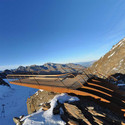
Top of Tyrol / astearchitecture

Uploaded by — Filed under: Infrastructure ,Selected ,Structures , , , ,
 

Architects: astearchitecture
Location: Stubai Glacier in Tyrol,
Project year: 2008
Design Team: Arch.DI Kathrin Aste, Arch.DI Frank Ludin, Thomas Feuerstein
Client: Wintersport Tirol AG & Co, Stubaier Bergbahnen KG
Construction Engineer: aste construction
Soil Mechanics Engineer: Ingenieurbüro Wietek
Photographs:

During recent years a number of observation platforms have been created attempting by different means to confront the visitor with the beauties of nature.

This panorama platform was commissioned by the management of one of the five glacier ski arenas in Austria.

Like most of its competitors the management is intent upon retaining a high level attractiveness of its ski region.

One hour’s drive from Innsbruck, the Stubai Glacier offers a large variety of mountain climbs and hikes. The aim of the newly erected platform is therefore mainly the revival of seasonal and summer tourism.
During the winter season the platform can be accessed the weather conditions permitting.

Like the structural engineer we were directly commissioned for the project. The client placed complete trust in our team and left the team with unlimited scope for implementing an innovative design.

The mountain station Schaufeljoch at 3180 metres above sea level is reached via the mountain station.The path to the mountain peak platform starts from the funicular. One climbs up a number of steps to
the ridge leading to the Great Isidor. After another 70 meters walk through natural landscape one arrives at the platform.

The Great Isidor is centrally positioned in the Stubai Glacier and divides the Stubai Glacier into a western and an eastern half.

Only by creating access has a panorama view become feasible enabling the onlooker to grasp the dimensions of the landscape.

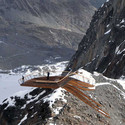
The unique position of the platform opens up an unobstructed view onto the permanent glacier as well as the 109 three thousand metre peaks of the Tyrolean Alps. The breath-taking 360 degree panorama
stretches from the Zillertal and Stubai Alps to the Dolomites and Chalk Alps. The platform invites the visitor to take a rest and to enjoy the peace and beauty of the mountains.

“As clients we wanted to create a spiritual place in which even stressed mountaineers can find peace and recuperate while letting their thoughts wander and enjoying the seemingly endless expanses of the
mountain world” says Reinhard Klier, Head of the Stubai Gletscher Bahn.

The observation of the glacier during the summer months with a critical eye to climate change and the resulting melting of the glacier is a though-provoking interesting experience.

As unusual as the panorama from the platform might seem, so crucial is the question concerning the solution to the invasion of nature or natural space. The platform is intended to represent a reaction to,
and also form part of this natural environment. So the design goal was more the design of a situation in space rather than a building.

By setting in scene and exaggerating the existing topography the landscape generates shaped architecture, in other words, artificial landscape. It expresses both a dynamic and static aspect and
forms part of its transformation: an obstruction interacting with the landscape, each reflecting and influencing the other.

The panorama platform on Mount Isidor is a drawing in snow, architecture as a walk along and transformation of a ridge. Path and platform are found in the brittle rock; for six months the lamellas will disappear under the
snow; only the swords extending beyond the northern cliff will remain visible all year round.

As in a sketched drawing, wind and sun expose the lamellas like feint traces on the snow surface.Through the external influence of the glacier the structure of the steel design is transformed, providing a
vantage point for shapes of ice and snow.

Due to its high iron content the rock has a red hue. It is clearly textured and serrated, which gives it a unique character. The choice of materials emphasises a contrast to the zinc covered steel structures of
the surrounding ski region.

The platform is a steel construction made from weather resistant steel. The construction principle of the girder grate is an unstructured grid. The twisted, excrescent swords of Corten sheet steel are box
section beams with a triangular cross-section. The standing girders to the rear of the foundations are supported by reinforcement strips.

Between the 50 cm tall supports there is the floor of grating.
The arched railing is monolithic. The handrail and bench are made of larch wood and the filling consists of a stainless steel net.

The load is transferred to the foundations and to the upslope rock anchors. The platform lies in the high alpine permafrost area. This requires the foundations to be braced by 15m long rock anchors in the load
area and a steel-reinforced concrete foundations on which the structure rests.

The sandblasted steel swords of weather-resistant steel extend 9m beyond the rock edge. All in all 19 tonnes of corten steel, 60 m2 of grate and 50 m wood banister larch with stainless steel net were
worked.

The structure was erected exclusively by helicopter. Therefore the adaptation of the elements of the structure to fit the load limits of the helicopter and the perfectioning of the mounting surfaces and
accuracy of fit were essential aspects of design improvement.

A high level and standard of pre-fabrication, simple mounting surfaces and accuracy of fit are essential criteria for erecting an edifice 3200 meters above sea level.

As the erection of the building site, concrete works and the mounting of all the building components had to be achieved by helicopter, the weather conditions obviously had a considerable influence on planning
and execution.
 
 
Thumb up Thumb down 0
tym says:

wow… i am completely humbled… at first glance, i tot this was an artistic impression… but it turns out, its real.. and feasible…

truly amazing… wld love to go there b4 i die…

places to see b4 death… truly amazing…

 
# January 31, 2009 at 01:35
Thumb up Thumb down 0
roadkill says:

very convincing project… and beautifully executed. please post some drawings

 
# January 31, 2009 at 05:43
Thumb up Thumb down 0
pi says:

beautiful and a bit scary…

 
# January 31, 2009 at 07:35
Thumb up Thumb down 0
johanna says:

Beautiful project, but I think we need to discuss if this type of projects (e g the Norwegian mountain road project, too) does not in a sense defeat their purpose. The beauty of the place partly stems from the fact that it is uninhabited, and with these structures we are adding another element and thus inhabiting the space. By adding structures to highlight “Nature”, we are also transforming it. For better or worse?

 
# January 31, 2009 at 08:50
    Thumb up Thumb down 0
    mastoras says:

    Completely agree with your way of thinking – but you know as well that the decisions for the realization of such constructions is not an architect’s field – like “Contemporary Art wrote…if it HAS to go..an architct is obliged to make it the best possible

     
    # June 1, 2010 at 08:52
Thumb up Thumb down 0

This is very theatrical. I like it a lot. I agree that this compromises the mountain a bit, but if something has to go there this is definitely one of the best options.

http://www.contemporaryartdaily.com

 
# January 31, 2009 at 09:12
Thumb up Thumb down 0
Triplescience1 says:

I actually wol (wowed out loud)

 
# January 31, 2009 at 11:08
Thumb up Thumb down 0
JDR says:

I agree with CA.
The touristic pressure of visiting these “places you must have seen” is immense. I am therefor very glad that a good design like this has won it from another wooden cabine on the top of the mountain that would have been a misfit in the overall view.
I really like the dramatic feel of the platform,
absolutely amazing!

 
# January 31, 2009 at 16:31
Thumb up Thumb down 0
NMiller says:

The image of the visitors at the end of a slender cantilever overlooking the mountains approaches the sublime. I can only imagine being there.

The image on the main page looks like a rendering, but to find that it is a real project is a nice surprise.

 
# January 31, 2009 at 17:16
Thumb up Thumb down 0
Wyatt L O'Day says:

It’s simply a wonderful piece. I love how the structural expression is intertwined into the landscape of the mountain. Nicely done.

 
# January 31, 2009 at 22:02
Thumb up Thumb down 0
CJ says:

WOW! Amazing. it fits so perfectly with the site!

 
# February 1, 2009 at 00:17
Thumb up Thumb down 0
Mariola says:

Amazing project. These images really justify the shape. Movement and danger.

 
# February 1, 2009 at 00:43
Thumb up Thumb down 0
archidork says:

another innovative project but… please make sure to have frequent maintenance check up. Not as an architect but as an individual with acrophobia, I probably will get a heart attack.

 
# February 1, 2009 at 20:24
Thumb up Thumb down 0
Liam says:

So keen to see sum drawings

 
# February 1, 2009 at 23:23
Thumb up Thumb down 0
MZ says:

I have to agree with johanna. The project is beautiful, but totally unneccessary. It destroys the very thing it tries to show. We are all impressed from the natural beauty of the place. Now take the same photos and try to imagine WITHOUT the structure. WOW! If you are standing next to the platform you can enjoy the same beautiful view as from the structure, with one minor difference: if you stand ON the structure, you don´t have to look at it.
Further more, unfortunately I have to say, that the pictures are taken from a carefully chosen angle: on the otherside is a mountain-cabin with a restaurant just a hundred meters climb down the mountain, which is connected with the valley below through a cable lift. In other words: this mountain has been raped: cable lift, lodge, viewing platform. Imagine that all the surrounding mountains so highly installed…no, please don´t.
Let nature be nature.

 
# February 2, 2009 at 04:54
Thumb up Thumb down 0
martin says:

I like how the structure attaches to the earth. it makes me think of the work of lucy and bart.

 
# February 2, 2009 at 12:41
Thumb up Thumb down 0

this is wander full but i think it`s hard to keep clean from snow storms…

 
# April 8, 2009 at 06:59
Thumb up Thumb down 0
Yura says:

Very clever design. And to everyone who says that this is “out of place” or it destroys the nature, you can obviously see that it’s beside some sort of resort, since you can see a chair lift at the bottom of the canyon.

 
# April 20, 2009 at 10:02
Thumb up Thumb down 0
Peter says:

Remarkable.

 
# May 5, 2009 at 23:12
Thumb up Thumb down 0
2MACoff says:

ну, так короче, по мне так ШЛЯПА!

 
# May 29, 2009 at 10:13
Thumb up Thumb down 0
John H says:

@MZ & Johanna

I’m afraid that humans are part of nature too – don’t ever forget that we not just outside observers.

If you’re a small child, this gives the experience of being on the edge of a cliff without the risk. The integration with the landscape seems well considered too.

John.

 
# June 23, 2009 at 10:07
Thumb up Thumb down 0
mastoras says:

What if we could stop building new things for 5-10 years…stop acting aggressive to the environment….but that’s just utopia
There ‘ll be always somebody who will do it even more aggresively

 
# June 1, 2010 at 09:11
Thumb up Thumb down 0

3:40 AM Oct 11th

shit my pants http://t.co/z5zWum92

Thumb up Thumb down 0

3:45 AM Oct 11th

"@SyazaNadhirah: shit my pants http://t.co/1KAArLBW"

Leave a Reply »


Latest Comments »

They must call that the “Towering Inferno law”, their code is a...[+]
You are wrong completly. This is brillant. It have harmony, scale and...[+]
Howdy very cool web site!! Guy .....[+]
What a clichéed project. That “Grand Stairs in the Winter” image is a huge...[+]
I like the color and simplicity of it. Looks very Le...[+]

Upcoming Architecture Events »

got events? invite us! click here

Architecture Books & Magazines »

Reverse Effect: Renewing Chicago’s Waterways / Jeanne Gang

Reverse Effect: Renewing Chicago’s Waterways / Jeanne Gang

Our friends from Studio Gang Architects recently sent us their new book Reverse Effect. ”The culmination of a yearlong collaboration between Studio Gang Architects and the Natural Resources Defense Council (NRDC), Reverse Effect is dedicated to exploring the importance of


London Unfurled / Matteo Pericoli

London Unfurled / Matteo Pericoli

If you haven’t finished all your holiday shopping, and you need something for someone who loves both architecture and London then we might have the right gift for you. We recently received Matteo Pericoli’s London Unfurled. This accordion-style book folds out…


Construction Manual for Polymers + Membranes / Knippers, Cremers, Gabler, Lienhard

Construction Manual for Polymers + Membranes / Knippers, Cremers, Gabler, Lienhard

From the history of plastics and membranes in architecture to their material properties and requirements in construction and design, the Construction Manual for Polymers + Membranes cuts to the chase, providing the kind of solid and comprehensive overview of


Our partners »

AD on iPad via Pulse

Browse by date »

Browse by category »

Friends »