Architects: LAVA – Chris Bosse, Tobias Wallisser and Alexander Rieck
Location: Sydney, Australia
Project year: 2008
Project Team: Chris Bosse, Tobias Wallisser, Alexander Rieck
Collaborators: Jarrod Lamshed, Esan Rahmani, Kim Ngoc Nguyen, Anh Dao Trinh, Erik Escalante Mendoza, Pascal Tures, Mi Jin Chun, Andrea Dorici
Materials: Specially treated high-tech Nylon and light
Area: 300 sqm
Volume: 3,000 sqm
Fabrication and installation: Mak Max
Photographs: LAVA
Digital Workflow
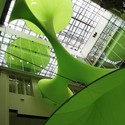
The project renounces on the application of a structure in the traditional sense. Instead, the space is filled with a 3-dimensional lightweight-sculpture, solely based on minimal surface tension, freely stretching between wall and ceiling and floor.
The design and fabrication procedure uses state-of-the-art digital workflow; beginning with 3D computer modelling, that is engineered structurally before undergoing a process of computer controlled (CNC) material cutting and mechanical re-seaming.
The computer-model, based on the simulation of complexity in naturally evolving systems, feeds directly into a production-line of sail-making-software and digital manufacturing.
The product shows a new way of digital workflow, enabling the generation of space out of a lightweight material that requires minimal adjustments onsite to achieve a complete installation in an extremely short time.
Sustainability
LAVA’s process of optimized minimal surface design and CNC (computer numeric code) fabrication technology allows the sculpture to reveal a new dimension in sustainable design practice.
Fulfilling the sustainable agenda of the venue, the work succeeds in its quest for optimum efficiency in material usage, construction weight, fabrication and installation time, while at the same time achieving maximum visual impact in the large atrium space.
The pavilion is easily transportable to any place in the world; can be quickly installed, and is fully reusable.
Fabrication
The sculpture materials consist of a double stretch, 2 way woven fabric that is mechanically attached to specially designed aluminium track profiles. Each profile is suspended from above, and to the side, on 2mm stainless steel cabling.
Concept
Since the 1970′s, with Frei Otto’s soap-bubble experiments for the Munich Olympic Stadium, naturally evolving systems have been an intriguing area of design research; something that hasn’t been lost on the team and their fascination with new building typologies and naturally developed structures.
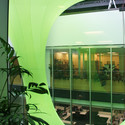
The installation is a ‘Minimal Surface’ that consists of a tensioned Lycra material, digitally patterned and custom-tailored for the space. Five sides of the sculpture reach out to carefully hover just off the main interior atrium of the Customs House above the model of the city.
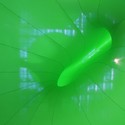
The lightweight fabric design follows the natural lines, contours and surface-tension of the fabric. The curves can be seen as the result of invisible bubbles that are translated into an organic 3-dimensional space.
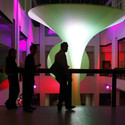
While appearing solid, the structure is soft and flexible and creates highly unusual spaces within customs house, which come to life with projection and lighting.
Rising up to the top level restaurant, a vertical distance of almost 20m, the sculpture provides an intense visual contrast to the beautifully restored heritage interior of Customs House.
The Customs House ‘Media Wall’ is also activated with content detailing the process of design, engineering, fabrication and installation of the sculpture along with the impressive, recent design projects completed by LAVA across 12 video screens.
The whole installation is immersed in a soundscape by sound artist David Chesworth and graphic design by TOKO, and includes the latest 3D works by visual artist Peter Murphy.
- concept image
- floor plan
- concept image
- situation plan
- concept image
- concept image
- section 01
- section 02
- concept image
- concept image
- concept image
- concept image


So it’s basically a sculpture, right? The process and materials are great, but as an artwork it feels arbitrary, as if designed by a committee. The aims for art are different than architecture though. I applaud the interest in art in any case.
–
http://www.contemporaryartdaily.com
It is a sculpture, though I suppose large-scale sculptures designed for specific spaces like this merit inclusion on an architecture site now and then. It sort of looks like a bizarre alien plant-form parasitically attaching itself to the atrium!
really amazing!!! i would like to see the fabrication process. i have to many cuestions…
is this architecture or decoration?
Anish Kapoor could not be reached for comment…
….why? ….no seriously, why?
am i dreaming or is it a green remake of Anish Kapoor’s piece at the tate modern in 2002 …
http://www.tate.org.uk/modern/exhibitions/kapoor/default.htm
Looks very “new style” for me, great work.
Shrek wants his ears back.
Kapoor ripoff
Anish Kapoor 2002
http://www.tate.org.uk/modern/exhibitions/kapoor/images.htm
Ernesto Neto 2006
http://www.pbase.com/wdkg/image/67963721
Zaha 2007
http://mmatlins1.wordpress.com/2008/07/29/moore-space-photo-in-miami-city-guide/
Very Interesting Art Installation!
Applause for the Designers
Selwyn
No matter if it is ‘taken’ or ‘inspired’ from anyone’s previous work, it still is a great work and statement in space with a very interesting technology behind it.
its a art installation/skulpture, made by designers/architects in a Kapoor/Snøhetta edition.
Great technology/statement!
Hi friends!
The work of Chris Bosse (one of the LAVA team) has always been related to organic forms and this projects has previous studies that you can see in his web-site, it’s not a copy of Kapoor… I think maybe ideas and inspiration are always around and sometime this kind of similarity just happens!
Take a look at the Entry pavillion or Moet Marquee here:
http://www.chrisbosse.de/
The engineering design and fabrication process is explained further at http://www.makmax.com.au
this does some great things for that space, It would be great if you could walk through it.
check frei otto soap experiment
20 years before kappor
http://www.andres.harris.cl/?page_id=30
check minimal surface theory
http://epinet.anu.edu.au/mathematics/minimal_surfaces
Although a beautiful sculptural form, it is in the realm of art.. but not at all original.. and almost definitely a copy of the groundbreaking Anish Kapoor installation in the Tate Modern.. with the vital exception of the interaction it gave to the visitors in London..
This is an interesting investigation into minimal sufaces and materials, but in my opinion it’s reduced to mere decoration for the atrium space. Something to look at and reflect light. Harsh but fair.
is that a phlem?
does anybody know what programm they use for the cutting patterns ?
It is a proprietary software developed by MakMax. It is used in conjunction with finite element analysis software.
wow
i went to visit today
it is totally unreal and looks different from every side
check out from every level.
super nice food at cafe sydney upstairs too.
and harbourview!
interesting!
absolutely fabulous proposal is this for real?
or good photoshop?
realy interesting Architecute work .. i hope we can know more about the materils itslef .. if its toxic , or ..
kasuba Alexandra, ya realizaba Estos trabajos en 1970
es una copia, y no Logro de las Naciones Unidas reales.
pero bueno, parece no comunes para Trabajan respuestas,
solo para llamar la atencion con soluciones formales
que impactan.
Perfect report, well written I must say.
Amazing! Image seeking yahoo for hours just for this and that i ultimately think it is right here!
Incredible! I have already been seeking search engines all day with this and i lastly thought it was right here!