1. ArchDaily
  2. women in architecture

women in architecture: The Latest Architecture and News

When Will Architects Speak Up for Women's Rights?

Subscriber Access | 

On April 12, 2013, the Board of Health of the Commonwealth of Virginia approved new laws deploying building codes and architectural regulations sanctioning that clinics offering first trimester abortions meet the same building specifications as newly-constructed, full-service surgical hospitals. Mandating compliance within about 18 months, these standards will entail significant and costly alterations to existing facilities that may bankrupt many clinics in the state.

The political maneuvering which occurred to achieve these architectural arrangements, and the responses of concerned professionals in Virginia, were well documented in the press. The Health Commissioner resigned in protest. The chair of the Department of Obstetrics and Gynecology at the University of Virginia’s School of Medicine called these building codes “arbitrary and capricious.” A director of the University of Richmond School of Law wrote an editorial challenging the legislation on legal grounds. Almost 200 physicians took a public stand, denouncing the politicians and urging the state to reject the architectural alterations.

Health policy analysts, social workers and advocates for low income women - who will be greatly impacted when these local clinics close - continue to speak up and organize. We have heard from just about everyone with a stake in the impending architectural arrangements. 

Except architects. 

AIA Elects Elizabeth Richter Chu, FAIA, for 2015 President

The American Institute of Architects (AIA) reports that it has elected Elizabeth Richter Chu, the CEO of Richter Architects in Corpus Christi, Texas, to serve as the 2014 AIA first vice president/president-elect and 2015 AIA president. James Easton Rains, Jr., FAIA, and Thomas V. Vonier, FAIA, will each serve as vice president from 2014 through 2015; James P. Grounds, AIA, will be the Institute’s Treasurer.

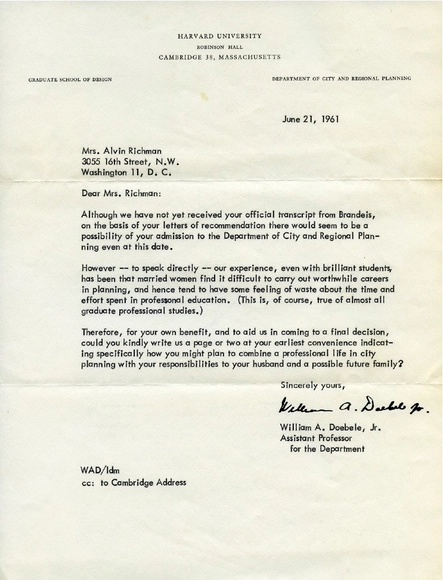
52 Years Later, A Would-Be Urban Planner Responds to Harvard's Sexist Letter

In 1961, Phyllis Richman, a student at Brandeis University, was considering applying to the Harvard Graduate School of Design's Department of City and Regional Planning. The response from Professor Doebele, which you can read above, was to question the validity/practicality of her desire to enter into higher education, being, as she would surely be, a future wife and mother.

While today it sounds almost quaint in its blatantly sexist assumptions, Ms. Richman's letter remains, unfortunately, all too relevant. In her article for The Washington Post, Richman says: "To the extent, Dr. Doebele, that your letter steered me away from city planning and opened my path to writing [a career Richman later describes as "remarkably well-suited to raising children"], one might consider that a stroke of luck. I’d say, though, that the choice of how to balance family and graduate school should have been mine."

She's absolutely right, of course; the decision was hers and hers alone to make. However, there's no avoiding that Richman eventually found success in a job that allowed her to live flexibly as a professional and parent. How many women, and for that matter men, can claim that of architecture? How many architects are convinced, just like Ms. Richman, to pursue success in other, more flexible careers?

More about Richman's letter, and where Denise Scott Brown comes in, after the break...