The second international Summer School run by the Bauhaus Dessau Foundation invites young students from various disciplines to take part in an idea contest held in Dessau from 21 to 30 July 2010. The format has been established successfully last summer, and will continue this year under the heading ‘Home is Everywhere’.
Ahylo lab in collaboration with supermanoeuvre and kokkugia are pleased to announce the launch of the apomechanes 2010 studio (seminar and workshop) to be held in Athens this summer, from the 19th of July till the 6th of August.
Apomechanes is an intensive 3-week computational design studio held each summer in Athens, Greece. The studio is devoted to furthering techniques and concepts of algorithmic processes as means for design and fabrication. Apomechanes brings together individuals from diverse backgrounds and fields of study to discuss, exchange and collaborate on projects that investigate modes of algorithmic and machinic processes in architectural design.
You can see images of the projects from Apomechanes 2009 after the break, along with more information of the event.
In the different areas of human production, it is curious to note the constitution of global informal networks that work between themselves in a process of sharing and collaboration. From this perspective of creation process, Circo de Ideias – Associação Cultural presents at Suggia Room in Casa da Música, Porto, Portugal, Saturday, June 12 2010, the international seminar OPEN SOURCE, term coined on the definition of software in which original code is shared freely and that can be redistributed with or without modifications.
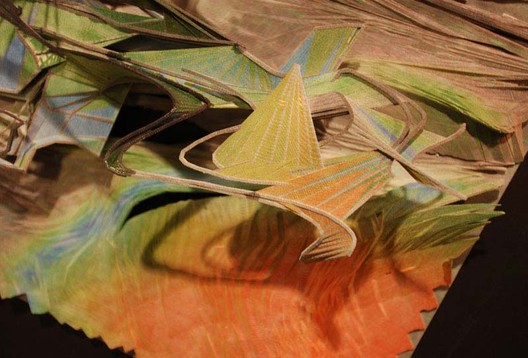
Immuring, a new exhibition by Hong Kong-based architecture firm davidclovers, will be on view from June 4 through July 18, 2010, in the SCI-Arc Gallery at the Southern California Institute of Architecture. Immuring invigorates the relationship between architectural graphic and architectural mass through the re-examination of fresco in a contemporary context.
Its clear in 2010 perhaps more than ever that significant shifts in economies and culture can occur extremely rapidly; climatic crisis can devastate enormous populations in seconds. Our architectural response is critical. The architectural recourse of one crisis needs to be more than a temporary fix as it is often the only opportunity to implement further preventative measures for a future occurrence.
Sublime Flesh brings together, for the first time, new designs for contemporary spiritual spaces developed by students at the Bartlett School of Architecture, UCL. A collection of research projects located in international cities including Istanbul, Rome, Turin, Lisbon, Havana and Miami, each explores a unique sense of sacredness and the Sublime.
Since 2006, The Festival des Architectures Vives tries to make people aware to architecture giving them tools to understand it by allowing people who live in town to meet people who draw the town.
On Friday, April 23, 2010, top UK, European and American industry leaders will gather at the Architectural Association in London for a day-long Think Tank to explore solutions that could change the building industry for the better.
ULHT (Universidade Lusófona de Humanidades e Tecnologias) organized an international workshop on the theme of waterfront design (European Workshop Waterfront Urban Design) EWWUD. The workshop is coordinated by Pedro Ressano Garcia. This event will take place between 14 and 28 March 2010 and has several international specialists in nine foreign universities.
Solutions for the relocation of port facilities and the consequent waterfront regeneration of old ports are dependet upon the capacity of both port and city to sucessfully develop the necessary means of negotiation, to work towards mutual improvements. while Port Representatives privilege the efficiency of maritime activity, City leaders pursue improvements to their citizens quality of life.
Exchange of good pratices between port cities is required with two goals: to support the port’s needed to expand and relocate, and to produce urban waterfront REGENERATION that integrates rather than segregates neighborhoods and their citizens. The Workshop’s objectives and list of universities involved, after the break.
Experts from all continents will meet in Mexico City at the 3rd International Holcim Forum for Sustainable Construction in April 2010. The conference for academics and professionals from architecture, civil engineering, urban planning, natural and social sciences will advance concepts on how construction needs to be re-invented and aligned with principles of sustainable development. Limited places are available – registration is possible until the end of January 2010.
Taking an array of disciplines into consideration, the focus of the Holcim Forum will be on knowledge mining and dissemination, material and product life-cycle assessment, CO2 emissions and energy efficiency, considered deployment of means and economic resources, as well as social welfare and equity. The event will offer opportunities for networking and discussion, stimulated by keynote speeches, workshops, panel sessions and a full-day excursion aligned with the workshop themes to sites in Mexico City.
Two events will take place next week at Columbia University. On Monday, ‘Pointless’, a lecture by Elizabeth Diller. Then on Wednesday, ‘Re:Activators’, a lecture by Jürgen Mayer H. Both events will take place at 6:30 PM in Avery Hall, Wood Auditorium, Columbia University.
A panel discussion including American and Danish architects will analyze the benefits, compromises, and challenges in creating and designing sustainable buildings and communities in the U.S. and Denmark.
The transformation of the urban landscape within the last decades has increasingly been dominated by the demands of capitalist utilization. Due to the current crisis, however, which goes far beyond a mere crisis of the real estate and financial market, these neoliberal politics and attendant forms of production of space have been subject to a loss of legitimation. For this reason, not only do the dominance and promises of the privatization model, the free market and private property have to be questioned, but also the conventions of the space-producing professions that follow and materialize these policies.
An urban design debate and a book launch will take place next monday November 9 at 6:30PM at the Wood Auditorium in Columbia Unviersity. “After BIGness” is the debate in which Alan Berger, Associate Professor at MIT, Kenneth Frampton, Professor at GSAPP, and Mahadev Raman, Principal at ARUP will discuse the designing for post crisis cities.
When we interviewed Jeffrey Inaba at the C-Lab last year, he told us about his research on altruism, which was the base for his new book “World of Giving”.
The Barcelona Institute of Architecture (BIArch) is an international institution set up to further interaction between academic research, specialized practice and the cultural dissemination of contemporary architecture. Occupying a space midway between schools of architecture and professional praxis, BIArch is an open laboratory for professionals and researchers that aims to promote new ways of thinking and acting for a technological, energy and economic reality in permanent flux.