

As promised, the second part of the interview with Cameron Sinclair, Founder and Eternal Optimist of Architecture for Humanity.
Interviews: The Latest Architecture and News
AD Interviews: Cameron Sinclair, Architecture for Humanity (Part II)
https://www.archdaily.com/23377/ad-interviews-cameron-sinclair-architecture-for-humanity-part-iiAmber P
Dragonfly Vertical Farm concept by Vincent Callebaut

Amidst financial buildings and high-rise apartments, Belgian architect Vincent Callebaut has redefined the conventional skyscraper. His 132 story complex for the south edge of Roosevelt Island addresses the pressing need for environmental and ecological sustainability. This conceptual design focuses on creating a completely self-sustaining organism that not only utilizes solar, wind, and water energies, but also addresses the pending food shortage problem.
More after the break.
https://www.archdaily.com/22969/dragonfly-vertical-farm-concept-by-vincent-callebautKaren Cilento
AD Interviews: John Bacus, Google Sketchup
During the AIA Convention 2009 we had the chance to talk to different AEC software companies, to learn how they are helping architects. We decided to keep the conversation on the same interview format we have been using, so you can hear it straight from the developers.
https://www.archdaily.com/22738/ad-interviews-john-bacusDavid Basulto
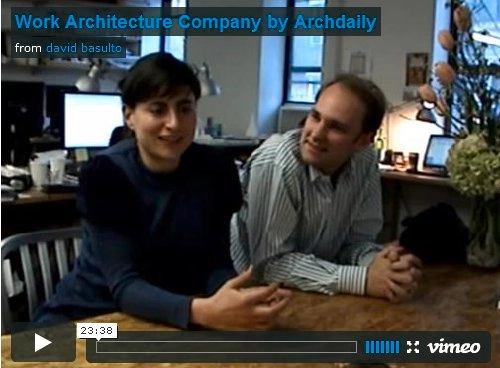
AD Interviews: Standard
While in LA we had the chance to visit Standard, a small firm doing residential and retail projects. We visited their Tree House, featured earlier on AD, where i was able to see for myself the minimalism found in their works. A simple work, but with lots of well executed details and spaces designed to benefit from the views and the shadow of the tree.
The practice was founded in 1996 by Jeffrey Allsbrook (M Arch USC, studies at the at the Städelschule in Frankurt, Germany and at the Berlage Institute in Amsterdam) and Silvia Kuhle (Architect Technische Universität Darmstadt, Germany, M Arch Columbia University).
Completed projects include residential, retail, educational, office and manufacturing spaces for a diverse clientele of artists, writers, filmmakers, clothing designers, educators and entrepreneurs in California, New York, Las Vegas, Paris and Mexico. While Standard continues to grow, its partners insist upon maintaining a practice that is rigorous and attentive. Direct accessibility and sustained dialogue between clients and the firm’s partners are viewed as essential to project success.
It was a very good talk, and i really liked their point of view on an central aspect of the profession: the clients.
https://www.archdaily.com/22478/ad-interviews-standardDavid Basulto
Villa Panorama / Sponge Architects

Dutch practice, Sponge Architects sent us their latest residencial project: Villa Panorama, where you can “enjoy the country life in a home where your dream landscape reveals itself before your own eyes”, as they say.
See some more images and drawings after the break.
https://www.archdaily.com/20364/villa-panorama-sponge-architectsAmber P
AD Interviews: Lorcan O'Herlihy
A few weeks ago we had the chance to visit L.O.H.A. and interview Lorcan O’Herlihy in Los Angeles.
https://www.archdaily.com/20733/ad-interviews-lorcan-oherlihyDavid Basulto
A New Infrastructure, Los Angeles

Los Angeles is often portrayed as the example of the car-friendly city. The traditional image of the town is an endless pattern of single family dwellings, interconnected by traffic-clogged freeways, where transit is undeveloped and the air is choked with smog.
However, Los Angeles is changing. The city’s Transport Authority has planned in the last years a series of measures aiming to improve quality of life through improving transit and walking and providing alternative to car commuting.
https://www.archdaily.com/17645/a-new-infrastructure-los-angelesMarco Castroni
The best of Postopolis! L.A.

Postopolis! LA has come to an end (at least for 2009). Postopolis! was discussion, debate and reflection around Architecture and a great variety of related topics: Art, City, Technology, Geography, Visualization, etc., which merged into a multidisciplinary conversation broadcasted live by seven different blogs. It’s impossible to resume in a couple of paragraphs what this days in LA were without thinking we suffered a big overdose of information that we need to take the proper time to digest.
Trying to sort out some ideas, I think at least five topics defined these days for us.
The event for itself, that concentrated expositions and discussions about some very interesting and diverse topics. From talks about the city and security with people from the LA Police Department to understand how some cities are reformulating the relation between cities and their citizens through technology, thanks to Ben Cerveny’s exposition. Complete list of everyone who participated can be found here.
In these five days we had the opportunity to interview some of the best exposers of Contemporary Architecture based in LA. Yo-Ichiro Hakomori (wHY Architecture), Dwayne Oyler & Jenny Wu (Oyler Wu Collaborative), Whitney Sander (Sander Architects), Sarah Johnston & Mark Lee (Johnston MarkLee) and Austin Kelly (XTEN Architecture), Eric Oweb Moss (Eric Owen Moss Architects), and some others we will introduce soon.
Of course, being in LA, we were forced to travel through the city and it’s renowned highways. We realized how hard it is to move without owning a vehicle. But we also got to know a friendly side of the city, with many interesting and different central places to visit.
Finally, a special mention for the place where Postopolis! was carried out: The Standard Hotel in Downtown LA, a great renovation of a 13 floor building by Konig Eizenberg Architecture, where it seems that everything was specially design for the hotel which has one of the most interesting rooftops of LA.
At the same time, Postopolis! was part of the LA Art Week, organized by the For Your Art foundation, so we were immersed in a great cultural environment. Finally, our most sincere thanks to everyone who made Postopolis! possible, specially to everyone who works at The Storefront for Art and Architecture (Joseph, Gaia, Cesar, José, Faris), For Your Art (Bettina, Devin, Julia, Melissa), to the folks at the Standard Hotel, each one of the curators: BLDGBLOG (Geoff), City of Sound (Dan), SubTopia (Bryan), Mudd Up! (Jayce a.k.a. dj/Rupture), We Make Money Not Art (Regina) and of course, every guest who gave life to the event. Thanks to all!
Images that try to resume these 5 days in LA, after the break.
https://www.archdaily.com/19144/the-best-of-postopolis-laDavid Assael
AD Round Up: Interviews Part I
Since we started with ArchDaily, we’ve tried to interview some of the most important and influential architects of the world. It’s really interesting to see what’s on the mind of the architects behind the amazing projects we’ve all seen. So now, we bring you our first Round Up of previously featured interviews. Enjoy!
https://www.archdaily.com/18152/ad-round-up-interviews-part-iSebastian Jordana
Work in Progress: Green Walls, Reception and Panel Discussion

The success of green roofs has driven Landscape Architects and Architects to explore alternative exterior and interior applications of green planting technology, such as green walls, and green screens. Vertical planting presents challenges to proper irrigation and climate control, requiring innovative solutions. This panel of experts will discuss the relevance of green walls and how can we improve their applications.
https://www.archdaily.com/17566/work-in-progress-green-walls-reception-and-panel-discussionSebastian Jordana
303 East 33rd Street, a green project by Perkins Eastman + Studio V Architecture
New York-based architects Perkins Eastman sent us their new project, 303 East 33rd Street, the first green development in the Murray Hill neighborhood of Manhattan. It’s a 12-story, 165,00 sf building. They worked on the exterior while Studio V Architecture worked on the interior design. They also worked with Archipelago on the landscape of the roof garden.

More images and the architect’s proposal, after the break.
Developed by Toll Brothers, Inc. and The Kibel Companies; 303 East 33rd Street is the first green development in the Murray Hill neighborhood of Manhattan. Designed by top ranked green architecture and design firm Perkins Eastman, the LEED Certified development is a fresh interpretation of the full- and half-block residential complexes built during the last century, and reflects the mix of architectural diversity in the area.
https://www.archdaily.com/17453/303-east-33rd-street-a-green-project-by-perkins-eastmanSebastian Jordana
RMJM design Vista Center, LEED Platinum Office Building

Daniel R. Brenna Jr. of Capital Real Estate Group and architects RMJM unveiled the design for Vista Center, a new LEED Platinum office tower in Trenton, which will be the city’s largest commercial development in decades.
Vista Center is a 25-story, 700,000-square-foot Class A office building planned directly adjacent to the Trenton Transit Center, the second busiest train station on New Jersey’s Northeast Corridor, which runs from Boston to Washington. The transit-oriented development will include 12,000 square feet of ground-level retail, a parking garage for more than 1,140 cars and two public art components – a plaza with a signature sculpture and lobby with a video art installation.
The project is targeting a LEED Platinum certification by the U.S. Green Building Council – the highest sustainability rating offered – which would make it the first Platinum office tower located directly at a Northeast Corridor Hub.
Images after the break.
https://www.archdaily.com/17195/rmjm-design-vista-center-leed-platinum-office-buildingSebastian Jordana
AD Interviews: Mark Wigley
A few months ago we interviewed Mark Wigley, Dean of Columbia University’s Graduate School of Architecture, Planning and Preservation.
https://www.archdaily.com/17252/ad-interviews-mark-wigleyDavid Basulto
Four “Tropical Skyscapers” Commissioned To Keep Shenzhen Stock Exchange HQ Nice and Shady

Steven Holl Architects‘ winning design from the “4 Tower in 1″ competition calls for a quartet of towers to be built around the brand new Shenzhen Stock Exchange and its surrounding plaza.
https://www.archdaily.com/15640/four-%25e2%2580%259ctropical-skyscapers%25e2%2580%259d-commissioned-to-keep-shenzhen-stock-exchange-hq-nice-and-shadySebastian Jordana
12 year old makes shelter for the homeless with plastic, wire and packing peanuts

Max Wallack, a 12 year old from Natick, has just won WGBH’s Design Squad “Trash to Treasure” design contest with his “Home Dome” invention, which is a shelter for the homeless, built with just plastic, wire and packing peanuts. The structure is in the form of a Mongolian yurt and includes a built-in bed.
For his winning design, Max won $10,000, a Dell laptop and a trip to Boston to see how his design becomes real. The “Home Dome” was selected as the winning innovation out of more than 1,000 contest submissions.
Seen at The Design Blog. Watch a video about the winner, after the break.
https://www.archdaily.com/15589/12-year-old-makes-shelter-for-the-homeless-with-plastic-wire-and-packing-peanutsSebastian Jordana
Building on Canvas: Sarah McKenzie and the New American Landscape

In recent years, the art world has played host to a number of lively explorations of architecture and the built environment. (In 2006, The New Yorker went so far as to snipe, “Painting about architecture has become popular to the point of excess, much the way seventies artists went overboard on the cube.”) By looking at architecture through the lenses of politics, psychology, humor, and more, artists have been helping to enrich the conversation about the field.
Last week I sat down with painter Sarah McKenzie, who was in New York for the opening of her new show, Building Code, to discuss her thoughts on art and architecture. McKenzie, who first came to public attention for her aerial views of suburban developments, currently uses images of construction sites as her source material.
The interview after the break.
https://www.archdaily.com/15016/building-on-canvas-sarah-mckenzie-and-the-new-american-landscapeSarah Wesseler
Green Campus Symposium and Workshop at the Texas Tech's College of Architecture

Texas Tech University’s College of Architecture in conjunction with the American Institute of Architecture Students will host a symposium and workshop April 15-16 that will focus on making its campus more environmentally friendly.
https://www.archdaily.com/14894/texas-techs-college-of-architecture-will-host-green-campus-symposium-and-workshopSebastian Jordana
AD Interviews: L.E.FT
We got the chance to sit down with the tree partners at L.E.FT a few months ago, and chatted about their practice, ongoing projects and their thoughts on the state of architectural education, the role of architects in current society and more.
I found their work very interesting, and it was no surprise to see them invited to the P.S.1 competition for 2009 we featured earlier. I also selected them for our section AD Futures, as i think they have a promising future.
You can read more about them on the article AD Futures #2. Some pictures of their office after the break.
UPDATE: I´m currently uploading the video to Blip.tv in better quality
https://www.archdaily.com/13711/ad-interviews-leftDavid Basulto